When to bring plants inside for winter depends on night temperature more than the calendar. Clemson Extension says temperatures of 50°F or lower can damage many tropical plants, and University of Minnesota Extension says most houseplants should come in when it is below 50°F. Move them before then, and always before your average first frost date. Plants that stay out need cover instead, which how to protect plants in winter covers.
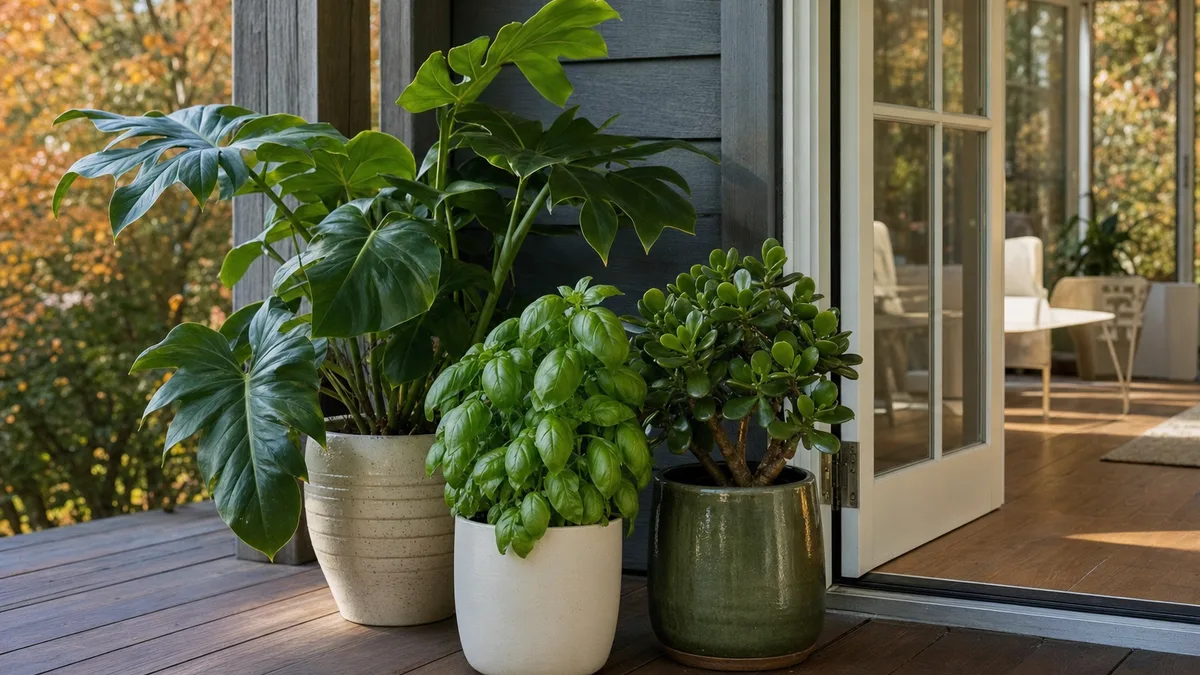
Bringing Plants Inside at a Glance
Plants hit their cold limit at different temperatures. This table collects what extension services say, so you can sort pots into the ones that move first and the ones that can wait. Hardy perennials follow zone rules instead, which our hardiness zones guide explains.
| Plant or situation | Limit | What to do | Source |
|---|---|---|---|
| Tropical houseplants on the patio | Damage at 50°F or lower | Move in when nights are about 50°F | Clemson, University of Minnesota, UVM, Iowa State |
| Succulents and cacti | A few tolerate 40°F weather | Can stay out a little longer | University of Minnesota |
| Basil | Cannot survive below 50°F | Bring in early | Penn State |
| Tomato in a container | Below 50°F can harm it | Compact types only, bright window | Utah State |
| English lavender | Hardy to zone 5 | Leave outdoors in zone 5 and warmer | Colorado State, Iowa State |
| French and Spanish lavender | Not winter hardy in Iowa or Indiana | Pot up and bring in | Iowa State, Purdue |
| Potted strawberries | Likely damaged or killed outdoors in Iowa | Unheated garage in November | Iowa State |
| Tender perennials such as geranium and coleus | Before the first frost | Pot up or take cuttings | University of Illinois |
| Frost forecast | Minimum of 33 to 36°F on a clear, calm night | Frost advisory, so cover or move plants | National Weather Service |
What Temperature Should You Bring Plants Inside?
The working number is 50°F at night. Iowa State Extension says to move houseplants back in when nighttime temperatures dip consistently into the 50s, and UVM Extension gives the same trigger, noting that nights matter most. University of Minnesota Extension is a little more cautious, saying temperatures dipping below 45 to 50°F can cause damage depending on the species, and that the cooling usually begins in late September. Iowa State adds that many plants are damaged in the mid to lower 40s. Succulents are a split case, since hens and chicks stay outside while aloe and jade do not, as can succulents survive winter explains.
Clemson Extension also advises moving plants in when indoor and outdoor temperatures are close to equal. That way the plant adjusts to its new spot before the furnace comes on and dries the air, a common cause of the crispy edges our brown leaf tips guide explains.
Frost is a harder deadline than the 50°F rule. The National Weather Service issues a frost advisory when the minimum temperature is forecast to be 33 to 36°F on clear, calm nights during the growing season, because frost can form on plants even when the thermometer reads above freezing. Our guide to what temperature frost forms explains why, and the calculator below gives the average date for your location.
How to Bring Outdoor Plants Inside for Winter, Step by Step
Extension advice agrees on the order of jobs, even where details differ. Each step is covered in the sections below.
- Watch the forecast. Plan the move for when night lows head toward 50°F, and well ahead of any frost.
- Inspect and rinse. Check leaves, stems and the underside of the pot, then hose the plant off and let it dry (Clemson Extension).
- Treat for pests if needed. Use insecticidal soap or another labeled product, and follow the label.
- Step down the light. Over several days, move the pot from sun to shade to a porch (Clemson, NC State).
- Repot or prune only if the plant needs it. A pot one size larger is the rule if it has outgrown its container (UVM Extension).
- Quarantine for a few weeks. Keep it apart from your existing houseplants (Iowa State, UVM).
- Place it in the brightest spot you have. Add a grow light if the window is weak, and keep leaves off the glass.
- Water less and skip the fertilizer. Check the top inch of soil first.
If your area is also heading into hard freezes, the rest of the garden needs attention too, and our winterize garden checklist covers beds, tools and hoses.
How Do You Check Plants for Pests Before Moving Them In?
Plants that spent the summer outside carry hitchhikers, and the warm indoors lets them multiply. Clemson Extension says to look under the pot for anything crawling through the drainage holes, hose the leaves and stems, let them dry, then spray the leaves (top and bottom), the soil and the pot with insecticidal soap. It also says to test a small area first if the label does not list your plant, because damage can take 7 to 10 days to show. Reapply after several days outdoors, then bring the plant in two to three days later.
Other states add useful steps. University of Minnesota Extension suggests bathing smaller plants in a bucket of water with a little mild dish soap, and applying a houseplant insecticide 3 weeks before the move as a preventive measure, following the label. North Carolina Cooperative Extension, in Wayne County, says to soak the container in slightly warm water for about 15 minutes so insects in the soil come to the surface, and to check the bottom of the pot for fire ants. For fungus gnats, University of Minnesota Extension says to let the soil dry between waterings and use yellow sticky traps.
Quarantine is the safety net. Iowa State Extension says to isolate returning plants from your other houseplants for 3 to 4 weeks, since pests usually show up within about a month. UVM Extension suggests an enclosed porch or spare room for a few weeks. If a plant arrives with root problems, the damage pattern in our root rot guide will help you tell pests from rot.
Do Plants Need to Adjust Before Moving Inside?
Yes, a short transition helps. Clemson Extension describes moving plants over about a week from sun to light shade, then heavy shade, then indoors, and matching indoor light to outdoor light as closely as you can. NC State Extension says to start a few days before the move by putting plants somewhere close to the house, such as under a porch, where it is slightly warmer and has less light, which helps prevent yellow leaves, dieback and wilt.
Some leaf drop is normal even with care. Iowa State Extension says tropical hibiscus and weeping fig may drop leaves after the move, with new foliage replacing them, and University of Minnesota Extension says shorter daylight can trigger dormancy in plants such as hibiscus, ficus and citrus. If leaves keep yellowing weeks later, work through our guide to why plant leaves turn yellow.
Light indoors is far weaker than even outdoor shade. Iowa State Extension recommends bright, indirect light and supplemental light if conditions are too dim, and University of Illinois Extension recommends a sunny spot with supplemental lights if natural light is inadequate. Our comparison of LED and fluorescent grow lights helps you choose.
Should You Repot or Prune Before Moving Plants In?
Only when the plant needs it. UVM Extension says that if a plant has grown considerably over the summer, this is a good time to repot, using a pot one size larger and quality potting soil. Minnesota Extension also mentions repotting with fresh soil in a clean pot when a pest such as mealybugs is hard to control. If a plant has not outgrown its container, the same UVM page suggests replacing the top layer of soil instead.
For plants growing in the ground, such as coleus or geraniums you want to save, University of Illinois Extension says to dig them up, check for pests and replant in fresh potting soil, cutting the plant back so about half of the original remains. UVM Extension gives a gentler figure for the same job, saying to cut back up to one-third of the foliage. Treat that as a range.
How Do You Water Plants After Moving Them Inside?
Less than in summer, and by feel rather than by schedule. University of Illinois Extension says to water when the top inch of soil is dry and to let water run out of the drainage holes. University of Wisconsin Extension in Chippewa County adds that watering needs are usually lower in winter, and that you should empty the saucer 15 to 30 minutes after watering. NC State Extension also says to feel the soil before watering. If you have succulents in the group, our guide to how often to water succulents shows how much longer they can go between drinks. Aloe and poinsettia follow the same check-first rule, and how often to water aloe vera and how often to water poinsettia give a schedule for each. Once the plants are settled, how often to water plants in winter covers snake plant, ZZ plant and the outdoor pots you leave behind.
Stop feeding. Iowa State, Illinois and Wisconsin Extension all say to skip or reduce fertilizer in fall and winter, because most plants are not actively growing. For humidity, Wisconsin Extension says many houseplants prefer 40 to 50 percent relative humidity and that misting is not an effective way to raise it; it suggests a humidifier, grouped plants or a pebble tray with the pot kept above the water. Orchids need a different watering method, which how to water orchids explains.
How Do You Keep Indoor Plants Warm in Winter?
Aim for the range most houseplants already get in a normal home. Iowa State Extension gives 65 to 75°F by day and 60 to 65°F at night as best for most houseplants, and says temperatures below 50°F or rapid fluctuations may harm some. Wisconsin Extension gives a slightly lower daytime range of 65 to 70°F with the same 60 to 65°F at night.
Most winter damage indoors comes from the spot, not the room. Wisconsin Extension says to keep plants away from heat vents, fireplaces and radiators, and also from windows and doors that can bring cold drafts. Iowa State Extension adds that leaves should not press against chilly glass, and UVM Extension gives the same advice about window panes.
For tender patio plants that you cannot fit indoors, grouping pots against a wall and covering them can buy a few extra nights. Our guide to protecting plants in winter covers covers, mulch and how long each one helps.
Which Garden Plants Can You Bring Inside for Winter?
Garden plants are harder than houseplants, because many were never meant to live indoors. Where extension sources are silent, that is noted.
Can You Bring Tomato Plants Inside for Winter?
Yes, in containers, but the plan matters. Utah State University Extension says tomatoes can be grown indoors in winter in containers, which it calls the most practical option for hobbyists. It warns that temperatures below 50°F can harm tomatoes, recommends a south or west window, and suggests small varieties such as Tiny Tim or Micro Tom that grow 1 to 2 feet wide in a 1-gallon pot. With compact fluorescent bulbs, it says to use at least 100-watt equivalents and keep plant tops 3 to 6 inches away. The sources reviewed describe growing compact varieties indoors, not digging up a full-size garden plant, so moving a big vine inside is an experiment rather than a proven method. If your real aim is to rescue the fruit, see our guide to ripening green tomatoes. To keep the plant itself through winter, see can tomato plants survive winter.
Can You Bring a Basil Plant Indoors for the Winter?
Yes, and do it early. Penn State Extension says basil cannot survive temperatures lower than 50°F and should not be kept on a windowsill in winter, which fits with the cold-glass problem above. It recommends 65 to 70°F by day and 55 to 60°F at night for herbs, and says most herbs need 6 hours of direct sun or 14 to 16 hours under two 40-watt cool white fluorescent bulbs 6 to 12 inches away. Penn State does not list a separate light figure for basil, so use the herb range as a guide. For woody herbs that handle cool rooms better, read how to overwinter rosemary.
Can You Bring a Lavender Plant Inside for the Winter?
It depends on the type and your zone. Colorado State University Extension says English lavender (Lavandula angustifolia) is hardy to zone 5, and Iowa State Extension agrees it is reliably winter hardy to zone 5, so in-ground English lavender usually stays outside. Iowa State says Spanish, spike and French lavender are not winter hardy in Iowa and are grown as annuals or overwintered indoors, and Purdue Extension says the same about Lavandula dentata and L. stoechas. Iowa State also says container plants generally do not overwinter well outdoors.
Two rules help with pots. Penn State Extension and University of Illinois Extension both say to choose plants hardy two zones colder than yours for outdoor containers, because roots in a pot are exposed to the winter air. Check your zone with the finder below, and see our hardiness zones explained guide for how to read it. None of the sources reviewed gives an indoor temperature for lavender, so none is given here; Purdue’s advice for rosemary, a sunny but cool spot with good drainage and air flow, is the closest guide. Our lavender growing guide covers the plant in general.
Can You Bring Strawberry Plants Inside for the Winter?
Not into a warm living room. Iowa State Extension says potted strawberries left outdoors will likely be seriously damaged or killed, and its options are to move the container into an attached, unheated garage in November, or to discard the plants, empty the soil and replant in spring. The same source says day-neutral and everbearing varieties do better in containers than June-bearing types. University of Illinois Extension notes that many perennials need cold dormancy and that stored plants should sit between 20 and 45°F, though that page does not name strawberries. Strawberries in the ground are a different job: Iowa State says to mulch them with 3 to 5 inches of straw once nights are near 20°F, rather than bring them anywhere. The full routine is in how to winterize strawberry plants.
Which Tender Perennials Are Worth Saving?
University of Illinois Extension lists geranium, coleus, lantana, begonia, Persian shield and Joseph’s coat among tender perennials, and cordyline, gardenia and croton among tropicals. Its cutting method is simple: a healthy shoot 3 to 5 inches long with four to six leaf nodes, bottom leaves removed, in bright indirect light under a clear plastic bag, with roots in three to four weeks. UVM Extension suggests 4 to 6 inch cuttings rooted in room-temperature water. Tender pepper plants can also come in, as our guide to overwintering pepper plants explains. Tropical hibiscus has to come in too, and how to overwinter hibiscus sorts the hardy types from the tender ones. Calla lilies are another potted plant with both indoor and garden care, covered in how to look after a calla lily.
Once the plants are inside, a reminder system helps keep their different needs straight. The Houseplant Care App keeps a list of what each plant needs today, from watering to repotting. You can follow everything above without it, and for more indoor plant guides, browse the indoor plants hub.
Free book · 25 pages, PDF
When to Bring Plants Inside for Winter FAQ
When should I bring my plants inside for winter?
Bring them in when nights fall to about 50°F, and before frost. Clemson Extension says temperatures of 50°F or lower can damage many tropical plants, and Iowa State Extension says to move them when nights dip consistently into the 50s. University of Minnesota Extension says damage can start at 45 to 50°F depending on the species.
What temperature is too cold for houseplants kept outside?
About 50°F for most tropicals. Clemson Extension says 50°F or lower can damage many of them, and Iowa State Extension says many plants are damaged in the mid to lower 40s. University of Minnesota Extension notes that a few succulents and cacti tolerate 40°F weather.
How do I move plants inside for winter without bringing bugs?
Inspect, rinse and quarantine. Clemson Extension says to check under the pot, hose the leaves and stems and spray with insecticidal soap. NC State Extension says to soak the container in slightly warm water for about 15 minutes. Iowa State Extension says to keep returning plants apart for 3 to 4 weeks, because pests usually appear within a month.
How do I keep indoor plants warm in winter?
Keep rooms at 60 to 65°F at night and 65 to 75°F by day, and avoid drafts. Iowa State Extension gives those ranges, and Wisconsin Extension says to keep plants away from heat vents, radiators, and cold windows and doors. UVM Extension says leaves should not touch the window glass.
Can I bring my basil plant indoors for the winter?
Yes, but bring it in before nights reach 50°F. Penn State Extension says basil cannot survive temperatures lower than 50°F and should not sit on a windowsill in winter. Give it a warm, bright spot, or supplemental fluorescent light.
Can I bring my lavender plant inside for the winter?
Only the tender types need it. Colorado State and Iowa State Extension say English lavender is hardy to zone 5, while Iowa State and Purdue Extension say French, Spanish and spike lavenders are not winter hardy there and can be overwintered indoors. Potted plants are more exposed, so Penn State Extension advises plants hardy two zones colder.
Can you bring tomato or strawberry plants inside for winter?
Tomatoes can grow indoors in containers, but strawberries should not go in a warm room. Utah State Extension says compact tomato varieties can grow in a sunny window, but temperatures below 50°F can harm them. Iowa State Extension says potted strawberries should go into an unheated garage in November, since they will likely be seriously damaged or killed outdoors.
Sources & further reading
The 50°F trigger, pest steps and light transition come from Clemson Cooperative Extension’s guide to moving plants indoors and outdoors, Iowa State Extension’s answer on bringing houseplants back indoors, UVM Extension’s article on moving houseplants back indoors, University of Minnesota Extension’s guide to when to bring houseplants inside, its page on bringing houseplants in for winter and NC State Extension in Wayne County. Indoor temperatures, watering and humidity are from Iowa State Extension and University of Wisconsin Extension, Chippewa County. Tender perennials and cuttings are from University of Illinois Extension and UVM Extension. Container hardiness is from Penn State Extension and University of Illinois Extension. Plant-specific figures are from Penn State Extension’s growing herbs indoors, Utah State University Extension, Colorado State University Extension, Iowa State Extension’s lavender guide, Purdue Extension’s lavender publication and Iowa State Extension’s strawberry guide. The frost advisory range is from the National Weather Service. For how we source the facts on this site, see our methodology page.
Free book · 25 pages, PDF
The Indoor Plants Repotting Cheat Sheet
Sent