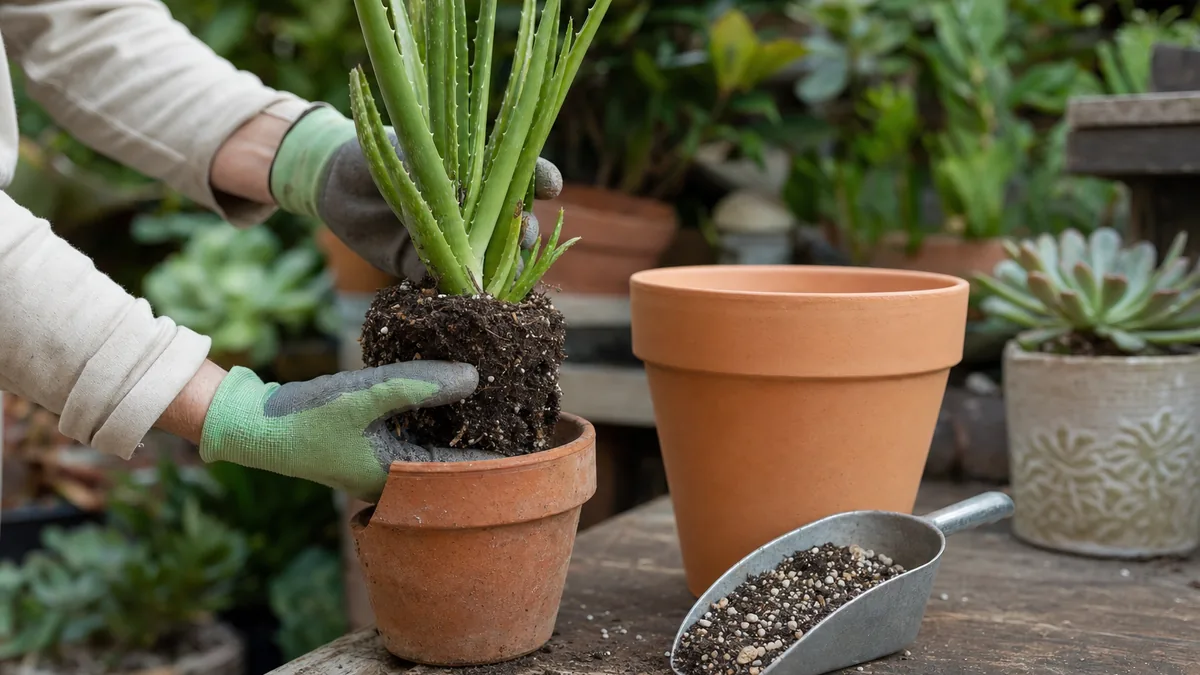
How to repot aloe vera: do it in spring, when roots poke from the drainage holes or crowd the pot, and move the plant into a container only slightly larger than the old one. Fill it with a coarse, fast-draining cactus-style mix and make sure the pot has a drainage hole. Extension sources agree on those basics and differ mainly on how much bigger the new pot can be and when to water afterward. If you are still setting up the plant, start with our aloe vera growing guide, and browse more indoor plant guides for the rest of your shelf.
Repotting Aloe Vera at a Glance
| Question | Short answer | Source |
|---|---|---|
| Best season | Spring, or late winter to early spring | NC State Extension, Penn State Extension, Montana State Extension |
| How often | About every two years, or as needed | Penn State Extension, UF/IFAS |
| New pot size | Slightly larger. No more than 2 inches wider, or about one third wider, or up to two pot sizes, depending on the source | NC State, Montana State, UF/IFAS |
| Soil | Coarse, well-draining. One part potting soil, one part sand, one part perlite or lava rocks | Penn State Extension |
| Pups | Remove when a couple of inches tall, let the cut dry for a week or so | University of Arizona Extension |
| Fertilizer after | Wait at least two weeks | Montana State Extension |
When to Repot an Aloe Plant
Aloe does not need frequent repotting. UF/IFAS says to repot as needed, either to refresh the potting media or to give the plant room to grow. Penn State Extension says replanting an aloe every two years can help refresh the soil and reduce crowding of the roots. Treat two years as a rough ceiling and let the plant tell you. Once it is in fresh mix, our guide to how often to water aloe vera covers the watering side.
- Roots at the surface or the holes: NC State Extension calls roots appearing from the drainage holes or the soil surface a sure sign it is time to repot.
- Fast-drying mix: Penn State Extension asks whether the potting mix dries out very quickly, even in cooler weather.
- Tangled root ball: Penn State says that if it is difficult to see any potting mix in the bottom third of the root ball, the roots have taken over.
- Tipping or salt crust: Montana State Extension lists a top-heavy plant prone to tipping, and salt or mineral buildup on the soil or pot.
NC State and Penn State Extension both recommend spring, when the plant begins its seasonal growth. Montana State says late winter or early spring, and adds that a stressed plant can be repotted at any time. So if the plant is sitting in soggy mix in October, do not wait until April. Also check the roots before assuming crowding is the problem: wilting or yellowing can come from wet soil, and our guide to root rot shows what damaged roots look like.
Choosing the Pot: Size, Material and Drainage
The new pot should be only slightly larger than the old one. UF/IFAS Charlotte County Extension says to move to a pot just a bit bigger, because too big a container can hold excess moisture and trigger root rot. Sources then put a number on “slightly,” and the numbers differ:
- UF/IFAS: do not increase the pot size by more than two pot sizes. It adds that a smaller pot keeps the plant small and a larger pot promotes growth.
- NC State Extension: choose a container no more than 2 inches larger in diameter than the current one.
- Montana State Extension: pick a pot about one third wider and deeper than the previous pot.
- Penn State Extension: leave 1 to 1.5 inches between the root ball and the edge of the pot.
By our arithmetic, a root ball 4 inches across fits a pot about 6 to 7 inches wide inside under the Penn State rule, and a 6-inch pot becomes an 8-inch pot under the one-third rule. The sources overlap around one step up. Our guide to plant pot sizes explains how nominal sizes map to real diameters.
Drainage is not optional
Penn State Extension says to use pots with large drainage holes, and UNH Extension notes that a gritty mix only protects against overwatering if the container has at least one drainage hole. NC State adds that a layer of gravel under the soil does not help, because it actually decreases drainage. If you love a decorative pot with no hole, Penn State suggests repotting into a container that drains and using the pretty one as an overpot. Never let the plant sit in a saucer of water, a warning that UNH, Penn State and UF/IFAS Charlotte County all repeat.
Terracotta, plastic or ceramic
Montana State Extension says plastic is light and cheap, ceramic is heavy and steadier for tall plants, and terracotta is porous and shows salt buildup sooner. Penn State says terracotta is ideal for succulents because clay pulls moisture out of the mix. If you reuse an old pot, NC State says to clean it with one part liquid bleach to nine parts water and rinse it well.
Best Soil for Repotting Aloe Vera
Regular potting soil alone holds too much water for aloe. Penn State Extension says aloes prefer a coarse, well-draining potting mix and offers a recipe: one part potting soil, one part sand and one part perlite or lava rocks. University of Arizona Extension suggests a commercial potting mix with extra perlite, granite grit or coarse sand added, or a packaged cactus mix, and UNH Extension recommends a well-drained mix with added sand. West Virginia University Extension gives a simpler succulent recipe of one part potting soil to one part coarse sand. Do not use garden soil in a pot. NC State says to use a professional or premium potting soil, and Montana State says that if you reuse old soil, add at least 50 percent new soil.
NC State also says to moisten the potting media before you use it, so it packs evenly.
How to Transplant an Aloe Vera Plant, Step by Step
This sequence combines the steps from NC State, Montana State and Penn State Extension.
- Gather your supplies. You need a clean pot with a drainage hole, gritty mix, a drip tray and a clean knife.
- Choose how damp the root ball should be. Sources split. Montana State says to water the plant first, and Penn State says to water in the original pot and let it rest for an hour. University of Arizona Extension says cacti should be transplanted into dry soil, though that bulletin covers landscape cacti. Aloe-specific sources do not settle it, so aim for the middle: not freshly soaked and not dusty dry.
- Remove the plant without pulling the leaves. NC State says not to pull a plant by the stem. Hold it at the base, turn the pot over and tap the rim on a table edge. Montana State adds that you can run a knife around the inside edge, and plastic pots may need to be cut.
- Inspect and loosen the roots. Montana State says to trim dead, diseased or damaged roots and gently separate any that circle the pot. NC State says to remove the top inch of old soil if salts have built up on it. If you find soft, dark or mushy roots, see our guide to root rot.
- Add a base layer of mix. Montana State suggests one to two inches in the bottom of the new pot. Do not add gravel.
- Set the depth. Penn State says to place the plant so its leaves are just above the soil level. NC State says the top of the root ball should sit an inch below the rim, so there is room to water.
- Fill around the sides. NC State says not to add soil above the original root ball level unless roots are exposed, and to settle the mix by tapping the pot or pressing gently without packing it down.
- Set it on a tray in indirect light. Montana State says to keep the plant in indirect light for a few days to reduce transplant shock.
How to Repot Aloe Vera Pups
Pups are the small plants that grow around the base of a mature aloe, and repotting day is the easiest time to separate them. Penn State Extension says pups may be removed from the mother plant and transplanted into another pot. University of Arizona Extension says to remove them when they are a couple of inches tall, cutting with a clean, sharp knife if needed. For general care once the pups are potted, see our guide to growing aloe vera.
- Check for roots. West Virginia University Extension says offsets are ready to repot once they are big enough to handle and have established roots. Tug gently, and resistance means roots have formed.
- Keep roots attached. Iowa State University Extension says to separate the offset with both leaves and roots attached.
- Let cut surfaces heal if needed. Sources differ here. University of Arizona Extension says to let the cut area scab over for a week or so before replanting, and WVU says a damaged or unrooted offset needs to callus first. Iowa State’s offset instructions do not mention callusing, so a pup with its roots intact likely needs less waiting.
- Pot it up small. Iowa State says to use cactus potting soil in a container with a drainage hole, and to water lightly. After a few weeks the new plant will establish, and Arizona says roots should develop after a month or so.
Use a small pot for a small pup, or it will sit in wet mix for weeks. Planning to replant a single leaf instead? The UF/IFAS Horticultural Sciences blog says cut leaf sections should dry and form a callus before planting, normally a day or two, but Iowa State lists aloe among the plants that propagate by offsets, so pups are the safer route. For succulents that do root from leaves, see our guide to growing succulents from cuttings.
How to Replant an Overgrown or Rootbound Aloe
A rootbound aloe has more root than mix, so water runs straight through and the plant dries out in days. You have three options.
- Move up one size. NC State says to cut and unwind circling roots. Montana State says that for an extremely rootbound plant you can make cuts about a half inch deep on all sides and the bottom with a sharp, sterile blade, then tease the roots apart. That is general houseplant advice, so try teasing first and cut only if the roots refuse to loosen.
- Divide it. If the clump holds several pups, split them off as described above and pot each one.
- Keep it the same size. Penn State’s houseplant guide says you can remove the outer section of the roots and cut back some top growth, then replant in fresh mix. UF/IFAS adds that a smaller pot keeps the plant small. That advice is for houseplants in general, so go lightly on an aloe.
Watering and Care After Repotting
Sources disagree on the first watering. NC State and Montana State, writing about houseplants in general, say to water thoroughly until water runs from the drainage holes after repotting. Penn State’s houseplant guide says to water thoroughly and let the pot drain well. Clemson’s indoor cactus fact sheet says the opposite for cacti: after repotting, wait several days before watering. Iowa State Extension says to water an aloe offset lightly after potting it up.
A sensible reading is that wet-then-dry beats wet-and-staying-wet. If you disturbed or trimmed roots, give them several days to heal before the first soak, then water thoroughly and let the mix dry. If the roots were healthy and untouched, a normal watering is fine. In both cases UF/IFAS says to water when the top inch of soil is dry to the touch and to never let the plant sit in water. For routines by season, see our guides on how often to water aloe vera and how to water succulents.
- Light: keep it in indirect light for a few days (Montana State), then move it back to a bright window. UF/IFAS warns that plants can sunburn if moved from low light to bright light too quickly.
- Fertilizer: Montana State says not to fertilize for at least two weeks, so the roots can regenerate.
- Winter care: Penn State says to reduce watering in the dormant period so the soil is barely moist and the leaves do not shrivel.
- Temperature: UNH Extension says aloe is sensitive to cold and should not be kept in a room that dips below 50°F.
If you plan to set the pot outside for summer, University of Arizona Extension says to bring it back indoors before the first fall freeze, and UF/IFAS says aloe can grow outdoors year-round in USDA zones 8 to 11. Look up your own zone on our growing zones pages before you decide, and our guide to succulents in winter lists the zone limits for aloe and other tender types.
Signs of Trouble After Repotting
Some stress is normal. Montana State Extension says yellowing leaves or some leaf drop is normal after repotting. Watch for the problems below.
- Soft, discolored leaves at the base: the mix may be staying too wet. Check drainage, empty the saucer and look at the roots. Penn State Extension says aloes are extremely drought tolerant and susceptible to root rot, so never allow the plant to sit in water.
- Shriveling leaves: Penn State says that in the dormant period the soil should be barely moist and the leaves should not shrivel, which suggests that shriveling is a sign of too little water.
- Leaning or toppling: the plant may be set too loosely. NC State says to settle the mix by tapping the pot or pressing gently, without packing it down.
- White crust on a clay pot: Montana State says terracotta shows salt buildup sooner. NC State says to scrub off salt buildup on clay pots when you reuse them.
If the plant is clearly failing, repot it again into fresh mix, trimming dead, diseased or damaged roots as Montana State describes. Montana State says a stressed plant can be repotted at any time of year.
Pet safety
Aloe vera is toxic to pets. The ASPCA lists Aloe vera as toxic to dogs, cats and horses, names saponins and anthraquinones as the toxic principles, and lists vomiting (not in horses), lethargy and diarrhea as clinical signs. Repot where pets cannot reach the plant, sweep up spilled mix and leaf scraps and set the finished pot out of reach. Check with your veterinarian if a pet chews on a leaf.
Free book · 25 pages, PDF
How to Repot Aloe Vera FAQ
When is the best time to repot an aloe vera plant?
Spring. NC State and Penn State Extension both recommend repotting as the plant begins its seasonal growth, and Montana State Extension says late winter to early spring. Montana State adds that a stressed plant can be repotted at any time.
How often should you repot an aloe plant?
About every two years, according to Penn State Extension, which says this refreshes the soil and reduces root crowding. UF/IFAS says to repot as needed to refresh the media or give the roots room.
What size pot should you use when you repot aloe vera?
One only slightly larger than the current pot. NC State Extension says no more than 2 inches wider, Montana State says about one third wider and deeper, and UF/IFAS says no more than two pot sizes up, since a pot that is too big can hold excess moisture and lead to root rot.
What is the best soil for repotting aloe vera?
A coarse, well-draining mix. Penn State Extension suggests one part potting soil, one part sand and one part perlite or lava rocks. University of Arizona Extension suggests commercial potting mix with extra perlite, granite grit or coarse sand, or a packaged cactus mix.
How do you transplant aloe vera pups?
Wait until the pup has roots, since West Virginia University Extension says a gentle tug that meets resistance means roots have formed. University of Arizona Extension says to cut it from the mother with a clean, sharp knife and let the cut area scab over for a week or so before potting it in a well-drained mix.
How long should you wait to water aloe after repotting?
Sources vary. Clemson Extension says to wait several days before watering a repotted cactus, Iowa State Extension says to water a potted aloe offset lightly, and Montana State and NC State Extension say to water houseplants thoroughly after repotting. If you trimmed roots, waiting several days is the cautious choice.
Is aloe vera toxic to pets?
Yes. The ASPCA lists Aloe vera as toxic to dogs, cats and horses, names saponins and anthraquinones as the toxic principles, and lists vomiting (not in horses), lethargy and diarrhea as clinical signs.
Sources & further reading
Aloe-specific repotting, soil and pup details come from UF/IFAS Gardening Solutions on aloe vera, Penn State Extension’s Aloe, a Hardy Houseplant, UNH Extension’s guide to growing aloe at home, UF/IFAS Charlotte County Extension’s aloe blog post, University of Arizona Cooperative Extension’s Aloe Vera bulletin and the UF/IFAS Horticultural Sciences blog on aloe. General repotting steps, signs and pot materials come from NC State Extension’s How to Repot a Houseplant, Montana State University Extension’s Ask Steward on repotting a houseplant and Penn State Extension’s Repotting Houseplants. Succulent and cactus soil, offsets and watering come from West Virginia University Extension’s Succulents 101, Iowa State University Extension’s guide to propagating succulents and Clemson HGIC’s Indoor Cacti. Pet safety comes from the ASPCA’s Aloe entry in its toxic and non-toxic plants database. For how we source the facts on this site, see our methodology page.
Free book · 25 pages, PDF
The Indoor Plants Repotting Cheat Sheet
Sent