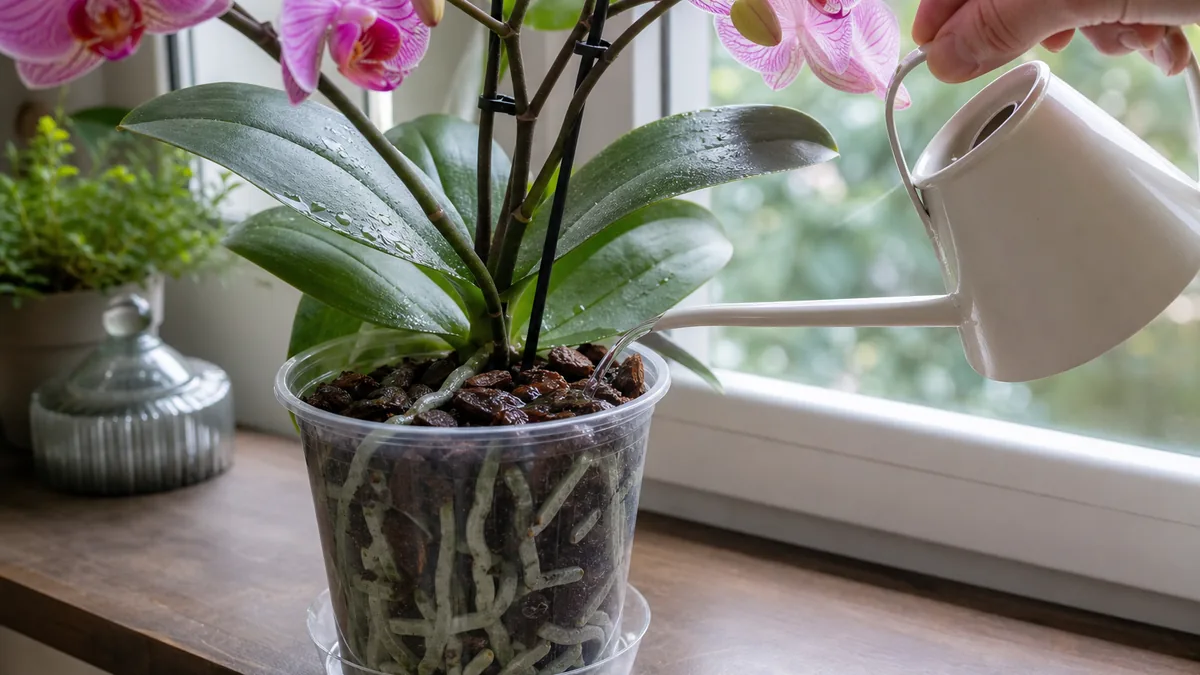
How to water orchids comes down to a soak and drain routine. Carry the pot to the sink, run lukewarm water through the bark or moss until the roots turn green, let every drop drain out, then put it back. For a moth orchid in bark that is about once a week, and a little too dry is safer than too wet. Overwatering is the most common way orchids die, so if you ever find soft, brown roots, start with our guide to root rot.
Orchid Watering at a Glance
Most advice online is about the moth orchid (Phalaenopsis), the one sold at grocery stores and garden centers, so that is what the figures below describe unless stated.
| Question | Short answer | Source |
|---|---|---|
| How often | No more than once a week at normal home temperatures | University of Maryland Extension |
| How much | Until aerial roots turn from silver or white to pale green | University of Maryland Extension |
| Method | Sink, 3 or 4 drenches over about 10 minutes, then drain fully | University of Maryland Extension |
| Water temperature | Lukewarm or tepid | Clemson Extension, Smithsonian Gardens, New York Botanical Garden |
| Time of day | Early, so the leaves dry quickly | University of Missouri Extension |
| Biggest risk | Overwatering, which kills the roots | University of Illinois Extension, NYBG |
How Often to Water Orchids Indoors
Sources give a schedule and then qualify it, because the right interval depends on your heat, light and potting mix. The University of Maryland Extension says that under normal home temperatures, waterings should not be needed more than once a week. Clemson Extension says watering once a week is generally sufficient for a moth orchid in bark. University of Missouri Extension, quoting horticulturist David Trinklein, recommends a thorough drenching every five to seven days for phalaenopsis, and every 10 to 14 days for cattleya orchids. Smithsonian Gardens gives the widest range, saying an orchid could need water every 5 to 14 days depending on how hot or cold, sunny or shady its spot is.
Read that as a window, not a timetable. The reliable rule, from Smithsonian Gardens and the New York Botanical Garden (NYBG), is to water when the potting mix is nearly dry. NYBG says to test an inch or so down with your finger. Clemson adds that you water more often in summer and less in winter.
How to Water an Orchid, Step by Step
- Check the mix. Push a finger an inch into the bark or moss. If it is still damp, wait.
- Move the pot to a sink. Both Clemson and the University of Maryland describe watering in a sink or tub so the water can run through freely.
- Use lukewarm water. Clemson specifies lukewarm, and NYBG says tepid water helps dissolve fertilizer salts and avoids shocking the plant.
- Drench the mix. The University of Maryland says to run warm water over the plant, bark and aerial roots in a series of 3 or 4 drenches over a 10-minute period. Clemson says to run water through the medium for a minute or so. NYBG notes that bark initially repels water, so water until it is saturated.
- Drain completely. Let the pot stand in the sink until it stops dripping. The Illinois Extension post on moth orchids says roots should never sit in water but above it.
- Return it to its spot. Put the pot back on a saucer or in a decorative pot only once it has drained.
Watering in the morning is the habit that most sources share. University of Missouri Extension says to water early in the day so the foliage dries quickly, which helps limit disease, and NYBG also recommends morning.
How Much Water Do Orchids Need?
There is no measuring cup answer, because the amount depends on the pot. The sources give signals instead.
- Root color. The University of Maryland says roots change from a dull silver or white to a pale green color when you have applied enough water. Smithsonian Gardens describes wet roots as vibrant green.
- Pot weight. Clemson says to check the weight of the pot. If it feels heavy, the plant does not need water.
- Saturation. NYBG says to water until the bark is saturated, since dry bark repels water at first.
After a few cycles you will know the weight of a freshly watered pot and the weight of a dry one, which is more reliable than counting days.
How to Tell if Orchids Need Water, or Have Had Too Much
The signs overlap, so look at roots and leaves together.
- Silver or white roots in a dry mix: thirsty. This is the University of Maryland’s color cue in reverse.
- Wrinkled leaves: the University of Maryland says leaves become wrinkled from underwatering or low humidity, because phalaenopsis have no water-storing pseudobulbs.
- Brown leaf tips: these can come from causes other than watering, such as minerals in tap water, so see our guide to why plant leaf tips turn brown to sort out which.
- Firm, white-coated roots: healthy, according to Smithsonian Gardens.
- Soft or browning roots: unhealthy, according to Smithsonian Gardens.
- Roots sitting in water: a problem in itself. The University of Maryland warns that flooding a pebble tray can keep the roots too wet and rot them.
The Illinois Extension post says most people tend to overwater, which kills the roots and ultimately the plant, and that it is better for the plant to get a little too dry. NYBG agrees that overwatering is the most common cause of orchid death. If the plant looks limp and you cannot tell whether it is thirsty or damaged, our guide to why a plant wilts helps you separate the two.
Water Quality and the Ice Cube Method
NYBG says orchids generally prefer low-mineral water, but that phalaenopsis is less sensitive and tap water is fine in most situations. If you have a rain barrel, our rainwater collection guide shows how to set up collection.
The ice cube method is where the sources disagree. Smithsonian Gardens says never to use ice, because cold shock damages roots. Ohio State University and the University of Georgia tested it: researchers there gave 48 Phalaenopsis orchids at both locations either three ice cubes once a week or an equivalent amount of room-temperature water, for four to six months. According to a post by Kaylee South and Michelle Jones, flower longevity and display life matched the room-temperature group, and root and leaf health were not negatively affected. The bark temperature dropped to 51 to 56°F during ice application and returned to 70°F about five hours later. The full study was published in HortScience.
The trial tested one specific amount on one type of orchid, so it does not prove ice is better. Lukewarm water through a sink is still the method every sourced guide above describes. The same sink method suits other houseplants, as in our guide on how often to water poinsettia.
How to Water Orchids in Bark and in Moss
The potting medium sets your schedule. Clemson says bark retains less water than moss, so bark needs watering more often. For moss, it says to water when the top feels dry to the touch. NYBG adds that a moss mix dries more slowly than bark, so check deeper before you water.
Mix also ages. The University of Maryland says to replace the media every one to two years, and signs it needs replacing include bark that looks like mulch, poor drainage or excess moisture retention. University of Missouri Extension says to repot about every third year, so use the plant’s drainage as your cue rather than the calendar.
Orchids in Pots and Orchids From the Florist
The pot matters as much as the water. The University of Maryland says to use a container with excellent drainage, and University of Missouri Extension says porous pots, with clay ideal, suit cattleya and phalaenopsis orchids. Clear plastic pots, common on store-bought plants, let you see the root color the University of Maryland describes.
If your orchid arrived from a florist in a decorative sleeve or cache pot, take the inner pot out to water it, then drain it fully before it goes back. This follows the rule from Illinois Extension that roots should never sit in water, since water collects at the bottom of a pot cover.
Humidity, Light and Feeding Change How Often You Water
Humidity is one reason the right interval differs from house to house. Smithsonian Gardens gives 50 to 80 percent, University of Missouri Extension says most orchids prefer 60 to 70 percent, and NYBG says at least 50 percent is required and 65 percent or more is preferred. NYBG also notes an average northeast home may drop to 25 percent. The University of Maryland says misting is usually not enough moisture indoors and suggests pebble trays under the pots, and Illinois Extension suggests a ceiling fan for air circulation.
Light and heat affect how soon the mix dries. The University of Maryland says indirect light from an east or west window is ideal for moth orchids, and Illinois Extension suggests placing plants 12 to 36 inches from a south window. For dim rooms, University of Missouri Extension says fluorescent or LED lamps can supplement natural light, and our comparison of LED versus fluorescent grow lights helps you pick.
Feeding goes with watering. Illinois Extension says to use a diluted balanced fertilizer at each watering, quarter-strength in the author’s greenhouse. University of Missouri Extension suggests a high-nitrogen formula such as 30-10-10 when the medium is bark. For more plant-care guides, see the indoor plants hub, or compare the soak and drain routine with our guide to watering succulents.
Watering Orchids Other Than Moth Orchids
Not every orchid on a windowsill is a moth orchid, and the schedule shifts with the type. University of Missouri Extension says phalaenopsis and paphiopedilums (lady’s slipper orchids) need a thorough drenching every five to seven days, while cattleyas can go 10 to 14 days between waterings. Its potting advice differs too. Cattleya and phalaenopsis do well in loose, airy orchid bark or osmunda fiber, while paphiopedilums prefer a finer bark, or a mix of bark with perlite, sand or sphagnum peat moss, so the medium retains moisture yet drains well.
Light needs follow the same pattern. The same source gives 2,000 to 4,000 foot-candles for cattleya and 1,000 to 1,500 for phalaenopsis and paphiopedilum. A brighter spot means faster drying, so a cattleya on a sunny sill may still need water on a similar rhythm to a moth orchid in a shadier room.
Common Orchid Watering Mistakes
- Letting the pot stand in water. The University of Maryland warns that a flooded pebble tray can keep roots too wet, and Illinois Extension says roots should never sit in water.
- Misting instead of watering. The University of Maryland says misting is usually not enough moisture indoors.
- Watering on a fixed day regardless of the mix. Smithsonian Gardens says to water only when the growth medium is dry, and Clemson says light and heat affect how soon watering is needed.
- Watering late in the day. University of Missouri Extension says to water early so the foliage dries quickly, which helps limit disease.
- Keeping old, broken-down bark. The University of Maryland says bark that looks like mulch, drains poorly or holds excess moisture needs replacing.
- Skipping the drain. Smithsonian Gardens says to let water drain out the bottom after soaking and to let the mix dry before the next watering.

Free book · 25 pages, PDF
How to Water Orchids FAQ
How often should you water an indoor orchid?
The University of Maryland Extension says a moth orchid should not need water more than once a week at normal home temperatures. Clemson says once a week is generally enough in bark, University of Missouri Extension says every five to seven days, and Smithsonian Gardens says 5 to 14 days. Water when the mix is nearly dry.
How much water does an orchid need?
Enough to saturate the mix and turn the roots green. The University of Maryland says roots change from dull silver or white to pale green when you have applied enough water, and NYBG says to water until the bark is saturated. Then let it drain completely.
Can you water orchids with ice cubes?
A study at Ohio State and the University of Georgia found that three ice cubes once a week gave the same flower longevity as room-temperature water over four to six months, with no root or leaf harm. Smithsonian Gardens still says never to use ice. Lukewarm water in a sink is the method every guide describes.
How do you know when an orchid needs water?
Look for silver or white roots, a dry mix an inch down (NYBG) and a light pot (Clemson). Wrinkled leaves are a late sign of underwatering or low humidity, according to the University of Maryland.
What is the best way to water an orchid in a pot?
Take it to the sink, run lukewarm water through the bark or moss, and drain it fully. The University of Maryland describes 3 or 4 drenches over a 10-minute period, and Clemson says to run water through for a minute or so. Return it to its spot only when it stops dripping.
Should you mist orchids?
Misting does not replace watering. The University of Maryland says it is usually not enough moisture indoors, and recommends pebble trays under the pots instead. Illinois Extension suggests clustering plants on saucers with rocks and water and running a ceiling fan for air circulation.
Sources & further reading
Watering frequency, method and root-color cues come from University of Maryland Extension’s Care of Phalaenopsis Orchids, Clemson Home and Garden Information Center’s General Care for Phalaenopsis Orchids, University of Illinois Extension’s Phaleonopsis, beautiful but picky and University of Missouri Extension’s Orchids: A cure for winter doldrums. Root health, water quality and humidity notes are from Smithsonian Gardens’ Care of Phalaenopsis and the New York Botanical Garden’s answer on watering Phalaenopsis. The ice cube findings come from the Ohio State University greenhouse blog. For how we source the facts on this site, see our methodology page.
Free book · 25 pages, PDF
The Indoor Plants Repotting Cheat Sheet
Sent