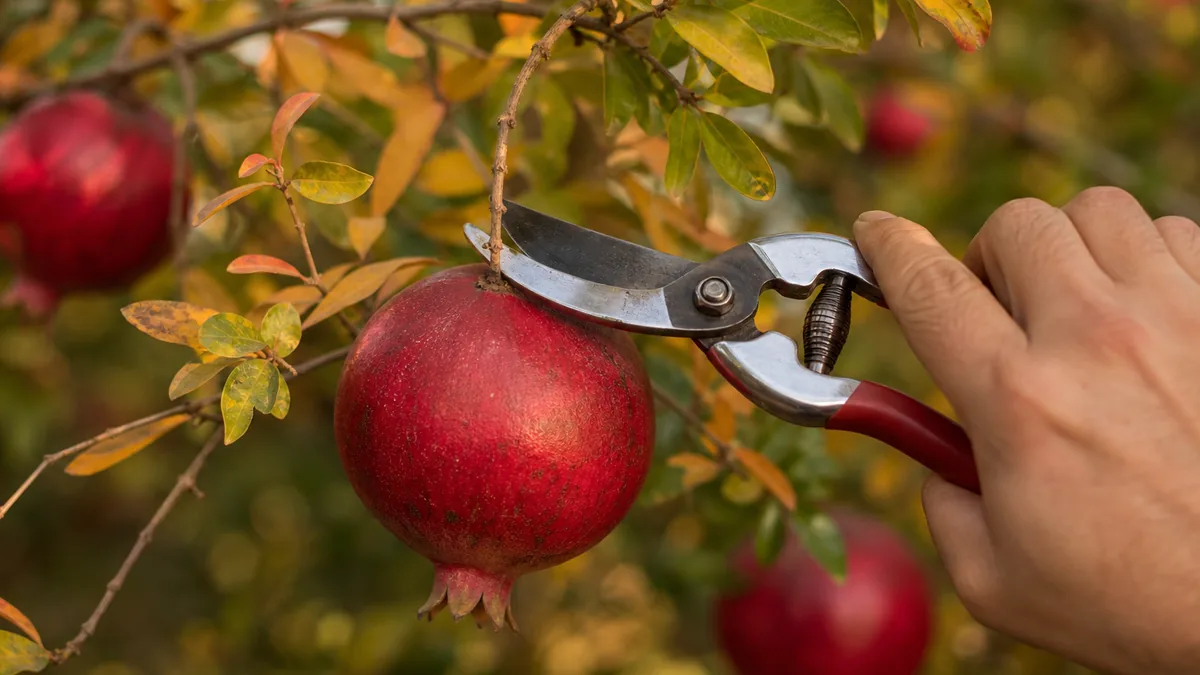
How to pick pomegranate fruit comes down to timing, a clean cut and gentle handling. Wait until the fruit is fully mature, because it will not ripen after picking. Then clip the short stem as close to the fruit as you can with sharp shears, rather than pulling, and place each fruit in a container without dropping it. This guide is about the act of harvesting. For the visual and sound cues that show a fruit is ready, see our guide to telling if a pomegranate is ripe.
Pomegranate Picking at a Glance
| Question | Answer | Source |
|---|---|---|
| Will it ripen after picking? | No, so harvest only at full maturity | Texas A&M AgriLife, UC Fruit and Nut Research and Information Center |
| Pull or cut? | Cut, leaving as little stem as possible | Texas A&M AgriLife, University of Georgia Extension |
| What tool? | Shears, cutting as close to the fruit as possible | University of Georgia Extension |
| How many passes? | Plan on two to four per season | University of Georgia Extension |
| How rough is too rough? | A strong bump can split the fruit | University of Georgia Extension |
When to Pick Pomegranates From Your Tree
The calendar gives a window, and the fruit gives the final answer. The UC Fruit and Nut Research and Information Center says pomegranates need 6 to 7 months after flowering to ripen, and Texas A&M AgriLife says about 6 months after bloom. That is why harvest months vary so much by region and variety. Your USDA hardiness zone is the first thing to check when you estimate your own window.
| Source | Harvest window it gives |
|---|---|
| UC Fruit and Nut Research and Information Center (California) | Typically August to November |
| Clemson Extension (South Carolina) | Early fall, August to October |
| University of Georgia Extension | Near the end of August for early cultivars, through October or early November for late ones |
| Texas A&M AgriLife | September for early varieties, through October for later ones |
Variety moves the date. Utah State Extension says Granada ripens one month earlier than Wonderful, and Early Wonderful about two weeks ahead of it. Clemson gives the same two comparisons, with Wonderful ripening in September.
Resist the urge to pick early. Texas A&M AgriLife says the fruit does not ripen after it is picked, so it should be harvested only after it reaches full maturity. The UC center goes further: it says to keep the fruit on the tree longer for optimal flavor, and that picking early to prevent cracking sacrifices flavor. University of Georgia Extension notes that growers judge maturity by sugar and acid content and color, and that experienced growers also tap the fruit and listen for a metallic ting.
How to Pick a Pomegranate, Step by Step
- Check the fruit first. Confirm the cues in our ripeness guide, and look for cracks. Split fruit is more likely to spoil, as covered below.
- Use sharp, clean shears. University of Georgia Extension says to clip the fruit with shears, and the cut should be as close to the fruit as possible.
- Cut, do not pull. Texas A&M AgriLife says to cut the fruit off rather than pulling it, leaving as little stem as possible. A long stub, it says, could rub and injure other fruit.
- Handle with care. University of Georgia Extension says a strong bump can split the fruit, so lower each one into your basket instead of tossing it. Commercial growers use orchard bins or shoulder harness baskets, per the same source.
- Pick split fruit first and use it soon. University of Georgia Extension says split fruit can become infected by field-borne diseases, which may develop during storage.
- Move the harvest indoors quickly. University of Georgia Extension says cooling is not required, but fruit benefits from cold storage as soon as possible.
Picking Before Rain: Splitting and Timing
Rain close to harvest is the main hazard. Utah State Extension says rain contributes to splitting, especially when it occurs near ripening, and that late summer and early fall rains encourage cracking, with the risk growing the closer the rain falls to harvest. It also says to harvest before the fruit is overripe, even a little early, to avoid splitting.
That advice pulls against the UC center’s flavor advice above, so it comes down to your forecast and your tolerance for loss. If heavy rain is coming and the fruit is close to ready, picking a little early may save the crop. If the weather is dry, wait. Both agree on the best prevention. Utah State suggests a deep, thorough watering every 7 to 10 days, and the UC center says steady irrigation near harvest reduces splitting. Clemson Extension also says even soil moisture reduces fruit drop and splitting, and University of Georgia Extension says excessive fall irrigation may contribute while adequate water during drought helps limit splitting when rain returns.
Disease can split fruit too. Texas A&M AgriLife says a fungus causes fruit to split as it begins to mature, that copper fungicide applied from late spring through summer may help though control is not fully understood, and that too much rain during bloom and ripening can cause heart rot. If you find fruit that is soft, split or discolored inside, discard it rather than storing it.
How Many Times to Harvest, and Reaching the Fruit
Fruit on one tree does not ripen all at once. University of Georgia Extension says to plan on two to four harvest passes per season, though once-over harvesting is occasionally used in intensive production. Keeping the tree at a manageable size makes each pass easier: the same source says that with proper pruning, harvest needs little ladder work, and trees are often kept at about 9 feet.
Storing Pomegranates After Picking
Storage guidance varies by source and by how carefully the fruit was handled.
- Texas A&M AgriLife: 40 to 45°F at 85 percent relative humidity for up to 3 months.
- University of Georgia Extension: 41°F for short-term storage under three weeks and 45°F for longer storage. It says fruit can be stored up to six weeks in open-air storage.
- Utah State Extension: 32 to 41°F with humidity around 80 percent, with fruit storing for 6 to 7 months and flavor often improving in storage.
The gap between three months and seven reflects commercial storage conditions against a home fridge, so the shorter figure is the safe plan. University of Georgia Extension warns that low temperatures held beyond about three weeks can cause chilling injury, with browning of the white membrane and arils, loss of aril pigment and softening. Because split fruit can carry infection into storage, keep unsplit fruit for storing and eat the cracked ones first.
What you do with the harvest is up to you. Texas A&M AgriLife says pomegranates are commonly eaten fresh, that some newer varieties have soft seeds that can be eaten with the pulp, and that juice can be made into a beverage or syrup or blended with other juices. University of Georgia Extension says commercial fruit is sorted into Grade 1 or Grade 2, a reminder that not every fruit from your tree will be storage quality.
Shopping for fruit rather than picking it yourself? The ripeness guide linked above covers store selection, spoilage and how to open a pomegranate.
Varieties and How They Differ at Harvest
Fruit size and behavior vary with the cultivar, which affects what you pick and when. Utah State Extension says fruit is 2 1/2 to 5 inches wide, with Balegal and Fleshman about 3 inches and Phoenicia 4 to 5 inches, and that King tends to split. Clemson Extension says fruit is generally 2 to 3 inches across but may be up to 5. Utah State also notes that the calyx, the crown on the fruit, persists even after harvest, so a crown on a picked fruit is normal.
Skin color is not a reliable single sign. Utah State says the skin turns from green to pink as it ripens, and becomes deep red in some varieties, while Clemson says fruit goes from green to several shades of red depending on the cultivar. Color alone can mislead, which is why the other cues matter.
When Can You First Pick Pomegranates From Your Own Tree?
Be patient with a young plant. Clemson Extension says a plant may bear one or two fruits in its first year and will begin to bear well three years after planting. Texas A&M AgriLife says trees begin producing fruit 3 to 4 years after planting. University of Georgia Extension says trees grown from hardwood cuttings bear in year two, trees grown from seed take at least three years, and the first harvest in year three is small, late and often drops early, with full commercial production in years five or six. If you started from seed, our guide to planting mangoes from seeds shows how slow seed-grown fruit trees can be: UF/IFAS Gardening Solutions says a mango can take 10 years to bear from seed.
Texas A&M AgriLife gives rough yields: about 20 to 25 fruits (around 10 pounds) at year 4, 100 to 150 fruits (around 50 pounds) at year 10, and 200 to 250 fruits (around 75 pounds) per year in a well-managed orchard. Utah State Extension adds that fruit is borne on 2 to 3 year old wood and that vigor declines after about 15 years.
Cold is the other limit. Utah State says pomegranates are suited to zones 8 to 11 and generally suffer damage below 12°F. Our winterizing checklist helps in colder areas.
To see what suits your area, browse the growing zones pages and the trees and shrubs hub.
If Your Tree Has No Fruit to Pick
A tree that flowers and never fruits is a common frustration. Clemson Extension lists the usual causes of poor fruit set: inadequate sunlight, lack of pollination, and over-pruning or cold damage. It says planting two or more plants improves cross-pollination, and that keeping soil moisture even reduces fruit drop and splitting. A newly planted tree also needs years before it fruits, which our pomegranate planting guide walks through.
Pruning matters here as well. Utah State says fruit is borne on 2 to 3 year old wood, which is one reason Clemson lists over-pruning among the causes. Texas A&M AgriLife adds that fruit needs about 6 months after bloom, so be patient after the flowers.
Free book · 23 pages, PDF
How to Pick Pomegranate Fruit FAQ
How do you pick a pomegranate from the tree?
Clip it. Texas A&M AgriLife says to cut the fruit off rather than pulling it, leaving as little stem as possible, and University of Georgia Extension says to cut as close to the fruit as possible with shears so a stub does not rub other fruit.
Can you pick pomegranates before they are ripe?
You can, but they will not improve. Texas A&M AgriLife says the fruit does not ripen after it is picked, and the UC Fruit and Nut Research and Information Center says picking early to prevent cracking sacrifices flavor. Utah State Extension does suggest harvesting slightly early when needed to avoid splitting.
What month do you pick pomegranates?
It depends on region and variety. The UC center gives August to November for California, Clemson says August to October, University of Georgia Extension says the end of August through October or early November, and Texas A&M AgriLife says September to October. Fruit takes 6 to 7 months from flowering (UC center).
How many times do you harvest a pomegranate tree?
University of Georgia Extension says to plan on two to four passes per season, because fruit does not ripen all at once.
How do you store pomegranates after picking?
Texas A&M AgriLife gives 40 to 45°F at 85 percent humidity for up to 3 months, and University of Georgia Extension gives 41°F for under three weeks or 45°F for longer. Utah State Extension reports 6 to 7 months at 32 to 41°F, so use the shorter figures at home.
Why did my pomegranates split on the tree?
Rain near ripening is the usual cause. Utah State Extension says rain contributes to splitting especially close to harvest, and sudden water uptake after a dry spell can split the rind. The UC center and Clemson both recommend steady irrigation.
Sources & further reading
Harvest method, passes and storage come from University of Georgia Extension’s Pomegranate Production, Texas A&M AgriLife’s Pomegranates: Texas Fruit and Nut Production, Utah State University Extension’s Pomegranate, Fruit of the Desert, Clemson Home and Garden Information Center’s pomegranate factsheet and the UC Fruit and Nut Research and Information Center’s pomegranate page. For how we source the facts on this site, see our methodology page.
Free book · 23 pages, PDF
The Spacing & Planting Cheat Sheet
Sent