What Growing Zone Is Florida In?
USDA hardiness zones
9a to 11b
2023 USDA Plant Hardiness Zone Map
Florida spans USDA hardiness zone 9a to 11b across its major population centers, according to the 2023 USDA Plant Hardiness Zone Map. That's a real range, not a single number: where you fall in it depends on where in the state you actually are.
Hardiness zone for ZIP 32202 (Jacksonville)
Your USDA hardiness zone
Zone 9b
Avg. annual minimum (°F)
25°F to 30°F
Avg. annual minimum (°C)
-4°C to -1°C
Nearest reference point: Jacksonville, FL
This is a regional estimate based on the nearest of 826 reference points, each matched to the official 2023 USDA zone map. It’s accurate to within about a half-zone across most of the country, but elevation shifts zones over short distances, so if you’re in mountainous terrain, check the official USDA map for your exact address (see Sources below).
Florida's USDA Hardiness Zones
Here's how the zone shifts across Florida's major cities:
For your exact zone by ZIP code, use the Hardiness Zone Finder, and for what a zone number actually measures (and doesn't), see how zones actually work.
Frost Dates in Florida
Frost dates track zone, so they shift across Florida the same way the zone number does:
- Panhandle (Tallahassee, Pensacola) (zone 9): average last frost Feb 8 - Feb 22, average first frost Dec 8 - Dec 22.
- Florida Keys (zone 11): average last frost Effectively frost-free, average first frost Effectively frost-free.
These are averages, not guarantees. For your specific frost window, use the Frost Date Calculator. For a full vegetable-by-vegetable planting calendar already calculated from Florida's frost dates, see the Florida Planting Calendar.
Florida's average winter lows span roughly 15-20F in the western Panhandle down to 45-50F in the Florida Keys on the 2023 USDA map -- one of the largest single-state hardiness-zone spreads in the continental US.
What Grows Well in Florida's Zones
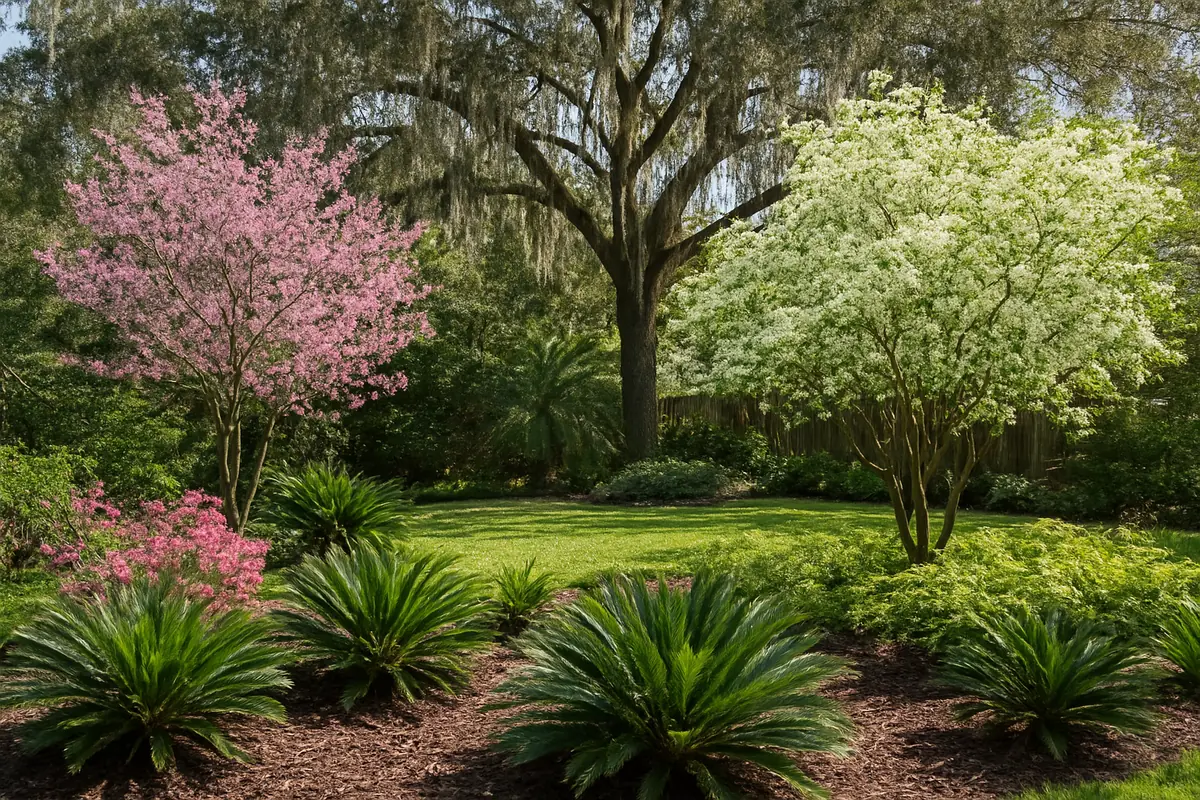
A few real, zone-appropriate picks recommended by UF/IFAS Extension (EDIS) for Florida landscapes: not an exhaustive list, but a genuine starting point.
- Coontie (Zamia integrifolia)
- Eastern redbud (Cercis canadensis)
- Fringetree (Chionanthus virginicus)
- Florida anise (Illicium floridanum)
- Seagrape (Coccoloba uvifera)
Ready to find your exact zone? Use the Hardiness Zone Finder: enter your ZIP code for a precise match against the 2023 USDA map.
Florida Growing Zone FAQ
What growing zone is Florida in?
Florida spans USDA hardiness zones 9a to 11b on the 2023 USDA Plant Hardiness Zone Map. Tallahassee is zone 9a and Jacksonville is zone 9b; enter your ZIP code in the Hardiness Zone Finder for your exact zone.
What growing zone is Jacksonville, FL?
Jacksonville is in USDA hardiness zone 9b on the 2023 USDA map. Zones within a city can differ by half a zone, so check your ZIP code for an exact match.
What growing zone is Miami, FL?
Miami is in USDA hardiness zone 11a on the 2023 USDA map. Zones within a city can differ by half a zone, so check your ZIP code for an exact match.
What growing zone is Tallahassee, FL?
Tallahassee is in USDA hardiness zone 9a on the 2023 USDA map. Zones within a city can differ by half a zone, so check your ZIP code for an exact match.
What growing zone is Orlando, FL?
Orlando is in USDA hardiness zone 10a on the 2023 USDA map. Zones within a city can differ by half a zone, so check your ZIP code for an exact match.
Free book · 23 pages, PDF
The Spacing & Planting Cheat Sheet
When to start, when to plant, how far apart.
Sources & further reading
Zone and city data checked against the official USDA Plant Hardiness Zone Map. Plant recommendations sourced from UF/IFAS Extension (EDIS). Climate note sourced from UF/IFAS Florida-Friendly Landscaping Program. For more on how we build and verify reference data across this site, see our methodology page.
Growing zones in nearby states
Gardening near a state line? Zones don't stop at the border:
Or browse all 51 state growing-zone guides.