To plant a garden, work the bed only when a handful of soil crumbles instead of sticking (University of Kentucky Extension), set seeds 2 to 3 times as deep as they are wide (University of Georgia Extension), put transplants in at about their container depth, then water in and mulch. Our spacing and planting guides cover each crop in detail.
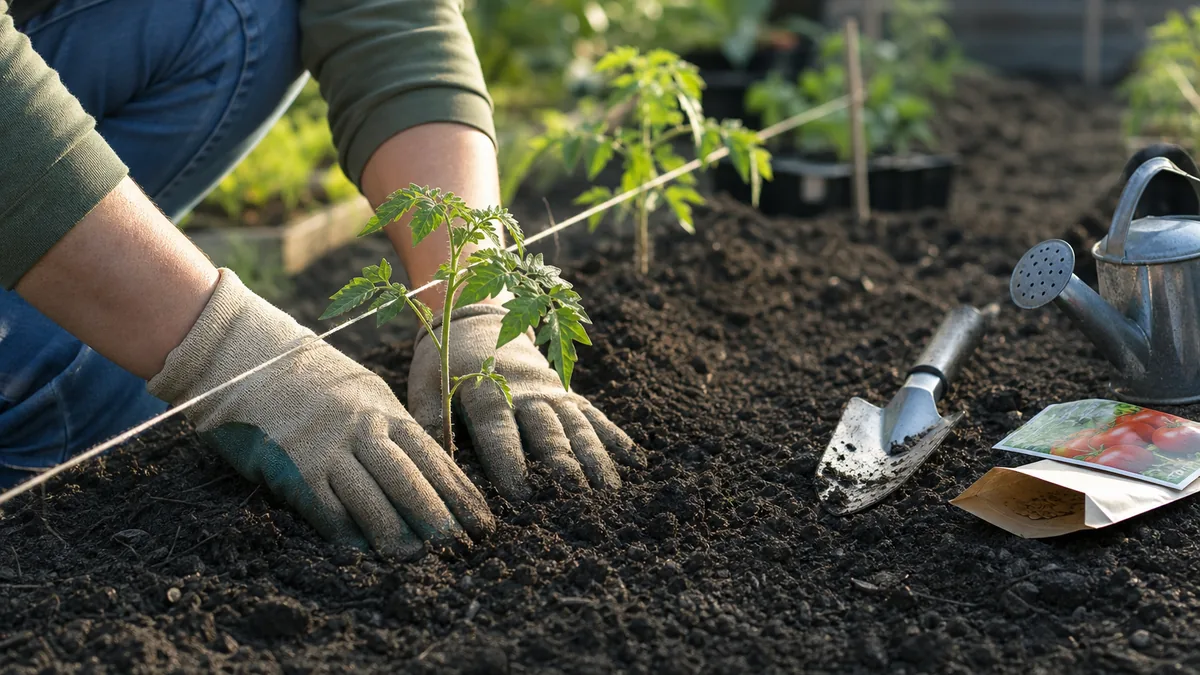
Planting Day Quick Reference
This guide is the hands-on part: the day you put seeds and plants in the ground, in the order you do it. Deciding what goes where comes first, and planning a garden on paper covers sun, soil and goals. A plan needs a layout, dates and a shopping list, and if you would rather not draw those by hand, the garden planner sets out your beds square by square and works out the watering, the planting dates and the shopping list for you. Everything below works on paper too.
| Planting step | Number to use | Source |
|---|---|---|
| Is the soil ready? | A squeezed ball crumbles under fingertip pressure | University of Kentucky |
| Compost to add | 2 to 3 inches | NC State |
| Seed depth | 1 to 2 times (NC State), 2 to 3 times (Georgia) or 2 to 4 times (UMass) the seed width | NC State, Georgia, UMass |
| Transplant depth | Container depth to 1/2 inch deeper; tomatoes deeper | UMass, Wisconsin, Georgia |
| Warm-crop soil | 60 to 65°F before planting | UMass |
| Water | About 1 inch a week, soaking 6 inches deep | NC State |
| Mulch | 2 to 4 inches once the soil has warmed | NC State |
What Should You Do Before Planting a Garden?
Settle four things first: the spot, the soil, the crops and the date. If you are brand new, how to start a garden walks through choosing a site and the first-season decisions. Penn State Extension says most vegetables and flowers need at least 6 to 8 hours of full sun a day, so confirm the light before you dig anything.
Then gather what you need on the day: a trowel, a rake, a string line, a watering can or hose with a gentle nozzle, plant labels, and the mulch. Check the weather as well. Georgia Extension says to transplant on a cloudy, wind-free day if you can, so a mild, overcast forecast is the best planting day you can ask for.
How Do You Prepare the Bed?
Test the soil’s moisture before you touch it. University of Kentucky Extension says to squeeze a handful into a ball: if pressure from your fingertips makes the ball crumble, the soil is fine for working. It warns that tilling wet soil can destroy soil structure, and that once structure is gone it is not easily re-established. Wet tilling also forms clods, and foot traffic on wet soil can do as much damage. If the ball stays sticky, wait a few days.
Then loosen and feed the bed. NC State Extension says to amend beds with 2 to 3 inches of homemade or certified compost, and to work in fertilizer to a depth of 3 to 4 inches in a row garden. It puts the ideal pH for most vegetables at 6.0 to 6.5. A lab report tells you what the soil needs, and our guide to reading soil test results explains the numbers. Kentucky also notes that mixing compost in, instead of leaving it on top as mulch, can speed soil warming and allow earlier planting.
Shape the bed so you never have to step on it. NC State says to design beds no more than 4 feet across so they can be managed from the outside, and describes raised beds as generally 8 to 12 inches high and 3 to 4 feet wide. If you are building one, how to fill a raised garden bed covers the soil mix. For row planting, mark each row with a string line so the rows stay straight and the spacing is easy to measure.
How to Plant a Vegetable Garden: Spacing and Depth
Spacing and depth are where extension sources differ most, so treat the numbers below as ranges and let your seed packet break any tie. Kansas State, Mississippi State, NC State and Wisconsin Extension all publish tables, and they do not agree. The reasons are real: Kansas State’s table is written for rows, NC State’s is for intensive planting in beds, and varieties differ in size.
| Crop | Depth (inches) | Space in the row (inches) | Source |
|---|---|---|---|
| Carrots | 1/4 to 1/2 | 1 to 3 | Kansas State, Mississippi State, NC State |
| Leaf lettuce | 1/4 | 4 to 12 (head lettuce 10 to 12) | Kansas State, Mississippi State, NC State |
| Bush beans | 1 to 2 | 2 to 6 | Kansas State, Mississippi State, NC State |
| Cucumbers | 1/2 to 1 | 12 to 24 | Kansas State, Mississippi State |
| Summer squash | 1 | 24 to 36 | Kansas State, Mississippi State |
| Tomato transplants | To the first leaves | 18 to 36 | Mississippi State, Kansas State, NC State |
| Pepper transplants | Container depth | 12 to 24 | Kansas State, Mississippi State, Wisconsin |
The depth rule behind the table is simple. NC State Extension says to plant seeds 1 to 2 times their greatest diameter in spring and summer, while Georgia Extension says 2 to 3 times their diameter and a planting fact sheet hosted by UMass Amherst says 2 to 4 times their width. All three agree on the direction: tiny seeds go barely under the surface, and big seeds go deeper. UMass puts lettuce and carrots at no more than 1/4 inch and beans, peas, squash and sweet corn at about 1 to 2 inches. Our guides to growing carrots from seed and growing lettuce from seed cover the shallow-sown crops, where keeping the surface moist matters as much as depth.
Row spacing is a separate number. Kansas State lists 18 inches between carrot rows and 36 inches between bush bean rows, and 48 to 72 inches between cucumber and summer squash rows. Wisconsin Extension (UW-Madison, Kenosha County) gives indeterminate tomatoes 4 feet between plants and rows and determinate tomatoes 3 feet between plants, with peppers at 18 to 24 inches in rows or 14 to 18 inches in beds. Wide, close-planted beds shrink all of these. NC State’s intensive table has bush beans 2 to 3 inches apart, head lettuce 10 inches, tomatoes 18 to 24 inches and pumpkins 24 to 36 inches. The vegetable garden layout for beginners shows how those spacings fill a real bed.
A few crops break the row pattern. Vine crops go in hills: Wisconsin Extension says to sow 4 to 5 seeds per hill, with hills 6 to 8 inches high, while UMass says 4 to 6 seeds within a 12-inch circle. UMass thins hill crops to 3 plants, and Wisconsin thins cucumbers to one plant per 12 inches of row. For bulbs that go in sets, Wisconsin says dry onion sets go 1 inch deep and 4 inches apart, and Kansas State gives 1 1/2 to 2 inches deep and 3 to 4 inches apart. How to plant onion sets goes through that one, and garlic has its own fall routine in how to plant garlic.
Planting a Garden: Seeds or Transplants?
Some crops are almost always started from seed in the bed, and some are almost always set out as plants. Kansas State’s planting guide lists carrots, bush beans, summer squash and radishes as seeded crops, and tomatoes, peppers and broccoli as transplants. Lettuce, cucumbers and kale appear as either seed or transplant. Plants bought or started indoors give long-season crops like tomatoes and peppers a head start, while quick crops are usually sown straight into the bed.
If you want to raise your own plants, when to start seeds indoors shows how many weeks before your last frost each crop goes into trays, and the seed starting calendar turns that into month-by-month sowing dates. For one crop in depth, see how to grow tomatoes from seed. NC State adds a reason to start some cool-season crops early: starting lettuce or spinach indoors or in a greenhouse can help them mature before heat causes bolting.
When Should You Plant? Match the Bed to Your Frost Dates
Dates decide whether a perfect planting day works out. UMass says to transplant cool-weather crops such as broccoli, cabbage, lettuce and Brussels sprouts about two weeks before the average last frost date, and to plant warm-weather crops such as tomato, pepper, eggplant and melon after frost danger passes, when the soil reaches 60 to 65°F. NC State agrees that warm-season plants go out when the danger of frost has passed. Find your own date on the frost dates by place pages, or enter your ZIP code at the planting calendar by ZIP code to see what is plantable this month.
For a full list by region, the planting calendar by zone sets out what goes in when, zone by zone. Once the first crop is up, succession planting shows how to refill the space with a second sowing instead of leaving bare soil.
How to Plant Garden Seeds and Transplants
Sowing seeds
Start with moisture. NC State Extension says to water the soil thoroughly, 4 to 6 inches deep, before seeding so germination starts in damp soil. UMass takes the other approach and says to water with a fine shower right after sowing and to keep the soil moist until seedlings appear. Both work. What matters is that the seed bed never dries out and never turns to mud.
Cut a shallow furrow to the depth in the table, drop seeds more thickly than the final spacing, cover with loose soil and firm it lightly. Kansas State says to plant more seeds than the final plant count and thin after germination. NC State says to start thinning when plants have one or two pairs of true leaves, to snip the extra seedlings rather than pull them so you do not disturb the roots of the keepers, and to thin in the evening. If sown seedlings keel over at the soil line in cool, wet weather, that is usually damping off, and it is easier to prevent than to fix.
Setting out transplants
Harden the plants first. Illinois Extension describes a one-week routine: a shady spot outdoors by day, back inside at night for 3 or 4 days, some sun from day 4, and outside full time by day 7. Utah State Extension recommends starting at least two weeks before transplanting, so the sources range from about one week to two. Whichever you pick, do not skip it.
Plant in the right light. Georgia Extension says to plant on a cloudy, wind-free day, or late in the afternoon when the sun has begun to set. Utah State says morning or a cloudy day. The shared point is to avoid harsh midday sun. UMass and Wisconsin both say to water the plants about an hour before planting, and Georgia says to soak the plants in their flats so the soil and roots hold together.
Then dig and set. Utah State says to dig a hole about twice as wide as the root ball and no deeper than the root mass. Depth advice varies a little: UMass says to plant at container depth, Georgia says slightly deeper than in the flat, and Wisconsin says 1/2 inch deeper. Tomatoes are the exception. Georgia says they can go much deeper, UMass up to the first set of leaves, and Wisconsin says to remove the bottom one or two sets of leaves and bury the stem. A leggy plant can be laid on its side with the top above ground, which is a good fix for leggy seedlings. Firm the soil gently, and Illinois adds not to compress the soil around the roots.
Georgia Extension says a high-phosphorus, water-soluble starter solution such as 8-45-14 can help most in early spring when the soil is cool. Wisconsin suggests protecting new transplants from sudden night temperature drops with row cover, baskets or boxes. Wisconsin adds that peat pots, pellets and soil blocks should be buried below the soil line.
How Do You Water In New Plants?
Water right after planting, slowly, at the base. Utah State Extension says to water all plants immediately after planting to settle soil around the root ball, then keep it damp but not perpetually soggy. Georgia Extension says to soak new transplants, aim the water around the base and not on the leaves and stems, and keep watering young transplants for the first three or four days.
UMass gets specific: give each new transplant one quart, water daily with a quart on sunny days during the first week, then twice a week. After that, shift to a deep weekly routine. NC State says vegetable gardens need about 1 inch of water a week, minus rain, and the goal is to wet the soil to a depth of 6 inches. For a crop with strong opinions, how often to water tomatoes turns that inch into gallons per bed.
When and How Should You Mulch?
Mulch once the plants are in and the soil is warm. NC State Extension says to apply organic mulch to a depth of 2 to 4 inches around well-established plants, but only after the soil has warmed. University of New Hampshire Extension says natural mulches should go on after the crop has begun to grow and the soil has warmed, and that the soil should be weed-free and moist first. Kentucky Extension notes that compost left on top of the soil insulates it and can slow warming, so wait for warmth before covering the bed.
The right depth depends on the material. New Hampshire says to apply 2 to 3 inches of shredded bark, grass clippings or compost, 3 to 4 inches of leaves or pine needles, and 6 to 8 inches of straw or hay. It adds that mulch should not touch plant stems, which raises the risk of disease, and should stay 2 to 3 inches from the base of plants. Our comparison of organic vs inorganic mulch helps you choose a material, and the common mulch mistakes are worth a read before you spread it.
Steps to Planting a Garden, in Order
Here is the whole planting day in sequence. It leaves out the planning, which belongs on an earlier weekend.
- Check the date and the weather. Warm crops wait for frost to pass and soil near 60 to 65°F (UMass); pick a cloudy, wind-free day if you can.
- Test the soil’s moisture. A squeezed ball should crumble (University of Kentucky). If it sticks, wait.
- Loosen the bed and add compost. 2 to 3 inches, mixed in (NC State).
- Mark rows and spacing. Use a string line and the spacing in the table, or the seed packet.
- Sow seeds at the right depth. About 2 to 3 times their width (Georgia), then water gently.
- Set out hardened-off transplants. Water first, plant at container depth or slightly deeper, tomatoes deeper.
- Water in. Soak the base, keep it up for the first 3 or 4 days (Georgia).
- Mulch. 2 to 4 inches once the soil is warm, kept off the stems (NC State, New Hampshire).
- Label and record. Note crop, variety and date so next year’s plan starts from facts.
Starting small keeps this manageable. How to start a small vegetable garden covers beds and pots for a first season, and companion planting garden layout helps if you want to mix crops in the same bed. If you would like the layout, watering, planting dates and shopping list kept in one place, try the free demo of the Garden app, which plans your beds square by square. The method above works the same on paper.
5 free books · 120 pages, PDFs
How to Plant a Garden FAQ
How do you plant a vegetable garden for beginners?
Prepare the bed, then sow or set out plants at the right depth and spacing, water them in and mulch. University of Kentucky Extension says to work the soil only when a squeezed ball crumbles, and NC State Extension says to mix in 2 to 3 inches of compost. Start with a few crops.
How deep should I plant seeds in a garden?
Plant seeds about 1 to 4 times their width, depending on the source. NC State Extension says 1 to 2 times in spring and summer, Georgia Extension says 2 to 3 times, and UMass says 2 to 4 times. Tiny seeds such as carrots and lettuce go no deeper than about 1/4 to 1/2 inch.
What is the best time of day to plant a garden?
Late afternoon or a cloudy day is the usual advice for transplants. Georgia Extension says to plant on a cloudy, wind-free day or late in the afternoon, while Utah State Extension says morning or a cloudy day. Both avoid harsh midday sun.
How far apart should I plant vegetables?
It depends on the crop and the sources vary, so check your seed packet. Kansas State Extension lists carrots 1 to 2 inches apart and summer squash 24 inches, while Mississippi State Extension lists squash at 36 inches. Close beds, as in NC State's table, use tighter spacing.
Should I water new transplants right after planting?
Yes, water them in right away. Utah State Extension says to water all plants immediately after planting to settle the soil around the roots. UMass says to give each transplant a quart, daily during the first week on sunny days, then twice a week.
Should I mulch right after planting?
Wait until the soil has warmed and the plants are growing. NC State Extension says to apply 2 to 4 inches of organic mulch around established plants once the soil has warmed, and University of New Hampshire Extension says to keep mulch 2 to 3 inches away from plant bases.
Sources & further reading
Soil, depth and transplanting: University of Kentucky Extension, Spring Garden Tilling, NC State Extension Gardener Handbook, Vegetable Gardening, University of Georgia Extension, Planting Depth and Soil Temperature, University of Georgia Extension, Transplanting Rules, Utah State Extension, Starting Vegetable Seeds Indoors and Transplanting and University of Illinois Extension, Starting Transplants.
Spacing, timing and mulch: UW-Madison Extension, General Planting Tips, Kansas State Research and Extension, Vegetable Garden Planting Guide (MF315), Mississippi State Extension, Vegetable Planting Guide, University of Massachusetts Amherst, Planting a Vegetable Garden, University of New Hampshire Extension, Mulching and Penn State Extension, Beginning a Vegetable Garden.
5 free books · 120 pages, PDFs
The Garden Starter Bundle
Sent