How to start a small vegetable garden: build one 4 by 4 foot bed (16 square feet) or set out a few 5 gallon pots where they get at least 6 hours of sun, fill them with potting mix or compost, and plant compact crops. University of Wisconsin Extension suggests a single 4 by 4 frame for a first attempt. More in our spacing and planting guides.
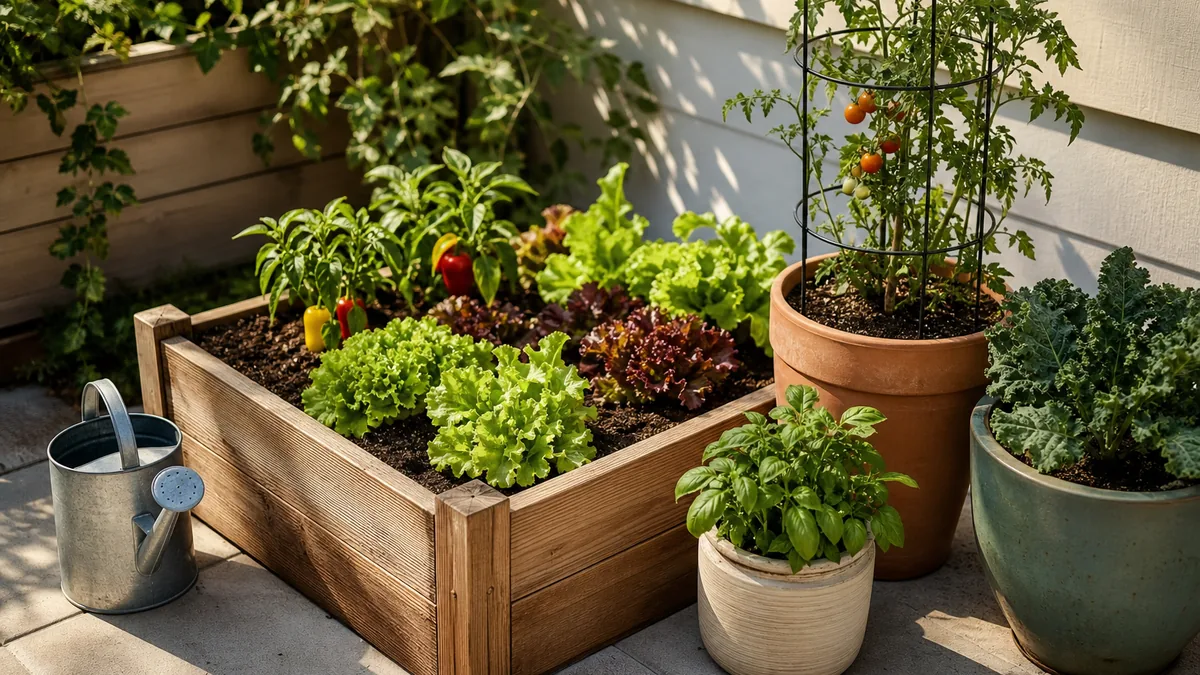
How Big Should a Small Vegetable Garden Be?
Smaller than most beginners expect. University of Maryland Extension calls 50 to 75 square feet a good starter size, and Iowa State Extension says many new gardeners benefit from starting even smaller, such as 4 by 8 feet. NC State Extension says to start small and expand as you have time and interest. Kansas State Extension adds that even a 100 square foot garden can produce a good portion of the vegetables for a family of four. The general beginner checklist is in how to start a vegetable garden; this guide stays with beds, pots and balconies.
Any plan, even a small one, needs a layout, planting dates and a shopping list. You can draw all three on paper with the steps below, or let the garden planner do it: the app lays out your beds square by square and works out the watering, the planting dates and the shopping list in one plan. A free demo is linked near the end, and the paper method works just as well without it.
The table turns those sizes into something you can build (soil quantities for other depths are in the 4 x 8 raised bed soil chart); a 4 by 4 frame is Wisconsin’s first-attempt size and 4 by 8 is Iowa State’s small start. The soil volumes are my arithmetic from the depths the sources give: University of Wisconsin Extension describes a frame no wider than 4 feet and 6 to 8 inches deep, and Oklahoma State Extension says about 4 feet is the maximum recommended raised bed width, because an adult can reach about 2 feet in from each side. A comparison of frame materials and bed layouts is in raised bed garden designs.
| Small garden | Growing area | Soil to fill it |
|---|---|---|
| 4 x 4 foot bed | 16 sq ft | 8 to 10.7 cu ft at 6 to 8 inches deep |
| 4 x 8 foot bed | 32 sq ft | 16 to 21.3 cu ft at 6 to 8 inches deep |
| One 5 gallon pot | Roughly 1 sq ft of floor | About 0.67 cu ft |
| Balcony or patio, 4 to 6 pots | About 4 to 8 sq ft of floor plus a trellis | 3 to 4 cu ft in total |
Where Should a Small Garden Go? Sun, Water and Weight
Sun decides what you can grow, and the sources give slightly different numbers. University of Maryland Extension says warm-season crops such as tomato, pepper, eggplant and squash want 6 to 8 hours of direct sun, while cool-season lettuce, spinach and Asian greens manage on 3 to 5 hours. NC State Extension’s small-space guide says leafy greens can grow on 3 to 6 hours and fruiting crops need at least 6, with morning sun best if the plant only gets part of the day. Colorado State Extension is stricter, saying fruiting vegetables in containers need at least 8 hours. Count the hours on your spot before you buy anything.
A balcony or patio adds practical limits. University of Maryland Extension says water access is essential and that drainage water can stain concrete and decking, so use saucers or self-watering containers. The same page says a 20 inch container with moist growing medium and plants can weigh about 100 pounds, so use plant caddies and check what your balcony allows before you stack several.
For a bed, run the long sides north to south where you can, with tall crops at the north end. Our guide to planning a vegetable garden covers orientation and a sample 4 by 8 plan, so this guide stays with what is specific to small spaces.
Small Garden for Beginners: A Bed or Containers?
Either works, and the choice usually comes down to what is under your feet. Iowa State Extension says containers are a great alternative if no good garden spot is available. Pick by these questions:
- Is there a patch of ground or room for a frame? A bed is more forgiving and is the better start if you can find 16 or 32 square feet with enough sun.
- Is the ground paved, shaded or poor? Use containers. Colorado State Extension says not to use native soil in pots because it compacts and limits oxygen to the roots.
Many small gardens use both: a 4 by 4 bed for lettuce, carrots and beans, and big pots for tomatoes and peppers. If you go with a frame, how to fill a raised garden bed explains what goes in it without overspending, and our beginner vegetable garden layouts have copyable 4 by 4 and 4 by 8 plans.
Veggie Garden for Beginners: Which Crops Earn Their Space?
Start with crops that are forgiving. University of Maryland Extension lists bush bean, tomato, cucumber, pepper, lettuce, summer squash and leafy greens such as Swiss chard and kale among the easiest vegetables, and Iowa State Extension adds leaf lettuce, kale, radish, basil and cilantro. For a pot or a 4 by 4 bed, University of Nebraska-Lincoln Extension names tomatoes, lettuce, turnips, summer squash and edible-pod peas as high-yielding choices, and says to pick compact or bush cultivars bred for containers.
Small space changes the ranking, because some crops take far more room than they return. Four kinds tend to pay off:
- Repeat-harvest greens. University of Wisconsin Extension calls arugula, kale, lettuce and spinach easy, repeat-harvest crops. Lettuce is a good first project, and picking leaves as you need them keeps a plant producing.
- Small roots. Carrots, beets and radishes fit tight spacing, and Purdue Extension’s band-planting table lists about 100 carrots or 144 radishes per square foot. Carrots from seed need a deep container or bed and even moisture to germinate.
- Climbers on a trellis. Kansas State Extension says pole beans need 5 to 6 feet of row per person against 15 to 16 feet for bush beans, and NC State Extension estimates that 6 to 8 feet of fence could yield enough cucumbers to eat fresh and to pickle. Pole and bush types are compared in how to grow beans from seed.
- Fruiting plants. University of Wisconsin Extension’s table gives one tomato or one pepper plant a single square foot, and a pot of that size or a trellis keeps them compact. Growing tomatoes in raised beds covers their spacing and depth.
Be wary of sprawlers. Rutgers Cooperative Extension’s planting guide lists pumpkins at 48 inches in the row and 96 inches between rows, and Kansas State Extension gives watermelon 72 to 90 inches between rows, nearly the whole length of a 4 by 8 bed. Potatoes are also a stretch: University of Maryland Extension and NC State Extension both list 30 gallons of potting mix for them. Summer squash overproduces, and the University of Nebraska-Lincoln guide says one plant for every one or two family members is probably enough.
How Much Will a Small Vegetable Garden Yield?
Extension yield figures are written per 10 feet of row, not per bed, and three publications disagree widely. This table shows what each says, so you can see the range rather than trust one number.
| Crop (yield per 10 ft of row) | Rutgers | Kansas State | Purdue |
|---|---|---|---|
| Tomatoes | 50 lb | 10 lb | 60 lb |
| Peppers | 12 lb | 6 lb | not listed |
| Snap beans, bush | 6 lb | 12 lb | 6 lb |
| Cucumbers | 8 lb | 12 lb | not listed |
| Summer squash | 25 fruit (bush squash) | 15 lb | not listed |
| Carrots | 10 lb | not listed | 10 lb |
| Leaf or head lettuce | 15 heads (leaf, romaine) | 10 heads (head) | 5 lb (leaf) |
The gap on tomatoes is the biggest. Rutgers lists 50 pounds and Purdue 60 pounds per 10 feet, while Kansas State lists 10. Rutgers spaces tomatoes 24 inches apart (five plants in 10 feet) and Kansas State 24 to 36 inches. By my arithmetic that is about 10 pounds a plant in the Rutgers figure and about 2 to 3 pounds a plant in Kansas State’s. Plan for the low number and treat the high one as a good year. Blossom end rot is one common way a tomato crop is lost.
To scale it to a bed, use spacing, not rows. University of Wisconsin Extension’s square-foot table puts one tomato or pepper plant, four lettuce, sixteen carrots and sixteen radishes in each square foot. A 4 by 4 bed has 16 of those squares, so four squares of lettuce, two of carrots, one of radishes, a few of bush beans and one each of tomato and pepper make a full first-year bed. Rutgers’ list also includes 24 pounds of kale, 14 pounds of beets and 7 pounds of spinach per 10 feet of row, which is why greens and roots earn their place.
What Size Container Do Vegetables Need?
Bigger is easier. NC State Extension says the larger the container, the easier it is to grow vegetables, and drainage holes are essential. Extension sources do not agree on the minimums, though, so the table shows two of them side by side.
| Crop | Virginia Tech minimum | NC State minimum |
|---|---|---|
| Tomato, full size | 5 gallons | 5 gallons |
| Pepper | 2 gallons | 2 gallons |
| Bush beans | 2 gallons | 2 gallons |
| Cucumber | 5 gallons | 1 gallon |
| Leaf lettuce | 1/2 gallon | 2 quarts, 6 to 8 inches deep |
| Carrots | 1 quart | 2 quarts, 10 inches deep |
| Radishes | 1 pint | 2 quarts, 4 to 6 inches deep |
The plant pot size chart turns gallons into diameters. Other sources run bigger. University of Wisconsin, Colorado State and Oklahoma State Extension all give 5 gallons for tomatoes, Wisconsin and Colorado State give 5 gallons for peppers, and Wisconsin says at least 2 gallons for leaf lettuce where Colorado State says 3. Virginia Tech lists cherry tomatoes at 1 gallon and summer squash and eggplant at 5. Use the larger figure for anything that sets heavy fruit, and the smaller one only for greens and roots you will harvest young. University of Maryland Extension groups it by plant size instead: 8 to 10 gallons and 12 to 16 inches deep for large vegetables, 4 to 6 gallons for medium ones, and 1 to 3 gallons for small ones.
How Much Soil Does a Small Garden Need?
Containers first. University of Wisconsin Extension says commercial potting mixes work well for most vegetables, and that bags come in 1, 2 or 2.8 cubic feet (7.5, 15 and 21 gallons). One 21 gallon bag therefore fills about four 5 gallon pots, by my arithmetic. Oklahoma State Extension advises leaving an inch or so between the mix and the rim, and not packing it tight, because roots need air. Wisconsin says not to put rocks or broken pottery in the bottom, since layering impedes drainage.
Use potting mix, not dirt from the yard. NC State Extension says for water-hungry plants such as tomatoes the mix should include vermiculite and compost for greater water-holding capacity, with compost limited to roughly 15 to 40 percent of the mix, and Colorado State Extension says never to reuse potting soil from a previous season.
For beds, University of Wisconsin Extension’s square-foot method is a mix of one half compost and one half peat moss, or 100 percent compost, with no soil needed. Oklahoma State Extension recommends a two inch layer of compost or other organic material each spring and fall, and alternate layers of compost and soil as ideal for framed beds. For a 4 by 8 foot bed, the total at 6 to 8 inches deep is 16 to 21 cubic feet (see the table above), and the full 4 x 8 raised bed soil chart works through other depths and bag sizes.
How Do You Water a Small Vegetable Garden?
Pots dry out far faster than beds, and that is the main chore of a small garden. University of Wisconsin Extension says to water until it runs out of the drainage holes, and that fruiting crops such as tomatoes, peppers, eggplant, zucchini and cucumbers will need watering daily. Oklahoma State Extension says containers may need water twice a day, depending on temperature, plant, medium and size. Colorado State Extension says containers should never dry out completely or the fine roots die, and that about 10 percent of the water should drain out the bottom to avoid salt buildup. University of Maryland Extension says to water when the top of the soil feels dry, and to avoid soggy soil.
Beds are easier. NC State Extension says that on average a vegetable garden needs 1 inch of water a week, minus whatever rain supplies, and that organic mulch conserves soil moisture. Oklahoma State Extension recommends drip irrigation in each raised bed, because overhead sprinklers also wet the paths and encourage weeds. University of Wisconsin Extension says to water at the base of the plant and try not to wet the leaves.
Three habits cut the work. Choose larger pots, which University of Nebraska-Lincoln Extension says hold more soil and dry out more slowly. Mulch the top of each pot; NC State Extension says a top dressing of mulch over the potting mix significantly reduces moisture loss. Avoid dark pots in full sun, since University of Maryland Extension says dark colors create higher temperatures that could injure young tender roots. For tomatoes, the amounts and schedule in how often to water tomatoes show how a weekly total becomes a routine.
How to Start a Small Garden for Beginners, Step by Step
This is the whole method for a first season, whether you use graph paper or an app.
- Count your sun. Watch the spot and note the hours of direct light. Under 6 hours means greens and roots; 6 to 8 or more means tomatoes and peppers can join.
- Pick the size. One 4 by 4 foot frame, or a 4 by 8, or 3 to 6 pots. Keep any bed no wider than 4 feet.
- Choose five or six crops you will eat. One fruiting plant, one climber, one or two greens, one root and one herb is a balanced start.
- Set the containers. Use the larger figure from the table above, drill or check drainage holes, and put heavy pots where they will stay.
- Fill with the right mix. Potting mix in pots, compost-rich mix in the frame, filled to an inch below the rim.
- Place the crops. Tall and trellised plants on the north side or the back, short crops in front, and thirsty plants near the tap.
- Plant at the right time. Cool-season crops early, warm-season ones after the last frost (see the next section).
- Mulch and water. Soak until water drains from pots; give beds about an inch a week from rain and watering together.
- Feed. NC State Extension says peppers and tomatoes want liquid fertilizer monthly, while heavy feeders such as cucumbers and squash want it every 2 weeks.
- Write it down. Note what you planted, the dates and what thrived, so next year starts from real data.
First Time Vegetable Garden: When Should You Plant?
Timing comes from frost, not the calendar. NC State Extension says warm-season vegetables are generally not planted in the ground until after the last frost date, while cool-season crops grow well in early spring and fall. University of Nebraska-Lincoln Extension says to plant containers at the same time you would plant an in-ground garden, or earlier in a protected, warm spot. Look up your own dates on the frost dates by place pages, or enter your ZIP code at the planting calendar by ZIP code to see this month’s list. When the date arrives, how to plant a garden walks through the planting day itself, from seed depth to watering in.
A small bed pays back the most when it never sits empty. Iowa State Extension says to sow new batches every 7 to 10 days to spread out the harvest of radish, carrots, beets, lettuce and beans, and to pair fast crops such as radishes with slow ones such as tomatoes (intercropping). Our guide to succession planting shows how to put a second crop in the spot an early one leaves behind. For spacing numbers by crop, the plant spacing pages list the in-row and between-row distances.
When you are ready to keep the layout, watering, planting dates and shopping list in one place, you can try the free demo of the Garden app, which plans a garden square by square. The paper method above works the same way without it.
5 free books · 120 pages, PDFs
Small Vegetable Garden FAQ
How do you start a small vegetable garden?
Pick a spot with at least 6 hours of sun, build one 4 by 4 foot bed or set out a few 5 gallon pots, fill them with potting mix or compost, and plant five or six crops. University of Wisconsin Extension suggests a single 4 by 4 frame for a first attempt, and University of Maryland Extension calls 50 to 75 square feet a good starter size.
How big should a small garden for beginners be?
A 4 by 4 or 4 by 8 foot bed is plenty. Iowa State Extension says many new gardeners benefit from starting even smaller than 100 square feet, such as 4 by 8 feet, and NC State Extension says to start small and expand as you have time and interest. Oklahoma State Extension says to keep beds about 4 feet wide at most.
What are the easiest vegetables for a first time vegetable garden?
Bush beans, tomatoes, cucumbers, peppers, lettuce, summer squash and leafy greens. That is University of Maryland Extension's list of some of the easiest vegetables. Iowa State Extension adds green beans, zucchini, radish, kale, basil and cilantro, and University of Nebraska-Lincoln Extension recommends compact or bush cultivars for containers.
How much sun does a small vegetable garden need?
At least 6 hours for tomatoes, peppers and other fruiting crops, and less for greens. University of Maryland Extension says 6 to 8 hours for warm-season crops and 3 to 5 hours for lettuce, spinach and Asian greens, while Colorado State Extension says fruiting vegetables in containers need at least 8 hours.
What size pot does a tomato need?
Five gallons for a full-size tomato. Virginia Tech Extension, NC State Extension, University of Wisconsin Extension and Oklahoma State Extension all give 5 gallons, and Virginia Tech lists cherry tomatoes at 1 gallon. A five gallon pot holds about 0.67 cubic feet of mix.
How often should I water vegetables in containers?
Usually every day in warm weather, and sometimes twice a day. University of Wisconsin Extension says fruiting crops in containers need daily watering, and Oklahoma State Extension says containers may need water twice a day depending on temperature, plant, medium and size. Water until it drains from the holes, and never let the pot dry out completely.
Sources & further reading
Size, site and crops: University of Maryland Extension, Iowa State Extension, NC State Extension Gardener Handbook, Vegetable Gardening, NC State Extension on vegetable gardening in small spaces, University of Nebraska-Lincoln Extension on gardening in small spaces and Oklahoma State Extension on raised beds.
Containers, soil and watering: Virginia Tech Extension, Vegetable Gardening in Containers, NC State Extension Gardener Handbook, Plants Grown in Containers, University of Wisconsin Extension on growing vegetables in containers, Colorado State Extension on container gardens, Oklahoma State Extension on container gardening, University of Maryland Extension on growing vegetables in containers and University of Maryland Extension on types of containers.
Yields and spacing: Rutgers Cooperative Extension, Planning a Vegetable Garden, Kansas State Extension, Vegetable Garden Planting Guide MF315, Purdue Extension HO-124, Small Plot and Intensive Gardening and University of Wisconsin Extension, Taylor County, on square foot gardening.
5 free books · 120 pages, PDFs
The Garden Starter Bundle
Sent