A beginner vegetable garden layout works best as beds no wider than 4 feet, with paths of 18 to 24 inches and tall crops on the north side. Colorado State Extension gives 3 to 4 feet as the bed width and those path widths, and Purdue Extension says to group tall crops at the north end. Our spacing and planting guides cover each crop in more depth.
What Is the Best Vegetable Garden Layout for a Beginner?
There is no single best vegetable garden layout, because the right one depends on your space, your soil and how you want to work. What extension sources agree on is the starting size. Texas A&M AgriLife Extension says making the garden too large is one of the most common mistakes of first-time gardeners, and Iowa State Extension calls about 100 square feet (10 by 10 feet) a manageable start while noting that many new gardeners begin smaller, such as 4 by 8 feet. The four plans below fit that range.
| Layout | Size | Spacing method | Pick it when |
|---|---|---|---|
| 1. Square bed | 4 × 4 ft, 16 sq ft | 1 foot grid squares | You want the smallest first try |
| 2. Raised bed | 4 × 8 ft, 32 sq ft | Short rows across the bed | Soil is poor or you want less bending |
| 3. Row garden | About 10 × 10 ft or more | Long rows with set gaps | You have open ground and may add a tiller |
| 4. Small plot | 10 × 10 ft, 100 sq ft | Two wide-row beds, one path | You have lawn or bare ground to convert |
This guide gives you the layouts. For crop choice, frost dates and a different 4 by 8 sample, see how to plan a vegetable garden, and if your space is a patio or a few containers, how to start a small vegetable garden is the closer match.
What Makes a Good Vegetable Garden Layout?
A good vegetable garden layout follows a handful of rules that hold for all four plans. Extension numbers for each:
- Sun. University of Wisconsin Extension (Taylor County) says 6 to 8 hours of sun a day, and Purdue Extension says at least 6 hours of direct sun in an open, level spot away from trees and shrubs.
- Bed width. Colorado State Extension says 3 to 4 feet, with 4 feet ideal for most vegetables because you can reach the middle from either side. UW Extension also caps a bed at 4 feet, or 2 feet if you can reach only one side. UGA Extension allows up to 5 feet for hand-worked beds, so the range is 3 to 5 feet.
- Paths. Colorado State says 18 to 24 inches, mulched with 3 to 4 inches of wood chips. UF/IFAS Gardening Solutions calls 3 feet a good aisle for square-foot beds, and UW Extension says 2 to 3 feet.
- Tall crops north. Purdue says to group sweet corn, tomatoes and pole beans at the north end, and Texas A&M says the same for okra, corn and tomatoes. UF/IFAS puts a trellis on the north outer edge so it does not shade the rest of the bed.
- Do not walk on the beds. UF/IFAS says to tend the bed from the aisles to avoid compacting the soil.
Direction is the one place the sources differ. Colorado State says east-west beds collect a little more heat and north-south beds give a little more summer light on both sides, and that neither is clearly better. Oregon State Extension says you can make either way work, and that shading matters most for winter vegetables because the sun is low. Both agree on putting the tall crops where they cannot shade the short ones. Paths and bed shapes for a whole yard, not only vegetables, are covered in how to plan a garden layout.
How Do You Lay Out a Vegetable Garden on Paper?
The same steps lay out any of the plans below. Use graph paper, one square per foot, and mark north first.
- Mark the site. Draw the area, a north arrow, the tap and any tree or fence that casts shade.
- Set the bed width. Draw beds 4 feet wide, or narrower if reaching is hard.
- Draw the paths. Leave 18 to 24 inches between beds, or more if you will push a cart.
- Put the tall crops at the north. Tomatoes, pole beans and trellises go on the north edge of the bed.
- Add short crops to the south. Lettuce, carrots, radishes and beets sit in front.
- Apply spacing and count plants. Use the numbers in the plans below, one square or one row at a time.
- Write the shopping list. Add up plants, seed packets and soil from the finished drawing.
A plan needs a layout, planting dates and a shopping list, and you can draw all three by hand. If you would rather not redraw it every year, the garden planner lays out your beds square by square and works out the watering, the planting dates and the shopping list in one plan. The paper method works just as well, and the goals, budget and records that sit around a layout are in how to plan a garden.
Plan 1: A 4 × 4 Foot Square Bed
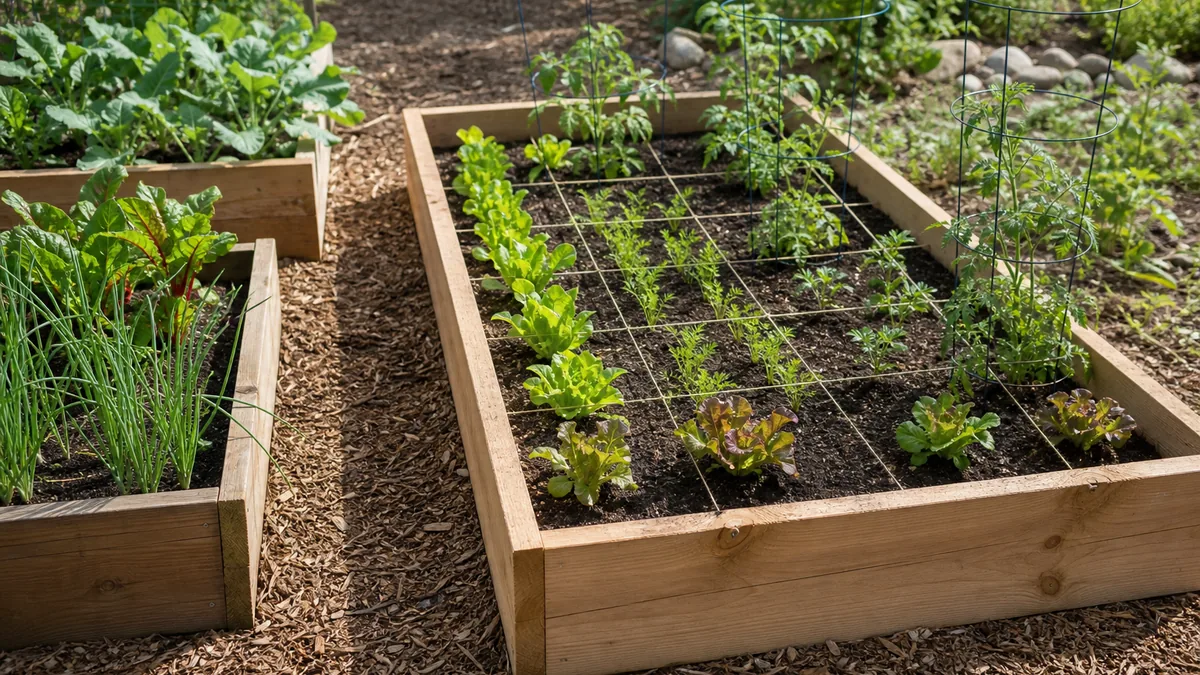
This is the smallest plan to copy. UF/IFAS Gardening Solutions calls 4 by 4 feet the typical planting area and divides it into sixteen 1 foot squares, and UW Extension recommends a 4 by 4 frame for a first bed. The north row holds the tall crops, and the counts come from the two sources’ plants per square foot lists.
| Row | West squares | East squares |
|---|---|---|
| 1 (north) | 2 squares: 1 caged tomato | 2 squares: 2 peppers |
| 2 | 2 squares: bush beans, 5 per square | 2 squares: chard, 4 per square |
| 3 | 2 squares: leaf lettuce, 4 per square | 2 squares: beets, 9 per square |
| 4 (south) | 2 squares: carrots, 16 per square | 2 squares: radishes, 16 per square |
The totals are 1 tomato, 2 peppers, 10 bush beans, 8 chard, 8 lettuce, 18 beets, 32 carrots and 32 radishes. The tomato gets two squares because Purdue Extension lists tomato plants 24 inches apart in the row, more than the one square both grid sources assign. Sources also disagree on some crops. UW Extension puts string beans at 5 per square and UF/IFAS at 9, and spinach is 9 per square in one and 4 in the other. Start with the wider number and tighten it only once the plants fill in. The crops that finish early, such as lettuce and radishes, free their squares for a second sowing, and carrots need their square kept evenly moist to germinate.
Plan 2: A 4 × 8 Foot Raised Bed With Rows Across
Colorado State Extension’s block-style layout swaps one long row for short rows across a 4 foot bed. Its raised-bed guide uses beds 4 feet wide with rows running across, and it says block layouts can increase yields fivefold compared with a traditional row garden. This plan runs the 8 foot length north to south and uses the Colorado State within-row numbers. How far to leave between different crops is my own arrangement, roughly the wider of the two neighbors’ spacing. For other bed shapes, path widths and frame materials, see raised bed garden designs.
| Bed length used | Crop | Spacing (Colorado State) | Plants |
|---|---|---|---|
| 0 to 2 ft (north) | Tomatoes, trellised single row | At least 24 in apart | 2 |
| 2 to 3.5 ft | Peppers, one row | 3 across the bed | 3 |
| 3.5 to 5 ft | Bush beans, double row | Rows 12 in apart, 4 in between plants | 24 |
| 5 to 6.5 ft | Leaf lettuce, two rows | 7 to 9 in each way | About 12 |
| 6.5 to 8 ft (south) | Carrots, block | 3 in centers | Up to 96 |
Colorado State puts tomatoes in a strip 24 to 36 inches wide with one row down the middle, and beans in a strip about 24 inches wide, single or double. The pepper numbers differ inside Colorado State’s own pages, 15 by 15 inches in one and rows 18 inches apart in another, so use 15 to 18 inches. For more on a bed like this, growing tomatoes in raised beds covers depth and blossom end rot, and how to grow beans from seed covers the bean row.
Depth matters for a raised bed. Colorado State says 8 to 12 inches of soil is the minimum where the subsoil is unsuitable. University of Maryland Extension, writing about beds on hard surfaces, says at least 8 inches for leafy greens, beans and cucumbers and 12 to 24 inches for peppers, tomatoes and squash. For the fill, see how much soil a 4 x 8 raised bed takes and how to fill a raised garden bed.
Plan 3: A Traditional Row Garden
Rows suit open ground, and the spacing comes from Purdue Extension’s planting table. Texas A&M AgriLife says most vegetables need at least 3 feet between rows, and UGA Extension says rows should be at least 36 inches wide if a rotary tiller will pass between them, with 60 to 72 inches for vining crops. Purdue’s table uses gaps of 1 to 2 feet for small crops such as carrots, lettuce and beans.
The plan below uses six rows, each 10 feet long, running east to west so the tomato row is the north edge. Each gap is the wider of the two neighbors, my own rule for mixing crops. Purdue footnotes that large gardens should adjust row distance to their equipment.
| Row | Crop | Gap from row before | In the row (Purdue) | Plants in 10 ft |
|---|---|---|---|---|
| 1 (north) | Tomato plants | None | 24 in | 5 |
| 2 | Pepper plants | 4 ft | 18 in | 6 |
| 3 | Bush snap beans | 2 ft | 2 in | Up to 60 |
| 4 | Carrots | 2 ft | 2 in | Up to 60 |
| 5 | Leaf lettuce | 1 ft | 4 in | 30 |
| 6 (south) | Radishes | 1 ft | 1 in | Up to 120 |
The rows add up to 10 feet front to back, so with a little margin the plot is about 10 by 11 feet. Purdue’s in-row distances are final spacing, so sow carrots and radishes thicker and thin them, and note that peppers and tomatoes go in as plants after the last frost. The bean row is sown the same way as in the raised bed, and the plant spacing pages list the in-row and between-row distances for individual crops. Sweet corn does not fit this plan, because Purdue and UGA both say corn pollinates better in blocks of several short rows than in one long row.
Plan 4: A Small In-Ground Plot (10 × 10 Feet)
This plan takes Iowa State Extension’s 100 square foot start and avoids wasting ground on aisles. Iowa State suggests wider rows of 2 to 3 plants to cut the space spent on aisles. Two beds 4 feet wide and 10 feet long with one 2 foot path between them add up to 10 feet, and the 2 foot path sits inside Colorado State’s 18 to 24 inch range. Run the beds east to west and the north bed gets the tall crops.
North bed (4 × 10 feet). Along the back edge, plant 3 tomatoes at least 24 inches apart (Colorado State) in cages or on a trellis, which takes 6 feet, then 4 feet of pole beans in a single row thinned to 4 inches (Colorado State), about 12 plants. SDSU Extension notes pole beans can grow 6 feet tall or more, so they belong at the north. In the front half, put 4 peppers 15 inches apart across 5 feet, then 5 feet of bush beans in a double row.
South bed (4 × 10 feet). Split the width into three bands of about 16 inches, planted as wide rows. SDSU Extension says wide rows can be 12 to 18 inches wide and suit leafy greens, and that carrots, beets and onions do well as three rows 6 to 8 inches apart. Use one band of carrots, one of beets and one of leaf lettuce, with a foot-wide row of radishes where a band empties early. You never need to step into a 4 foot bed, since you can reach 2 feet from each side.
Fill the path and cover the soil before you plant. Colorado State recommends wood chips 3 to 4 inches deep on walkways. In-ground beds also need good soil, so test it first and read the report with how to read soil test results.
Iowa State Extension says to sow every 7 to 10 days to spread out harvests of crops like radishes, carrots, beets, lettuce and beans, and our guide to succession planting shows how to refill a band once it empties. Which crops to put side by side is its own question, and companion planting garden layouts works through bed plans that pair crops on purpose.
How Do You Plan a Vegetable Garden Layout Across the Season?
A layout also has a calendar. Warm-season crops such as tomatoes and peppers go in after your last spring frost, and cool-season crops such as lettuce, radishes and carrots can go in earlier. Look up your own dates on the frost dates pages or enter your ZIP code at the planting calendar by ZIP code, then write the date next to each crop on your drawing. Mark which sections you will replant after an early crop finishes. When planting day comes, how to plant a garden gives the seed depths, transplant steps and watering to follow once the drawing is on the ground.
Keep the drawing. University of Delaware Extension says to rotate crops so similar vegetables are not planted in the same location consecutively, if possible, and a saved drawing of each year’s layout makes that easy. If you want the layout, watering, planting dates and shopping list kept together, you can try the free demo of the Garden app, which plans a garden square by square. The sketches above work on paper if you prefer.
5 free books · 120 pages, PDFs
Vegetable Garden Layout FAQ
What is the best vegetable garden layout for beginners?
A small bed with sun and easy reach is the best start. Colorado State Extension says 4 feet is the ideal bed width, and Iowa State Extension calls about 100 square feet (10 by 10 feet) a manageable start, with 4 by 8 feet an easier one. Choose a 4 by 4 square bed, a 4 by 8 raised bed, a short row garden or a 10 by 10 plot.
How do you lay out a vegetable garden?
Mark north, draw beds no wider than 4 feet, add paths of 18 to 24 inches, then put tall crops on the north side and short crops in front. Colorado State Extension gives those bed and path widths, and Purdue Extension says to group tall crops at the north end. Finish by counting plants from the spacing numbers.
How do you plan a vegetable garden layout?
Draw the site to scale, choose crops, size the beds and then apply spacing. Texas A&M AgriLife Extension says garden size should match your room, time and reasons for gardening, and warns that too large a garden is a common first-time mistake. Start with a small bed and expand it later.
How far apart should vegetable garden rows be?
At least 3 feet for most vegetables in a large row garden. Texas A&M AgriLife Extension says most need at least 3 feet between rows, and UGA Extension says 36 inches if a tiller will pass between them. Purdue Extension's table allows 1 to 2 feet for small crops like carrots, lettuce and beans in a hand-worked garden.
How wide should a vegetable garden bed be?
Between 3 and 4 feet is the usual answer. Colorado State Extension says 3 to 4 feet, with 4 feet ideal, and University of Wisconsin Extension caps a square-foot bed at 4 feet, or 2 feet if only one side is reachable. UGA Extension allows up to 5 feet for hand-worked beds.
Which direction should vegetable garden beds face?
Either direction can work, as long as tall crops sit on the north side. Colorado State Extension says neither east-west nor north-south is clearly better, and Oregon State Extension says you can make either work. Purdue Extension says to group tall crops such as corn, tomatoes and pole beans at the north end.
Sources & further reading
Layouts and spacing: Colorado State Extension, Block Style Layout in Raised Bed Vegetable Gardens, Colorado State Extension, Sample Planting Guide for Raised-Bed Garden, Purdue Extension HO-32-W, UW Extension Taylor County on square foot gardening and UF/IFAS Gardening Solutions on square foot gardening.
Size, rows and orientation: Iowa State Extension on planning your vegetable garden, Texas A&M AgriLife Extension, Planning a Garden, UGA Extension on garden row width, Oregon State Extension on row placement, SDSU Extension on using garden space efficiently and University of Maryland Extension on raised beds and University of Delaware Extension on planning a vegetable garden.
5 free books · 120 pages, PDFs
The Garden Starter Bundle
Sent