Garden planning starts with the site, not the plants: find a spot with at least 6 hours of direct sun (Oklahoma State Extension’s line for full sun), test the soil, then choose plants, lay out beds and set dates from your last frost. Our spacing and planting guides go deeper on each step.
Garden Plan Quick Reference
A garden plan needs three things: a layout, dates and a shopping list. You can make all three on paper with the steps in this guide, and if you would rather not draw it, the garden planner lays out your beds square by square and works out the watering, the planting dates and the shopping list in one plan. There is a free demo near the end. Growing only vegetables? Our vegetable garden plan has crop-by-crop spacing; this guide covers any garden, including flowers, herbs and mixed beds.
| Planning step | Number to use | Source |
|---|---|---|
| Full sun | 6 or more hours (Oklahoma State); 6 to 8 hours (NC State handout) | Oklahoma State, NC State |
| Vegetables | At least 6 to 8 hours; 8 to 10 is ideal | Penn State, NC State |
| Soil sample | 6 to 8 inches deep; 10 to 15 cores for a large area | Purdue |
| Vegetable pH | 6.0 to 6.5 | NC State |
| Starter size | 50 to 75 square feet | University of Maryland |
| Water | About 1 inch a week for vegetables | NC State |
| Perennial border | 6 to 8 feet wide, about twice the tallest plant’s height | Mississippi State |
| Mulch | 2 to 3 inches after planting | Penn State |
How Do You Plan a Garden? Start With What You Want From It
Planning a garden begins with a purpose, because purpose decides size, sun and plants. Oklahoma State Extension’s landscape planning fact sheet names three core steps: evaluate the site, identify your goals and sketch a bubble diagram that gives each use its own area. It adds that there is no correct sequence, and that planning is fluid. Its goals step asks you to list the activities you want, and how many people will use each area, then to involve everyone in the household. If you are brand new to all of this, how to start a garden covers the first-season decisions in plain steps.
Penn State Extension makes the same point for flower beds: decide first whether the bed is for viewing from a deck, for pollinators or for fragrance near a seat. For vegetables, Michigan State University Extension says to plan the garden on paper first and to limit the first year to just a few kinds of vegetables, because a large, varied garden can overwhelm a new gardener. University of Maryland Extension adds a useful filter: grow crops you like to eat and ones that are costly to buy.
Write your goals as a short list. For example: fresh salad greens, cut flowers for the table, a herb corner by the kitchen door, and one low-maintenance bed. Oklahoma State also suggests marking service areas such as compost and storage on the plan, so they do not end up in your best light.
Where Should I Put My Garden? Sun, Slope and Site
Sun comes first, and the definitions vary slightly. Oklahoma State Extension calls full sun 6 or more direct hours a day, part sun 4 to 6 hours and shade less than 4 hours. A NC State Extension handout gives full sun as 6 to 8 hours, part sun or part shade as 3 to 6 hours and full shade as less than 3 hours. Both agree on the 6-hour line. For crops, Penn State Extension says most vegetables and flowers need at least 6 to 8 hours of full sun every day, and NC State’s vegetable chapter says at least 6 hours, with 8 to 10 hours ideal.
Water shapes the site too. NC State says vegetable gardens need about 1 inch of water a week on average, minus rain. If the tap is far away, plan a barrel: our guide to a rainwater collection system shows how to build one.
Back to the light, and do not guess it. The NC State handout describes a simple method: start early in the morning, and each hour draw the sun and shade line on a graph-paper sketch of the garden, labeling the time. A day of lines shows how many sun hours each area gets. It warns that the sun’s angle changes with the seasons, so a map made in one season may not hold in another, which is why a spring map is worth repeating in summer.
Oklahoma State’s site analysis adds more to check. Low spots stay wet and get more frost, hot spots form near south-facing walls, and areas under roof overhangs tend to stay dry. Note wind, slopes and views as well. University of Maryland Extension recommends level ground away from the shade of trees, shrubs and buildings, and says easy access to water is essential. For herbs, Mississippi State Extension suggests a spot near a water outlet or near the kitchen, and University of Missouri Extension gives 6 to 8 hours of full sun for the best oil production.
What Should I Know About My Garden Soil Before I Plan?
Test it, then plan the beds around the result. University of Maryland Extension describes good garden soil as deep, crumbly, well drained and rich in organic matter, and says to test for nutrients, pH and lead, which should read less than 400 ppm. Purdue Extension says to sample gardens and flower beds to a depth of 6 to 8 inches, to take 10 to 15 cores for a large area or 4 to 6 for a narrow border, to mix the cores in a clean pail and to send about one pint. Our guide to reading soil test results explains the report that comes back.
A quick feel test helps while you wait. Oklahoma State says sandy soil feels gritty and drains quickly, clay feels smooth and drains slowly, and silt is powdery. Clay and sand call for different fixes, and the plan should show them. For clay, Oklahoma State says to mix in 3 to 4 inches of organic matter. On bare ground, University of Maryland says to dig in at least two inches of compost. Where lawn is in the way, Maryland suggests smothering it with cardboard or newspaper and adding a 2 to 4 inch layer of compost on top, and Penn State describes solarizing it under plastic for several weeks.
The pH target depends on what you grow, and sources do not agree for herbs. NC State gives 6.0 to 6.5 as the ideal for most vegetables. University of Missouri Extension says a pH of 6.5 to 7.0 produces the best herbs, while Mississippi State Extension says to aim for around 6.0 to 6.5. Your soil test tells you where you start, and the lower end of both ranges is safe for a mixed bed.
If the soil is poor or drains badly, raised beds are the shared fix. Mississippi State says raised beds or containers are the usual answer for herbs that fail in clay or wet weather, and Penn State lists raised beds for less-than-ideal soil. Be careful what you buy to fill them. The difference between topsoil and garden soil matters for a bed, and the soil type calculator can check what you already have.
What Should I Grow? Vegetables, Flowers and Herbs
Match each plant to a spot you have already measured. A shady corner needs a plant that wants part sun, not a tomato. Keep the first list short: Michigan State Extension says to limit yourself to a few vegetables the first year, and University of Maryland Extension calls 50 to 75 square feet a good starter size. NC State Extension says about 1,050 square feet should be adequate for a family of four, which is a different project from a salad bed. Our guides to starting a small vegetable garden and vegetable garden layouts for beginners show what that looks like in a small space.
Flowers
Penn State Extension advises varying plant height, density and bloom time so color lasts all season, and choosing plants hardy to your USDA Plant Hardiness Zone. It also prefers native plants, since some non-natives can become invasive. Penn State suggests buying one or two of each perennial and letting them spread, which in its example gives the bed you imagined in three years, or buying more for faster results. Annuals fill the gaps, and companion planting flowers with vegetables shows which blooms earn a place in the vegetable beds.
Herbs
Most herbs want sun and drainage. Mississippi State Extension notes that a few herbs may be easier in containers or an existing bed than in a dedicated herb garden, which needs regular weeding and watering. University of Missouri Extension warns that overly rich soil can produce excessive foliage that is poor in flavor, and gives spacing that varies by herb, such as 8 inches for cilantro. Growing cilantro covers that one in detail.
A mixed garden
Mississippi State describes informal herb gardens that mix herbs with perennials, bulbs and vegetables, and that is a fair model for any small yard. Group plants with similar sun and water needs together, and put the thirstiest ones nearest the tap.
How Do You Lay Out a Garden Plan? Beds, Paths and Heights
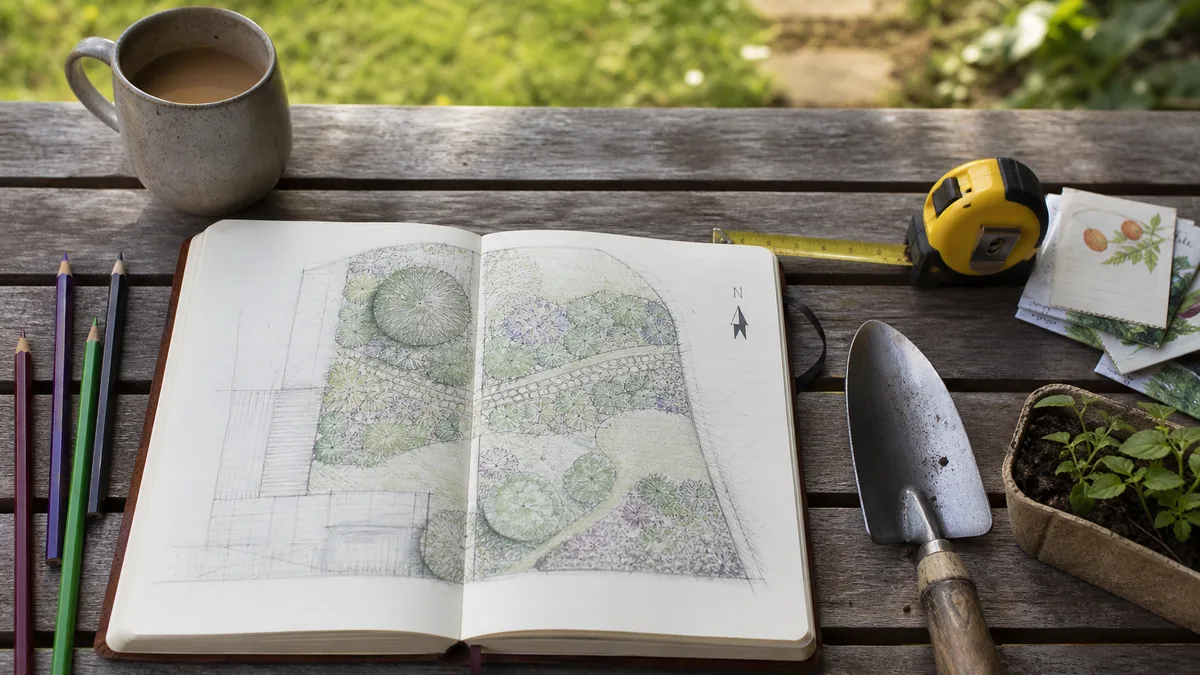
Draw it to scale. NC State Extension suggests graph paper or a scale so you can accurately draw the size of beds and plants, and Mississippi State Extension suggests letting each square stand for a set measurement such as six inches. Oklahoma State says any drawing that makes sense to you is adequate, and to mark the house, fences, taps and existing plants first. Our guide to how to plan a garden layout goes through bed shapes, paths and focal points in detail, so the notes here stay short.
For flower beds, Mississippi State Extension says perennial borders are often 6 to 8 feet wide, with room for six or more species, and to keep the planting width about twice the height of the tallest plant. It puts tall plants at the back of a border and in the center of an island bed, with short plants in front. Penn State’s example leaves 4 feet between the beds and the hedge behind, uses 4 foot paths between beds, and makes round beds 8 feet across so you can reach the center from a 4 foot radius. For vegetables, University of Maryland Extension puts taller crops on the north and west sides so they do not shade shorter ones.
Put the work areas where you will use them. Oklahoma State adds an irrigation plan once the bubbles turn into shapes. Mark the tap, the hose reach and the compost bin on the drawing before you place a single plant.
When Do I Plant What? Build the Calendar Into the Plan
Anchor the calendar to your average last spring frost. NOAA’s climate.gov defines the last spring freeze as the date after which temperatures stay above 32°F for the rest of the season. Its map, built on the 1991 to 2020 NOAA climate normals, shows the date when the chance of freezing drops below 50 percent, and it warns that the exact date varies and is only known well after it has passed. Our comparison of Farmer’s Almanac and NOAA frost dates explains why two sources can give different dates for one town, and the site’s frost dates by place list the NOAA-based numbers.
University of Vermont Extension adds that your growing season is the number of days between the last spring frost and the first autumn frost, and that it tells you which vegetables will mature in time. It also says to check your hardiness zone before buying perennials. NC State says warm-season vegetables are generally not planted until after the last frost date, and for fall planting says to count back from the frost date using each crop’s days to maturity. Michigan State notes that cool-season crops go in during early spring and finish by mid-summer, and that succession planting can give two or three crops in a given area in one season. Succession planting shows how to schedule the second crop.
Enter your ZIP code at the planting calendar by ZIP code to see what to plant this month.
Planning a Garden on a Budget: What Does It Cost?
The sources give tips, not dollar totals, so price your own list. Michigan State Extension warns that costs for tools, fertilizer and water can add up quickly even in a small vegetable garden, and says the trick is limiting costs while maximizing yield. University of Vermont Extension says to buy what you need first and what you want only once you are sure you will use it, and that better tools cost more but are less likely to need replacing.
- Start from seed. Oregon State Extension says seed packets can contain 100 seeds, so starting your own plants saves money over time, even after lights and trays. Michigan State says most seeds can be stored for at least one or two years.
- Buy smaller plants. Oregon State says to choose a 4-inch pot over a 1-gallon plant, or a 1-gallon over a 5-gallon, because smaller plants usually catch up in a season or two.
- Shop the sales. Oregon State lists spring community and Master Gardener plant sales and nursery markdowns in late summer and late fall.
- Test before you amend. University of Vermont says a soil test means you buy only the amendments and fertilizer your soil needs.
- Pick perennials for repeat color. University of Vermont says perennials return each year, and annuals cost less to fill gaps while perennials grow in.
- Make compost and share mulch. Oregon State says compost takes time but saves a lot of money, and suggests splitting a mulch delivery with a neighbor or asking arborists for wood chips.
Compost is the easiest saving to plan for. What can you compost lists what goes in the pile, and the compost calculator sizes a bin or a bed top-dressing for your plan.
How to Plan a Garden for Beginners, Step by Step
This is the whole method in order. Oklahoma State Extension says the sequence is flexible, so loop back whenever a step changes an earlier one. Once the plan is finished, how to plant a garden takes you through planting day itself, from bed prep to mulch.
- Write your goals. What the garden is for, who uses it, and how much time you have each week.
- Draw a base map. The house, fences, taps, trees and slopes, to scale on graph paper.
- Map the sun. Mark sun and shade each hour for a day, then label each area full sun, part sun or shade.
- Test the soil. Take a sample 6 to 8 inches deep, check drainage and decide where raised beds help.
- Choose plants for each spot. A short list of vegetables, flowers and herbs that fit the light and soil you found.
- Place beds and paths. Beds you can reach across, tall plants where they will not shade the rest, water close by.
- Set the dates. Write the average last spring frost and first fall frost on the plan, then work out each planting date.
- Price the list. Plants, seed, compost, mulch and supports, counted from the plan.
- Start a record. Save the map and what you planted so next year’s plan starts from real data.
Garden Planning Tips and Record Keeping
A few garden planning tips save the most grief. Plan for less than you think you can manage, since Maryland, Michigan State and NC State all say to start small and expand. Put water where it is needed before you plant. Cover the soil, and avoid the common mulch mistakes: Penn State says to add a 2 to 3 inch layer of mulch after planting and to water at least daily for a week. NC State says to avoid planting related vegetables in the same location more often than once every three years, so mapping each year’s beds matters.
Iowa State Extension says a garden journal can hold planting dates and locations, seed-starting and harvest dates, harvest amounts, favorite varieties, garden maps and dimensions, crop rotation plans, problem weeds, insects and diseases, and fertilizer applications. It also lists weather conditions, bloom times, plant sources and to-do lists for next season. A page per bed, with a copy of the map, covers most of that.
If you want the layout, watering, planting dates and shopping list kept in one place, you can try the free demo of the Garden app, which plans your garden square by square. The paper method above works the same way without it.
5 free books · 120 pages, PDFs
Garden Planning FAQ
How do you plan a garden for beginners?
Start with a goal, a sunny spot and a small plot, then add soil, plants, layout and dates. University of Maryland Extension calls 50 to 75 square feet a good starter size, and Michigan State University Extension says to limit the first year to a few kinds of vegetables and to plan on paper first.
What is the first thing to do when planning a garden?
Evaluate the site and identify your goals. Oklahoma State Extension names a site evaluation, goals and a bubble diagram as the three core planning steps, and says there is no correct sequence. Mapping the sun is a good first task, since it limits everything else.
How much sun does a garden need?
Most gardens need at least 6 hours of direct sun a day. Oklahoma State Extension calls 6 or more hours full sun, and Penn State Extension says most vegetables and flowers need at least 6 to 8 hours. NC State Extension says 8 to 10 hours is ideal for vegetables.
How do I plan my garden on paper?
Use graph paper and draw the site to scale. NC State Extension suggests graph paper so you can draw beds and plants accurately, and Mississippi State Extension suggests each square stand for a set measure such as six inches. Add sun lines, then beds, paths and a plant list.
How big should a garden plan be?
For a first season, 50 to 75 square feet is plenty. University of Maryland Extension gives that range as a good starter size. NC State Extension says about 1,050 square feet should be adequate to supply a family of four, so size follows your goal.
How do I plan planting dates in a garden?
Use your average last spring frost as the anchor. NOAA's climate.gov defines the last spring freeze as the date after which temperatures stay above freezing for the rest of the season, and NC State Extension says warm-season vegetables generally go in after the last frost date.
Sources & further reading
Planning, goals and site: Oklahoma State Extension, Planning the Landscape, Penn State Extension, Beginning a Vegetable Garden, University of Maryland Extension, NC State Extension Gardener Handbook, Vegetable Gardening, NC State Extension, Sun to Shade handout and Michigan State University Extension.
Soil, flowers and herbs: Purdue Extension, Collecting a Soil Sample, Oklahoma State Extension, Six Steps to a Successful Vegetable Garden, Penn State Extension, Starting a New Perennial Garden, Mississippi State Extension, Designing Perennial Plantings, Mississippi State Extension, Herb Gardens for Mississippi and University of Missouri Extension, Herbs.
Dates, budget and records: NOAA climate.gov on the last spring freeze, Oregon State Extension, How to Cut Spending on Your Garden, University of Vermont Extension, Budget-Friendly Gardening Tips and Iowa State Extension on garden journaling.
5 free books · 120 pages, PDFs
The Garden Starter Bundle
Sent