A good gardening layout puts the garden where it gets 6 or more hours of sun (Oklahoma State Extension), keeps beds 3 to 4 feet wide so you can reach the middle (Clemson Extension), and leaves main paths at least 3 feet wide for a wheelbarrow (Washington State Extension). Our spacing and planting guides cover what goes in the beds.
How to Plan a Garden Layout: Quick Reference
| Layout question | Number to use | Source |
|---|---|---|
| Full sun | 6 or more hours of direct sun; part sun 4 to 6; shade under 4 | Oklahoma State |
| Bed you reach into | 3 to 4 feet wide; 3 feet for children | Clemson, Colorado State, Oregon State |
| Flower border | 6 feet wide or more, reachable from two sides | Colorado State |
| Paths | 18 to 24 inches at the narrowest; 3 feet or more for a wheelbarrow | Colorado State, Arizona, WSU |
| Direction | North to south for even light, though sources differ | Oklahoma State, Colorado State |
| Water | Near a tap or in reach of a hose; drip suits beds | UGA, K-State, Clemson |
| Drawing scale | 1 inch = 4 feet on graph paper | Colorado State |
A plan is more than a sketch. It needs a layout, planting dates and a shopping list, and you can make all three on paper with the steps below. If you would rather not draw it, the garden planner lays out your beds square by square and works out the watering, the planting dates and the shopping list in one plan, and there is a free demo near the end of this guide.
How to Layout a Garden on Paper: Start With a Base Map
Planning a garden layout starts with a drawing of what is already there. Oklahoma State Extension says to draw the site to scale as best you can, on grid paper, showing the house, walkways, drives, patios, fences and tree canopies. Colorado State Extension suggests graph paper at 1 inch = 4 feet and measuring from a fixed reference point, such as a house or patio corner. UGA Extension adds that you should mark each buried utility on the plan in a different color, and that free utility location is available before major work. Oklahoma State points to its own state call line, so use the one for your area.
Then make several photocopies and work in pencil. Oklahoma State suggests drawing bubbles for each use, such as beds, seating, compost and storage, sized roughly like the real areas, and making several bubble drawings before choosing one. Arizona Extension suggests a wish list ranked A, B and C, so the big wants get space first. NC State Extension says good garden design is not rushed in one season and recommends walking the property through a full year, noting where water flows after rain and which spots the sun reaches.
Decide what the garden is for before you size anything. Goals, soil, budget and records are covered in our guide on how to plan a garden, and this guide stays on the layout itself: where beds, paths, sun and water go.
Where Should I Put My Garden? Sun, Drainage and Access
Sun sets the limits, and sources give a range. Oklahoma State Extension defines full sun as 6 or more hours of direct sunlight a day, part sun as 4 to 6 and shade as under 4. UGA Extension says full-sun plants need at least 6 to 8 hours. Clemson Extension wants a minimum of six hours for raised beds, and Kansas State Extension says full sun is best, with at least a half day as the fallback. Washington State Extension says most summer vegetables need at least eight hours, and Colorado State Extension says many perennials want 8 hours or more at the height of summer. Record the hours each spot gets, as UGA suggests, and remember that winter sun sits lower and shadows are longer.
Shade is not a dead end. Clemson Extension says almost all herbs grow best with at least six hours of sun, while parsley and mint tolerate partial shade. UGA Extension says chives, parsley, mint and berries handle less light than fruiting vegetables, and Colorado State points to ferns, bleeding heart and hostas for the north side of a house.
Drainage comes next. UGA Extension says to run a drainage test in several spots, because it can vary across a site, and to watch the site during a heavy rain to see where water ponds. Oklahoma State Extension notes that low spots stay wet and get more frost than higher ground. A soil test tells you what the ground holds, and our guide to reading soil test results explains the report.
Finally, access. UGA Extension says the closer and more convenient a garden is to your home, the better you will care for it, and Clemson Extension suggests placing beds where you pass daily so you spot pests and disease early. Put the garden where you will see it, not behind the shed.
How Wide Should Garden Beds Be?
Wide enough to plant, narrow enough to reach. Clemson Extension says a raised bed should be only as wide as you can work from either side to the middle, 3 to 4 feet. Oklahoma State Extension gives about four feet as the maximum recommended width, because the average adult can reach about two feet in from each side. Kansas State Extension says a 4 foot width is preferred, with 4 by 8 or 4 by 10 foot beds as typical sizes, and Colorado State Extension says to design beds three to four feet wide and any length. Oregon State Extension keeps children in mind, with no more than 4 feet for adults and 3 feet for children. Frame materials, tall accessible beds and other bed shapes are covered in raised bed garden designs.
Flower borders follow a different rule because you often view them from one side. Colorado State Extension says perennial beds 6 feet wide or wider look most pleasing and should be reachable from at least two sides, with stepping stones in larger beds so you do not compact the soil. That suggests a simple rule: a bed you work from the edge stays at 4 feet or less, while a deep border needs stepping stones or a back path.
Height depends on the bed type. Kansas State Extension says raised beds are usually raised 6 to 8 inches, and Oklahoma State says about six inches above grade noticeably improves drainage. Clemson Extension gives 4 to 8 inches for unlined mounded beds. Length is flexible, and Oklahoma State calls eight feet an average. If you build frames, our guides on soil for a 4 x 8 raised bed and how to fill a raised garden bed turn the dimensions into a fill plan.
How Wide Should Garden Paths Be?
Here sources disagree, so choose by what you will push through the gap. Colorado State Extension says to make walkways between beds 18 to 24 inches wide. Clemson Extension says 3 to 4 feet is comfortable for most pathways between enclosed beds, and 2 to 3 feet between unlined mounded beds. Arizona Extension says paths should be no less than 3 feet if you use a wheelbarrow or want to walk two abreast, and Washington State Extension says main pathways should be at least 3 feet wide for a wheelbarrow. For wheelchairs, Oregon State Extension recommends 3 to 4 feet.
WSU adds a personal test: set the path so you can kneel or stand at the bed edge without stepping into the bed, which it measures from your knee to your shoe toe. A workable layout often mixes widths, with wide main paths where the barrow rolls and narrow ones between beds you work by hand. Where children help, WSU suggests stepping stones across beds about every 10 feet.
The surface matters too. Colorado State Extension suggests mulching walkways with grass clippings, wood chips or other organic mulch, and says three to four inches of chips reduces compaction from foot traffic. Our comparison of organic and inorganic mulch helps you choose, and 8 mulch mistakes that hurt plants covers depth and placement.
Which Direction Should Garden Beds Run?
Oklahoma State Extension says to build beds in a north to south direction for the best light, with taller plants on the north side so they do not shade shorter ones. Colorado State Extension is less certain. It says there is no clear winner, that east to west beds collect more heat, which helps with frost protection, and that north to south beds get sun on both sides of the row in summer. Pick the direction that fits your lot, then handle the tall plants.
For flowers, Colorado State Extension says to put taller plants at the back of a bed, or in the middle if the bed is seen from several sides, with shorter plants in front. Wind is a second layout input. Kansas State Extension suggests a windbreak on the south or southwest side to protect against harsh summer winds, and WSU says a windbreak should protect the garden without shading it.
If the garden is mostly vegetables, our vegetable garden plan gives a sample 4 x 8 bed with a planting window for each row, and vegetable garden layouts for beginners has copyable bed designs. This guide applies to any bed.
How Do I Design a Garden Layout for Water?
Put the water in the plan at the start. UGA Extension says to make sure the garden has access to water or use a hose long enough to reach the plants, and Kansas State Extension says a bed should be near a water source. Clemson Extension warns that raised beds dry out faster than in-ground beds, which means more watering in dry spells.
Drip suits most layouts. Colorado State Extension says drip irrigation is well suited to raised beds, and that sprinklers are less desirable because they can spread disease. It says vegetables use around a quarter inch of water a day in typical summer weather, and recommends putting the vegetable garden on its own irrigation zone, separate from the lawn. In a 4 foot bed, it runs the drip hose up and down four times on 12 inch spacing, and it keeps soaker lines to 25 feet or less for even delivery. Oklahoma State Extension adds that small gardens can be watered with a hose wand, and that leaving stakes in place helps guide the hose around corners.
If no tap is close, collect the water instead. Our guide to a rainwater collection system shows how to catch roof runoff near the beds. UGA Extension advises checking where roof water goes in heavy rain, since a downspout can flood a bed or feed a barrel.
How to Lay Out a Garden on the Ground: Stakes, String and a Hose
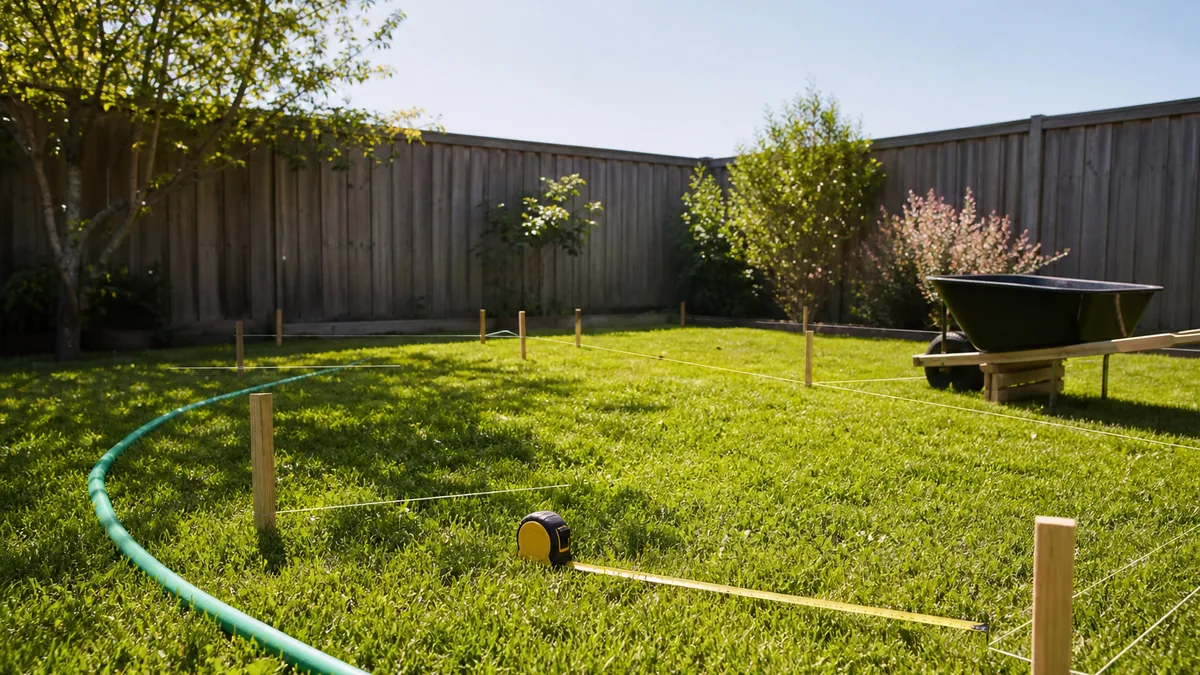
A drawing looks right until you stand in the yard. Mark the plan on the ground before you dig anything. The University of Vermont Extension says a garden hose or thick rope works well to lay out and reshape curvy beds, and that straight beds can be marked with stakes and a tape measure. Colorado State Extension also recommends laying a hose on the ground to outline a border.
- Fix your reference points. Measure from a house corner, patio or fence, as Colorado State suggests, and set a stake at each bed corner.
- Pull a string between the stakes. It shows the straight edge, and a tape measure along it checks the width against the 3 to 4 foot reach rule.
- Use a hose for curves. Lay it down, step back, and nudge it until the curve looks natural. Vermont recommends this for curved beds.
- Walk the paths. Push a wheelbarrow or stand with your tools in the gap, and widen it if you step on the beds. This is the knee-to-toe test WSU describes.
- Test the reach. Kneel at the edge and reach the middle. Oklahoma State puts the average adult reach at about two feet.
- Mark the outline. Vermont suggests landscape paint, then mowing the marked area as short as possible before you cover it.
If the beds replace lawn, Vermont Extension says to dig the edges 4 to 6 inches deep, overlap cardboard or newspaper by 8 to 10 inches with no gaps, and cover it with natural mulch. It calls 4 to 6 inches the ideal mulch depth, and the leaves, grass clippings and pine needles it lists for the layer are the same materials in our list of what you can compost. Leave the stakes where hoses will turn corners. Once the beds are marked and dug, how to plant a garden picks up from there with spacing, depth and watering in.
How to Plan a Garden Design for Flowers, Herbs and Mixed Borders
The same layout rules work for any plants, but each type adds a few. For flower beds and mixed borders, Colorado State Extension suggests planting the same variety in groups of three, five or seven, repeating each group two or three times across the bed, using diagonal or triangular spacing and leaving some open space. It adds annuals and bulbs for accent color, advises designing around each plant’s mature size and leaving room for airflow, and says to divide overcrowded perennials after three to five growing seasons. If your border mixes edibles and ornamentals, companion planting layouts shows full bed plans that combine them.
Herbs are a layout choice in themselves. Colorado State’s PlantTalk says herbs can grow in containers, among flowers or vegetables, or in a dedicated herb garden, wherever there is plenty of sun and well-drained soil. Clemson Extension gives a pH of 6 to 7 for herb soil, recommends raised beds to improve drainage and says to grow aggressive mint in a container. Our guides to growing cilantro and growing lavender show how two very different herbs behave once placed.
Mixed plantings are the other option. Flowers beside vegetables are a classic layout, and companion planting flowers with vegetables covers which pairings work. An easy edge flower is covered in how to grow marigolds. To check how far apart each plant goes, look up the crop on the plant spacing pages, since a layout only works when the mature plants fit the space you drew.
Garden Layout Planning Step by Step
This is the whole method in order. It works on graph paper or in an app, and it works for vegetables, flowers, herbs or a mix.
- List what the garden is for. Food, cut flowers, herbs, seating, play space. Rank the list A, B and C, as Arizona suggests.
- Draw the base map. House, trees, fences, slopes and utilities, to scale on grid paper.
- Record the sun. Write the hours of sun for each area, with north marked.
- Choose the site. At least 6 hours of sun for most beds, drained soil, water close, near where you walk daily.
- Sketch bubbles. One per use, sized roughly to scale, with a few alternatives.
- Set bed and path widths. Beds you reach into at 3 to 4 feet, borders deeper with stepping stones, paths sized to your barrow.
- Place tall plants and water. Tall on the north or back side, thirsty plants near the tap, a drip line to each bed.
- Mark it out. Stakes, string and a hose, then walk it before you dig.
- Add dates and a list. Count plants per bed, then set planting dates for your area.
The last step needs your frost dates. Look up your area in the frost dates by place pages or your growing zone, then enter your ZIP code at the planting calendar by ZIP code for this month’s list. If you are brand new to all this, how to start a garden covers the first-season basics, and how to start a small vegetable garden suits a patio or a single bed.
Finally, keep the drawing. A saved map shows next year what you planted where. If you want the layout, watering, planting dates and shopping list kept in one place, you can try the free demo of the Garden app, which plans your garden square by square, and the paper method above works the same way without it.
5 free books · 120 pages, PDFs
Garden Layout FAQ
How do I plan a garden layout?
Draw a to-scale base map, record the sun, choose a site, then size beds and paths and mark them out. Oklahoma State Extension says to draw the site to scale on grid paper and to sketch bubbles for each use before choosing a plan. Colorado State Extension suggests a scale of 1 inch = 4 feet.
How wide should garden beds and paths be?
Beds you reach into should be 3 to 4 feet wide, per Clemson Extension, and children's beds 3 feet, per Oregon State Extension. Paths range from 18 to 24 inches (Colorado State Extension) to 3 feet or more for a wheelbarrow (Arizona Extension and WSU), and 3 to 4 feet for wheelchairs (Oregon State Extension).
How many hours of sun does a garden need?
Most garden beds need 6 or more hours of direct sun. Oklahoma State Extension defines full sun as 6 or more hours, part sun as 4 to 6 and shade as under 4. Washington State Extension says most summer vegetables need at least eight hours, and Clemson Extension says herbs do best with at least six hours.
How do I lay out a garden with stakes and string?
Set a stake at each corner, measure the width with a tape, then pull string between the stakes. The University of Vermont Extension says straight beds can be marked with stakes and a tape measure, and curved beds with a garden hose or thick rope. Colorado State Extension says to measure from a fixed point such as a house corner.
Which direction should garden beds run?
North to south is the common advice, though sources differ. Oklahoma State Extension says north to south beds give the best light, with tall plants on the north side. Colorado State Extension says there is no clear winner, because east to west beds collect more heat and north to south beds light both sides in summer.
How do I plan a garden design for flowers and herbs?
Group plants, give them room and match them to sun. Colorado State Extension suggests groups of three, five or seven repeated through the bed, with taller plants at the back. Clemson Extension says almost all herbs want at least six hours of sun and well-drained soil with a pH of 6 to 7.
Sources & further reading
Planning and site analysis: Oklahoma State Extension, Planning the Landscape, UGA Extension, Site Analysis, NC State Extension, Home Garden Design, University of Arizona Extension, Basic Elements of Garden Design and UGA, Starting a Garden From Scratch.
Beds, paths and orientation: Clemson Extension on raised beds, Kansas State Extension MF2134, Oklahoma State Extension on raised beds, Colorado State Extension on block style layout, Washington State Extension, PNW Gardener’s Handbook and Oregon State Extension, Gardens Are for Everyone.
Water, flowers, herbs and marking out: Colorado State Extension on irrigating the garden, Colorado State Extension on perennial gardening, Colorado State PlantTalk on herb gardens, Clemson Extension on herbs and University of Vermont Extension on sheet mulching.
5 free books · 120 pages, PDFs
The Garden Starter Bundle
Sent