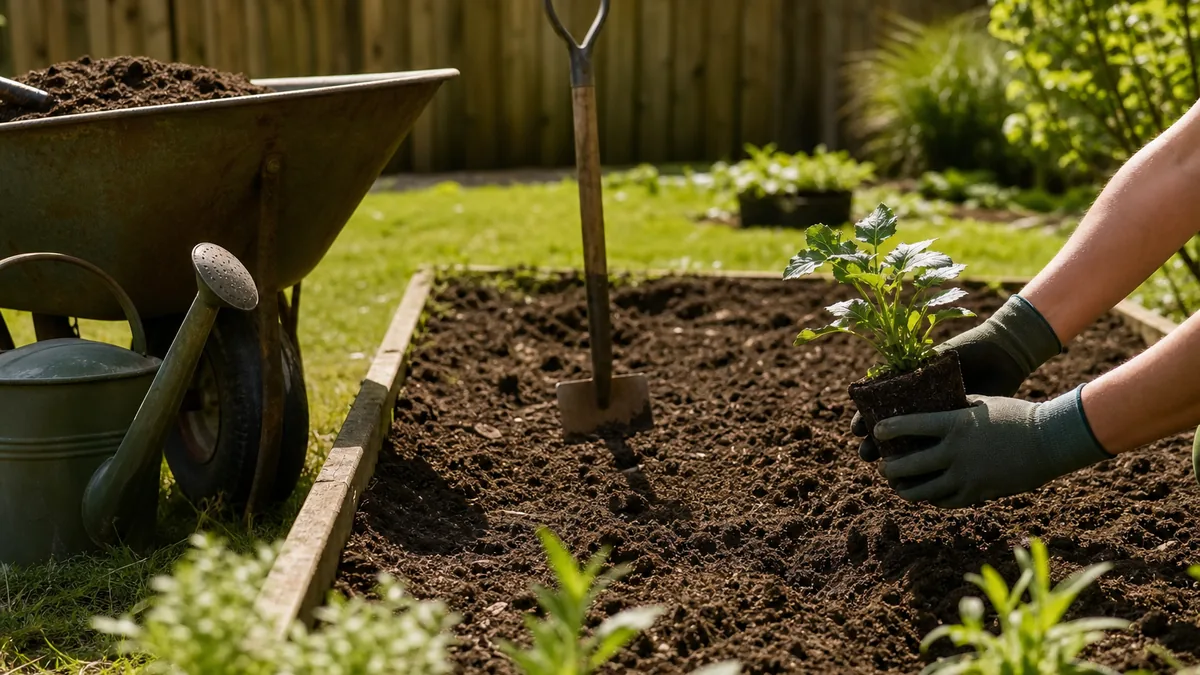
How to start a garden: choose a spot with at least 6 hours of direct sun (University of Wisconsin Extension), keep the first plot to 50 to 100 square feet (University of Maryland Extension suggests 50 to 75, Iowa State Extension about 100), clear the grass, dig in at least 2 inches of compost and plant after your last spring frost. Our spacing and planting guides go deeper on each step.
How to Start a Garden: Quick Reference
| Step | Number to use | Source |
|---|---|---|
| First-year size | 50 to 75 sq ft (Maryland); about 100 sq ft or a 4 x 8 bed (Iowa State) | Maryland, Iowa State |
| Sun | At least 6 hours; 8 or more for fruiting vegetables | Wisconsin, Maryland, NC State |
| Clearing grass | Smother for several months, solarize for 6 to 8 weeks, or cut the sod about 1 inch deep | Iowa State, Penn State |
| Compost | 2 to 4 inches, dug in at least a month before planting | Maryland, Wisconsin, Illinois |
| Soil pH | Around 6.5; most vegetables do well from 6.0 to 7.2 | Wisconsin |
| Water | About 1 inch a week | NC State |
| Timing | Warm-season plants after the last spring frost | NC State, NOAA |
A plan needs a layout, planting dates and a shopping list, and you can make all three on paper with the steps below. If you would rather not draw it, the garden planner lays out your beds square by square and works out the watering, the planting dates and the shopping list in one plan, and there is a free demo at the end of this guide.
How Do You Start a Garden? Pick a Size You Can Keep Up With
Start smaller than your ambition. University of Maryland Extension calls 50 to 75 square feet a good starter size. Iowa State Extension says about 100 square feet (10 by 10 feet) is manageable and that many beginners start with something smaller, such as 4 by 8 feet. West Virginia University Extension and University of Wisconsin Extension both advise keeping the first garden small so it is easy to maintain while your skills grow. NC State Extension puts it as a rule of thumb: plant only the amount of space that you can manage joyfully.
NC State adds that a 4 by 8 foot raised bed may supply a good portion of produce for one or two people. Beginning a garden with a few vegetables, herbs and flowers in one or two beds teaches you more than a large plot of one thing. How to draw the beds, paths and dates before you dig is covered in how to plan a garden, and if vegetables are the main goal, how to plan a vegetable garden works through crops, spacing and a sample bed.
Where Should You Start a Garden in Your Backyard?
Walk the yard at three times of day and look for sun first. University of Wisconsin Extension says most vegetables need at least six hours of direct sunlight daily and tells you to check for shade from trees or buildings from late morning through afternoon. West Virginia University Extension says six to eight hours and good drainage. NC State Extension is stricter: most vegetables need at least eight hours, leafy and root crops can manage on six but do much better with eight or more, and fruiting crops do better with 10. So the sources disagree a little. Six hours is the floor, and more sun gives you more choices.
Herbs and flowers are similar. University of Maryland Extension says most herbs want at least six hours of full sun, with chervil, mint, chives and cilantro tolerating light shade. University of Massachusetts Extension lists marigold, zinnia, petunia and snapdragon among its full-sun annuals.
Then check the ground and the surroundings. University of Wisconsin Extension says to avoid low spots where frost may settle and steep slopes where runoff or erosion could occur, to stay out of a black walnut’s root zone (its roots can extend three to five times the height of the tree from the trunk) and to confirm there are no underground utility lines where you plan to dig. Water matters too. Illinois Extension advises a backup water source near the garden, since rain is not always reliable, and a hose connection is the simplest answer. If there is no tap nearby, a rainwater collection system can put a barrel beside the beds.
How to Start a Garden From Scratch: Clear the Ground
Most backyard sites are lawn, so the first job is turning grass into planting space. Iowa State Extension describes three routes, and the time you have decides which one to use.
| Method | What the extension says | Time |
|---|---|---|
| Cardboard or newspaper | 6 to 8 sheets of newspaper or 1 to 2 layers of cardboard, topped with mulch (Iowa State) | Several months; start in fall for spring |
| Black plastic | One layer of light-excluding plastic, anchored, removed before planting (Iowa State) | About 6 to 8 weeks |
| Cutting the sod | Slide a spade just under the grass roots, about 1 inch deep, a couple of days after a soaking rain (Iowa State) | A weekend for a small bed |
The smothering method is the easiest on your back, and Penn State Extension gives the steps. Mow the grass as short as possible, mark the edge with a hose or stakes, then lay corrugated cardboard (tape and staples removed, no glossy inserts) with sheets overlapping by 8 to 10 inches and no gaps. Wet it, then pile on leaves, bark or wood chips to a total depth of four to six inches. Penn State says four to six months is usually sufficient before you plant.
- Mow low and mark the edge. Stakes and string for a rectangle, a garden hose for a curve.
- Pull out the tough weeds. Oregon State Extension warns that lasagna-style layering may not smother persistent weeds such as bindweed or quackgrass, so dig those out first.
- Lay the cardboard. Plain brown, overlapped 8 to 10 inches, wet as you go (Penn State).
- Add the cover. Compost or mulch on top (organic versus inorganic mulch compares the choices). Penn State says four to six inches in total, and University of Maryland Extension says a 2 to 4 inch layer of compost over cardboard.
- Wait. Several months, ideally from fall to spring, then pull the cover back and plant into the soil itself.
Two cautions. Clemson Extension says cardboard can take four to six months to break down and that it is somewhat water-repellent, so it can block water if it dries out. It also says to avoid colorful printed boxes and heavy-duty boxes with glued seams. Oregon State says to plant into the soil, not just the mulch. Clemson notes that a medium to coarse mulch, such as pine straw or large bark chips, blocks weed seeds better than a fine one.
Raised Bed or In-Ground: Which Is Easier for a Home Garden?
Both work. Oklahoma State Extension lists the raised bed advantages as better drainage in loose soil, earlier warming in spring, less mud, and water and fertilizer that go only to the growing area. It also lists the drawbacks: permanent structures cost more, the initial preparation can take many hours, and crowded plantings can use up nutrients faster. It says the maximum recommended width is about four feet, because the average adult can reach about two feet into a bed from each side, and that a six inch rise above the existing grade will greatly enhance drainage. Iowa State Extension gives 3 to 4 feet for raised beds and says in-ground plots should be no wider than 4 feet either.
If the lawn is compacted or heavy clay, a raised bed is the faster start. Iowa State warns that heavy clay or poorly drained soil can cause root rot. Oklahoma State says heavy clay is unsuitable as a bed fill and that bagged topsoil or sandy loam may need to be added. Our guide to soil for a 4 x 8 raised bed gives the volumes, and raised bed garden designs compares sizes, paths, layouts and materials.
What Soil Does a New Garden Need? Test, Then Add Compost
Test before you amend. University of Wisconsin Extension says to use a certified lab, and that the test reports soil type, pH, organic matter, and phosphorus and potassium. It gives an optimal pH of around 6.5, with most vegetables growing well between 6.0 and 7.2, and adds that if you test after planting, amending is more challenging. University of Maryland Extension says to test for nutrients and pH and to confirm that lead is below 400 ppm. Our guide to reading soil test results explains each line of the report.
Compost is the usual fix, and the sources give a range. University of Maryland Extension says to dig in at least 2 inches on bare ground. Illinois Extension says to dig the soil to a depth of at least 6 to 10 inches and incorporate a two to four inch layer of compost. University of Wisconsin Extension says to work in a two to three inch layer at least a month before planting, and ideally to start preparing the site the year before. Not every bag labeled soil is the same, and topsoil versus garden soil shows what you are buying. West Virginia University Extension offers a practical test for good enough: if the soil crumbles easily and retains moisture, it is healthy enough to get started, and the space should be prepared at least a couple of weeks before planting.
How to Start a Garden for Beginners: What to Grow First
Grow what you will eat or enjoy, and pick plants that forgive mistakes. The table gives extension-backed starting points for vegetables, herbs and flowers.
| Type | Easy first picks | What the extension says |
|---|---|---|
| Vegetables | Tomatoes, peppers, green beans, potatoes, zucchini, leaf lettuce, radish | Iowa State lists tomatoes, peppers, green beans, potatoes and zucchini as easy, plus leaf lettuce, kale, radish, basil and cilantro as novice-friendly |
| Quick, small crops | Radishes, turnips, beets | Illinois Extension says they need little space and mature quickly |
| Herbs | Basil, chives, oregano, thyme, parsley | West Virginia lists basil as an annual and chives, oregano and thyme as perennials; Maryland says drainage matters most |
| Flowers | Zinnias, marigolds | Wisconsin Extension calls zinnias a good choice for children and beginning gardeners |
For vegetables, Illinois Extension notes that tomatoes, bush green beans, squash and peppers take more room but produce over a longer period, and that vining crops can be trellised to save space. Our grow guides cover the quick wins: lettuce from seed for cool weather, and beans from seed for summer. The step-by-step vegetable version of this article is how to start a vegetable garden, and for a patio or a 4 by 4 plot, how to start a small vegetable garden shows what fits.
Herbs are the easy win for small spaces. University of Maryland Extension says herbs need well-drained soil, that soil need not be rich, and that too much fertilizer weakens flavor. West Virginia University Extension agrees that herbs do not require high levels of fertilizer. University of Maryland Extension says to sow dill, borage, coriander and fennel directly, since they do not transplant well, and to start basil and parsley indoors and move them out after frost danger passes.
Flowers earn their place in a first garden. Wisconsin Extension says zinnias grow best in full sun in well-drained soil, germinate at 65 to 70°F and can be direct sown after the danger of frost has passed. University of Massachusetts Extension says to plant sturdy, well-grown young annuals after the last frost and, for most annuals, to let plants grow to touch each other to discourage weeds. Our guide to planting marigold seeds gives depth and timing.
When Should You Start Planting a New Garden?
Anchor the calendar to your average last spring frost. NOAA’s climate.gov defines the last spring freeze as the date after which temperatures stay above 32°F for the rest of the season, and its map, built on the 1991 to 2020 U.S. Climate Normals, marks the average date when the chance of freezing drops below 50 percent. It warns that the last freeze varies from year to year, so the exact date is only known after it has passed. NC State Extension, explaining the same kind of NOAA probability tables, says the 90 percent level suits risk-seeking, aggressive decisions, the 50 percent level is moderate and the 10 percent level is conservative. For a first garden, lean conservative.
Then sort the plants. NC State Extension says warm-season crops go in after the last spring frost, once the soil has warmed, while cool-season crops are planted in early spring and early fall and thrive below 70°F, then bolt in summer as days lengthen. Wisconsin Extension’s zinnia advice follows the same logic, sowing once the soil warms. Check soil temperature for planting before you sow, and look up your own area on the frost dates by place pages, or enter your ZIP code on the planting calendar by ZIP code. Your hardiness zone, shown on the growing zones pages, matters most for perennials such as lavender and chives.
How to Begin Gardening, Step by Step
If you are wondering how to start gardening with no experience, this is the whole method in order, and nothing in it needs special tools.
- Pick the size. 50 to 100 square feet, or one 4 by 8 bed, per Maryland and Iowa State.
- Choose the spot. At least 6 hours of sun, good drainage, a water source nearby and no utility lines under it.
- Mark it out. Stakes and string, a hose for curves. Beds no wider than 4 feet, so you can reach the middle.
- Clear the grass. Cardboard and mulch from fall, plastic for 6 to 8 weeks, or cut the sod.
- Test the soil. Send a sample to a certified lab and read the pH and nutrient results.
- Add compost. 2 to 4 inches, dug in at least a month before planting, or fill a raised frame.
- Pick a few plants. Five to eight, a mix of vegetables, herbs and flowers you like, from the table above.
- Find your frost dates. Write down the average last spring frost and plant warm-season crops after it.
- Plant and label. Follow the seed packet or tag spacing, with tall plants at the north side.
- Water, mulch and write it down. Keep a map and dates so next year starts from real data.
Layout is the part beginners ask about most. How to plan a garden layout covers bed shapes and paths, and vegetable garden layout for beginners has copyable plans. Illinois Extension recommends putting tall crops such as corn and tomatoes on the north side so they do not shade shorter plants, and grouping crops by maturity so quick-harvest ones can be cleared early. West Virginia University Extension says to run rows north to south for maximum sunlight.
Starting a Garden: First-Season Care
The first season is mostly water, mulch and weeds. NC State Extension says vegetables need about one inch of water a week, supplied by rain where possible, and that new seeds and transplants should be watered daily until established if it does not rain. The tomato schedule in how often to water tomatoes shows how that weekly inch turns into a routine for one crop, and how to plant a garden covers watering in the first days after seeds and transplants go into the bed.
Mulch holds moisture and blocks weeds. NC State suggests one to two inches of weed-free loose mulch, or five to six layers of newspaper, and says to remove weeds before they flower and never let them go to seed. Keep mulch back from plant stems. Feed lightly. NC State says to fertilize only as needed following the recommendations on your soil analysis.
Plan for the next season while you harvest. Iowa State Extension says sowing every 7 to 10 days spreads out the harvest of radish, carrots, beets, lettuce and beans, and our succession planting guide shows how to reuse a bed. Illinois Extension says to avoid planting the same plant family in the same spot more than once every three years, which is easy if you have a map. When you are ready to turn this method into a full plan, you can try the free demo of the Garden app, which lays out your beds square by square, and the paper version above works the same way without it.
5 free books · 120 pages, PDFs
How to Start a Garden FAQ
How do I start a garden for the first time?
Pick a sunny spot, keep it small and prepare the soil before you plant. University of Wisconsin Extension says most vegetables need at least six hours of direct sun, University of Maryland Extension calls 50 to 75 square feet a good starter size, and Maryland says to dig in at least 2 inches of compost.
How big should a first garden be?
Between 50 and 100 square feet is the usual range. University of Maryland Extension suggests 50 to 75 square feet, Iowa State Extension says about 100 square feet (10 by 10 feet) is manageable and a 4 by 8 foot plot is easier for many beginners, and NC State Extension says to plant only what you can manage joyfully.
How do you start a garden from scratch on a lawn?
Smother the grass or cut the sod. Iowa State Extension says to lay 6 to 8 sheets of newspaper or 1 to 2 layers of cardboard topped with mulch, which takes several months, or to cover the area with light-excluding plastic for about 6 to 8 weeks. Penn State Extension says four to six months is usually enough for the cardboard method.
How do I start a backyard garden if the soil is poor?
Test it, then add compost or build a raised bed. University of Wisconsin Extension says to test through a certified lab and that most vegetables grow well at pH 6.0 to 7.2. Oklahoma State Extension says heavy clay is unsuitable as a bed fill and that sandy loam or bagged topsoil may need to be added.
When is the best time to start a home garden?
Prepare the ground in fall or at least a month before planting, and plant after your last spring frost. University of Wisconsin Extension says to ideally begin preparing the site the year before, and NC State Extension says warm-season crops go in after the last spring frost, while cool-season crops go in during early spring and early fall.
What are the easiest things to grow when you begin gardening?
Radishes, lettuce, bush beans, zucchini, tomatoes, basil and zinnias are good starters. Iowa State Extension lists tomatoes, peppers, green beans, potatoes and zucchini as easy vegetables, Illinois Extension says radishes, turnips and beets mature quickly in little space, and Wisconsin Extension calls zinnias a good choice for beginning gardeners.
Sources & further reading
Site, size and soil: University of Wisconsin Extension on site selection and soil preparation, University of Maryland Extension, Iowa State Extension on planning, NC State Extension quick reference, Illinois Extension on starting a garden, Illinois Extension on preparing soil, West Virginia University Extension on setting up a garden and Oklahoma State Extension on raised beds.
Clearing grass: Iowa State Extension on killing grass, Penn State Extension on sheet mulching, Oregon State Extension on sheet mulching and Clemson Extension on cardboard.
Herbs, flowers and dates: University of Maryland Extension on herbs, West Virginia University Extension on herbs, University of Wisconsin Extension on zinnias, University of Massachusetts Extension on annuals for sun, NOAA climate.gov on the last spring freeze and NC State Extension on freeze probabilities.
5 free books · 120 pages, PDFs
The Garden Starter Bundle
Sent