How long is spaghetti squash good for? It depends on the form. A whole, uncut squash kept in a cool, dry place lasts roughly 2 to 3 months, according to Ohio State and Missouri Extension. Cut raw pieces last about 5 days in the refrigerator, and cooked leftovers last 3 to 4 days, per USDA. This guide covers how to pick a ripe squash, how to store it and how to spot one that has gone bad. If you grow your own, our spacing and planting guides help you plan the patch.
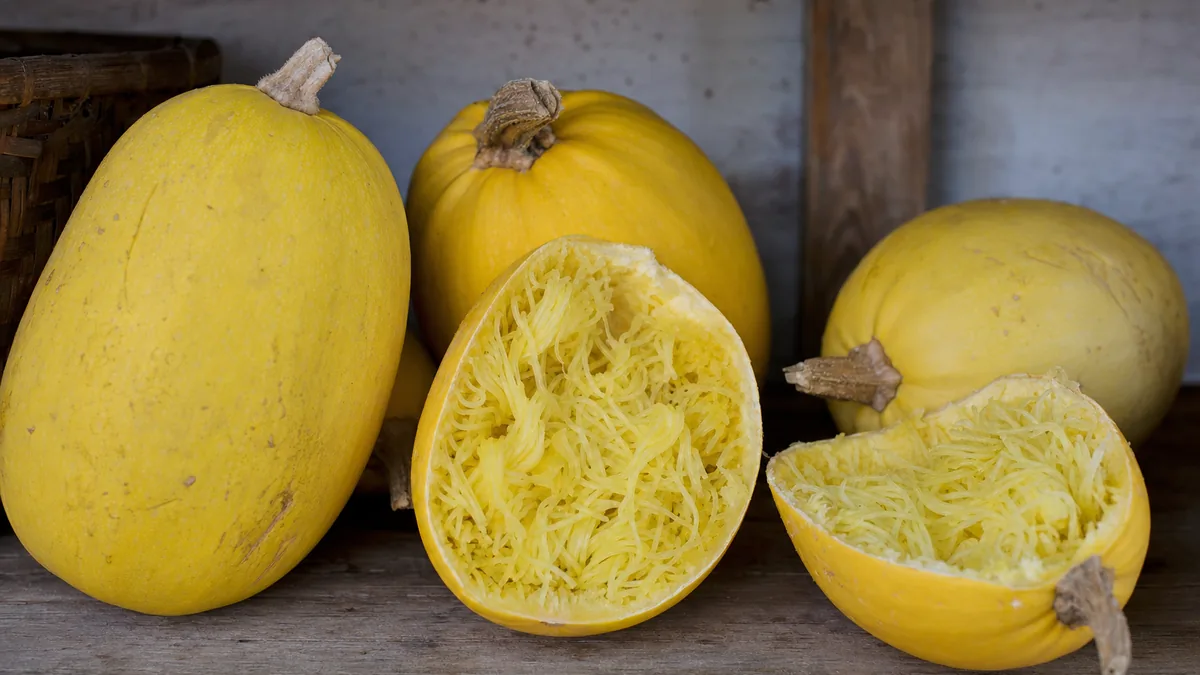
Spaghetti Squash Storage at a Glance
| Form | How long it keeps | Source |
|---|---|---|
| Whole, uncut, cool and dry | About 1 to 3 months, depending on the source | Purdue, Ohio State, Missouri Extension |
| Cut raw, wrapped, refrigerated | Up to 5 days | University of Missouri Extension |
| Cooked leftovers, refrigerated | 3 to 4 days | USDA Food Safety and Inspection Service |
| Cooked leftovers, frozen | 3 to 4 months for best quality | USDA Food Safety and Inspection Service |
| Best storage temperature (whole) | 50 to 60°F, away from chill and humidity | Purdue, Arkansas, Missouri, UMass Amherst |
How Long Do Whole Spaghetti Squash Last?
Extension sources do not agree on one number, so here is the range. Purdue Extension groups spaghetti with acorn and delicata and says these types are best within a month or two of harvest. Ohio State University Extension says spaghetti squash keeps for approximately 2 months, while most other winter squash typically last 3 months. University of Missouri Extension says a whole, raw spaghetti squash kept at 55 to 60°F should last up to three months. The University of Arkansas System Division of Agriculture is less specific and says mature fruit stored at 55 to 60°F in a dry location will keep for several months.
Read those together and the safe plan is to expect 1 to 3 months and use the squash early in that window. Keepers vary. Purdue says other winter squash such as buttercup and hubbard may be stored up to 6 months, so spaghetti is on the shorter end of the family. UMass Amherst notes that Cucurbita pepo types such as acorn and delicata store 2 to 3 months, but its fact sheet does not list spaghetti squash, so we do not rely on that figure for this crop.
Three things set where you land in that range. The first is maturity at harvest, because Kentucky’s Center for Crop Diversification says picking winter squash early leads to poor storage and a higher risk of decay. The second is skin damage, and the third is storage temperature, both covered below. One practical tip from Ohio State Extension is not to wash squash before storing it. Scrub it under cool running water only when you are ready to cut or cook it.
How to Tell if a Spaghetti Squash Is Ripe
Ripeness decides how long a squash lasts, so check it before you cut it from the vine. Several extension sources agree on the same cues.
- Color: Iowa State University Extension says to pick when the skin changes from ivory white to golden yellow. Colorado State University Extension says light yellow to golden yellow. Arkansas describes the rind turning from light tan to golden yellow, and Missouri Extension adds that the more yellow the squash, the riper it is.
- Hard rind: The Arkansas bulletin says the rind should resist a thumbnail. Clemson Extension says mature winter squash have very hard skins that cannot be punctured with your thumbnail, and that the surface shifts from a bright sheen to a dull, dry appearance.
- Size and weight: Ohio State Extension lists spaghetti squash at 8 to 10 inches long and 4 to 6 inches in diameter. Arkansas says fruit weighs roughly 2 to 5 pounds. Missouri Extension says to choose one that is heavy for its size, hard and free of blemishes.
- Days from planting: Colorado State says typical maturity is 80 to 100 days, and the Arkansas bulletin lists the spaghetti variety Tivoli at 100 days. Seed packets vary, so use the number on yours.
Use the packet’s description together with the rind test, since color alone can mislead. Our guides to growing squash and pumpkins cover the plants these fruit come from.
How to Pick Spaghetti Squash, Step by Step
The way you cut the fruit from the vine affects storage as much as ripeness does. Follow this order.
- Check the rind first. Press a thumbnail into the skin. If it dents, wait. Clemson Extension and the Arkansas bulletin both use this test.
- Watch the calendar and the thermometer. The Arkansas bulletin says to harvest all mature fruit before a hard frost. Oregon State University Extension says to harvest before temperatures fall below 50°F for more than a week, or when rain becomes frequent.
- Cut, do not pull. Use pruning shears or a sharp knife. Oregon State says do not break off the stem.
- Leave a short stem. Iowa State and Colorado State Extension both say to leave about 1 inch of stem. The Arkansas bulletin says to cut the stem 1 to 2 inches from the fruit. Oregon State suggests 2 to 4 inches for squash generally. The range across sources is 1 to 4 inches, and 1 to 2 inches is the spaghetti-specific guidance.
- Handle gently. Kentucky’s Center for Crop Diversification says to avoid cuts and bruises, and Iowa State agrees that squash without a stem will not store well.
- Sort the harvest. Set aside any squash with a soft spot, crack or missing stem. Eat those first, and keep the sound ones for storage.
A frost check is worth doing before the first cold night. Clemson Extension says all types of squash and pumpkins are highly susceptible to frost. Look up your average first fall freeze on our frost dates pages and plan to harvest ahead of it.
Curing and Storage Conditions
Curing is where sources disagree, so read this part carefully. Iowa State University Extension says to cure all winter squash except acorn at 80 to 85°F and 80 to 85 percent relative humidity, which hardens the skin and heals small scratches. Kentucky’s Center for Crop Diversification gives 5 to 7 days at 80 to 85°F, UMass Amherst gives 5 to 10 days at 80 to 85°F and 80 to 85 percent humidity, and Clemson Extension gives about 10 days at 80 to 85°F and 75 to 80 percent humidity. Oregon State says to keep fruit dry and warm at about 80 to 85°F for several days.
The caution comes from UMass Amherst, which says Cucurbita pepo squash should not be cured. It names acorn, delicata and sweet dumpling as examples, but does not list spaghetti. Meanwhile, the Missouri, Arkansas and Iowa State spaghetti squash pages give no curing step at all. Given that split, a cautious approach is to cure only briefly, if at all, and to check the sources for your region and variety. Fruit that already has a hard, dull rind is at the stage where extension sources say to harvest.
After that, move the squash to storage. The conditions below come from the sources we read.
- Temperature: Purdue says the ideal is 50 to 60°F. Missouri and Arkansas say 55 to 60°F for spaghetti. Iowa State and Oregon State say 50 to 55°F for winter squash in general, and Ohio State says a cool area of 50°F.
- Avoid chill: UMass Amherst says chilling injury occurs below 50°F, in the field or in storage, and that chilled fruit does not store well. Kentucky and Oregon State say the same. This is why the refrigerator is a poor place for whole squash.
- Humidity: UMass Amherst gives 50 to 70 percent relative humidity, adding that above 70 percent favors decay and below 50 percent causes dehydration. Kentucky gives 60 percent, and Clemson gives 50 to 75 percent. Missouri simply says to avoid extremely humid places.
- Air and neighbors: Iowa State and Oregon State both say to keep squash away from apples, pears and other ripening fruit, because their ethylene gas shortens storage life.
- Surface: Oregon State says to keep fruit off the floor with straw underneath, to avoid newspaper and paper bags, and to check stored produce weekly and remove any fruit that is softening or rotting.
Most homes do not have a dedicated cold room, so the cool end of a pantry, a closet on an interior wall, or an unheated but frost-free room can work if it stays within these ranges. For cold-season tasks around the garden, our winterizing checklist covers what to finish before the freeze.
Cut and Cooked Spaghetti Squash in the Refrigerator
Once you cut a squash, the clock speeds up. University of Missouri Extension says a cut spaghetti squash must be stored in the refrigerator, wrapped tightly in plastic wrap or kept in an airtight container, and that the cut pieces can remain there for up to five days.
Cooked squash follows food-safety rules for leftovers instead. The USDA Food Safety and Inspection Service says leftovers can be kept in the refrigerator for 3 to 4 days. It also says to throw away perishable foods left at room temperature for more than 2 hours (1 hour when the temperature is over 90°F), to divide large amounts into shallow containers so they cool quickly, and to keep cold foods at 40°F or below. Missouri Extension makes the same 2-hour point in its spaghetti squash recipe. Two different clocks, then:
- Raw, cut and wrapped: up to 5 days (Missouri Extension).
- Cooked and cooled: 3 to 4 days (USDA FSIS).
When you reheat cooked strands, USDA says leftovers should reach 165°F as measured with a food thermometer. If you are unsure how long a container has been in the refrigerator, throw it out rather than guess.
Freezing Spaghetti Squash
Freezing is the best way to stretch a big harvest. Clemson Extension’s preserving guide says to cook the squash by baking, boiling, steaming or pressure cooking, then scrape the flesh from the rind. It says that for spaghetti squash, mashing the cooked pulp is not necessary. To cool it, set the pan in cold water and stir occasionally. Pack it into freezer bags or containers, leave a half inch of headspace, then seal and freeze.
Do not plan on canning it. Clemson says spaghetti squash will not stay cubed when cooked and must be frozen instead of canned, and University of Missouri Extension says it is not suitable for canning. Missouri also suggests laying zip-close bags flat on a tray to freeze, which makes them easier to stack and quicker to thaw.
For time in the freezer, the best source we found is the USDA, which says leftovers can be frozen for 3 to 4 months. It adds that frozen leftovers are safe indefinitely but can lose moisture and flavor when stored longer. Foodsafety.gov says foods held continuously at 0°F or below can be kept indefinitely. Treat 3 to 4 months as the quality window and label each bag with the date.
How to Tell if a Spaghetti Squash Is Bad
Check stored squash every week or so, as Oregon State suggests. These are the warning signs that the extension sources describe.
- Softening skin: University of Missouri Extension says that when the skin has softened, it may be time to toss it.
- Leaking liquid: Missouri says that once a squash is leaking liquids it is no longer edible and should be disposed of.
- Mold, bruises or spots: Missouri lists these as flaws to avoid when selecting, and Ohio State says a good squash should have no cracks, bruises or decay.
- Black or shriveled stem: Ohio State and Purdue both say to avoid squash with black or shriveled stems. Purdue adds moist stems to the list.
A surface blemish is not always the end. A small spot on the outside is a reason to eat that squash first, while a soft, wet or moldy one should go. The sources do not give a rule for cutting away a bad area on spaghetti squash, so when in doubt, discard it. If the rotten squash is from your own garden, see what you can compost before it goes in the bin.
For cooked strands, the 3 to 4 day USDA limit matters more than appearance, so judge by the calendar and not by looks alone. The FSIS page says bacteria grow rapidly between 40°F and 140°F.
Growing Spaghetti Squash for a Storage Harvest
If you grow your own, planning pays off at the end of the season. Spaghetti squash is a warm-season vine, and Clemson Extension says to plant only after frost danger has passed and the soil at 4 inches is above 60°F. Our guide to soil temperature for planting explains how to check. Once it is growing, count roughly 80 to 100 days (Colorado State) to harvest, then work back from your first fall frost. For a close look at the plant itself, see the squash guide linked earlier on this page, and for a related sprawling vine, the pumpkin guide.
Spacing affects fruit size and airflow. The Arkansas bulletin says spaghetti squash can be grown much like other winter squash, with two to three seeds sown 24 inches apart, or three to four seeds in hills 48 inches apart. Clemson gives 2 to 3 feet between bush or short-vined plants in rows 3 to 5 feet apart, and 3 to 5 feet between large-vined plants in rows 6 to 8 feet apart. Check your packet to see which habit you have. For more crop spacing figures, browse our plant spacing pages.
A final planning point is volume. A few plants can produce more squash than a household eats in the time they keep, so match your plant count to what you can use, freeze or share. The calculator above can help you estimate it. If you want to stagger crops so the harvest is spread out, see our succession planting guide.
Free book · 23 pages, PDF
How Long Is Spaghetti Squash Good For FAQ
How long does a whole spaghetti squash last?
About 1 to 3 months in a cool, dry place. Purdue Extension says spaghetti squash is best within a month or two of harvest, Ohio State Extension says approximately 2 months, and University of Missouri Extension says up to three months at 55 to 60°F.
How long does spaghetti squash last in the refrigerator?
Raw cut pieces last up to five days when wrapped tightly or sealed in an airtight container, according to University of Missouri Extension. Cooked leftovers last 3 to 4 days, according to the USDA Food Safety and Inspection Service.
How do you tell if a spaghetti squash is ripe?
Look for a golden yellow rind. Iowa State Extension says the skin changes from ivory white to golden yellow, and the Arkansas bulletin says the rind should also resist a thumbnail. Missouri Extension says a ripe one is heavy for its size and hard.
How do you tell if a spaghetti squash is bad?
University of Missouri Extension says a softening skin may mean it is time to toss it, and a squash that is leaking liquid is no longer edible. Ohio State and Purdue Extension also say to avoid squash with black or shriveled stems.
How long should you leave the stem on when you pick it?
Leave a short stem. Iowa State and Colorado State Extension say about 1 inch, and the Arkansas bulletin says to cut the stem 1 to 2 inches from the fruit. Iowa State warns that squash without a stem will not store well.
Can you freeze cooked spaghetti squash?
Yes. Clemson Extension says to cook it, cool it in cold water, pack it in freezer bags or containers with a half inch of headspace and freeze it, with no need to mash it. USDA says frozen leftovers keep their best quality for 3 to 4 months.
What is the best temperature to store whole spaghetti squash?
Between 50 and 60°F. Missouri and Arkansas say 55 to 60°F, Purdue says 50 to 60°F, and UMass Amherst warns that chilling injury occurs below 50°F, which is why a cold refrigerator is a poor choice.
Sources & further reading
Whole-squash storage, ripeness and spoilage details come from University of Missouri Extension’s A Taste of Missouri: Spaghetti Squash, Ohio State University Extension’s Selecting, Storing, and Serving Ohio Squash and Pumpkin, Purdue Extension’s Winter Squash fact sheet and University of Arkansas System Division of Agriculture’s Winter Squash home gardening bulletin. Harvest, stem length and curing figures come from Iowa State University Extension on harvesting spaghetti squash, Iowa State’s Harvesting and Storing Vine Crops, UMass Amherst’s Pumpkin and Winter Squash Harvest, Curing and Storage, University of Kentucky Center for Crop Diversification’s Post Harvest Handling of Winter Squash, Oregon State University Extension’s guide to harvesting and storing pumpkins and winter squash, Colorado State University’s Plant Talk on harvesting fall squash and Clemson HGIC’s Pumpkins and Winter Squash. Freezing comes from Clemson HGIC’s Preserving Pumpkin and Winter Squash and University of Missouri Extension’s Preserving Winter Squash. Food-safety times come from the USDA Food Safety and Inspection Service’s Leftovers and Food Safety and Foodsafety.gov’s Cold Food Storage Charts. For how we source the facts on this site, see our methodology page.
Free book · 23 pages, PDF
The Spacing & Planting Cheat Sheet
Sent