New HarvestMath Garden plans your whole garden in five minutes.

Try it free

Pepper Plant Spacing: How Far Apart to Plant Peppers

By HarvestMath Editors 5 min read Share:

Space pepper plants 18 inches apart in the row, with 24 to 36 inches between rows -- figures backed directly by University of Minnesota Extension. That's a solid default for most bell and hot peppers, but a few sub-types genuinely need something different: Clemson Cooperative Extension gives pimento peppers wider spacing (18-24 inches), and New Mexico State University Extension splits hot New Mexican-type chiles even further by variety. One more thing worth knowing before you space peppers by the book: for large-podded types in hot, sunny climates, some extension guidance actually recommends planting closer together, not further apart.

Spacing at a Glance

Pepper spacing reference
Type In-row spacing Between-row spacing SFG (per sq ft)
Bell & most hot peppers 18 in 24-36 in 1
Pimento peppers 18-24 in 36-42 in n/a

The 18 in. in-row figure matches this site's Plant Spacing Calculator exactly, sourced to University of Minnesota Extension. That same source and Clemson HGIC both put between-row spacing at 30-42 inches in a traditional row garden -- wider than the calculator's 24 in. default. If you're working a traditional row garden rather than a raised bed, lean toward the wider end of that range for easier access between rows.

In a 4×8 ft raised bed at 18 in./24 in., peppers work out to about 5 plants per row and 2 rows -- 10 plants total, matching the count already published on the main Plant Spacing Calculator's FAQ.

Open the calculator for pepper

The Counterintuitive Case for Planting Peppers Closer Together

Most vegetable spacing advice is "give it more room." Pepper spacing has a real, sourced exception: University of California Cooperative Extension's Master Gardeners of Santa Clara County recommend planting two pepper seedlings in the same hole for large-podded varieties, specifically because it increases leaf cover over the developing fruit and reduces sunscald in hot, sun-exposed gardens. Their reasoning is direct -- "more leaves" mean more shade on the pods, and a bonus: "you'll get more peppers per square foot."

Sunscald itself isn't primarily a spacing problem, though -- it's usually a canopy-density problem, and canopy density can come from more than one cause. Cornell's Long Island Vegetable Pathology program notes that healthy plants typically carry enough leaves to shield fruit on their own; sunscald shows up mainly on diseased plants that have lost leaves to defoliation. A University of Delaware Cooperative Extension field trial adds a second cause entirely unrelated to leaf density: staked and tied pepper plants had under 2% sunscald damage, versus 17% for untied plants of the same variety planted the same day -- because untied plants lean and expose fruit to direct sun that upright ones don't.

Not every extension source treats bell and hot peppers the same, either. Clemson HGIC gives pimento peppers a wider in-row figure (18-24 in.) than its 12-inch standard, and New Mexico State University Extension splits New Mexican-type green chiles and jalapeños (10-12 in.) from red chile and paprika types (6-8 in.) -- a real varietal difference, not a universal bell-vs-hot rule.

Why Spacing Matters for Peppers

Pepper spacing is really managing two competing risks at once: too little leaf cover and fruit gets sunscald; too little airflow and disease pressure rises. The extension guidance above shows growers actually manage the first risk with plant density (doubling up in one hole) and orientation (staking upright) more than with raw spacing distance alone.

For a hot, sunny climate especially, the standard "more space is always better" instinct can work against you on pepper fruit quality specifically, even while it still helps overall plant health -- which is why this is one of the few crops on this site where the spacing chart alone won't tell you the whole story.
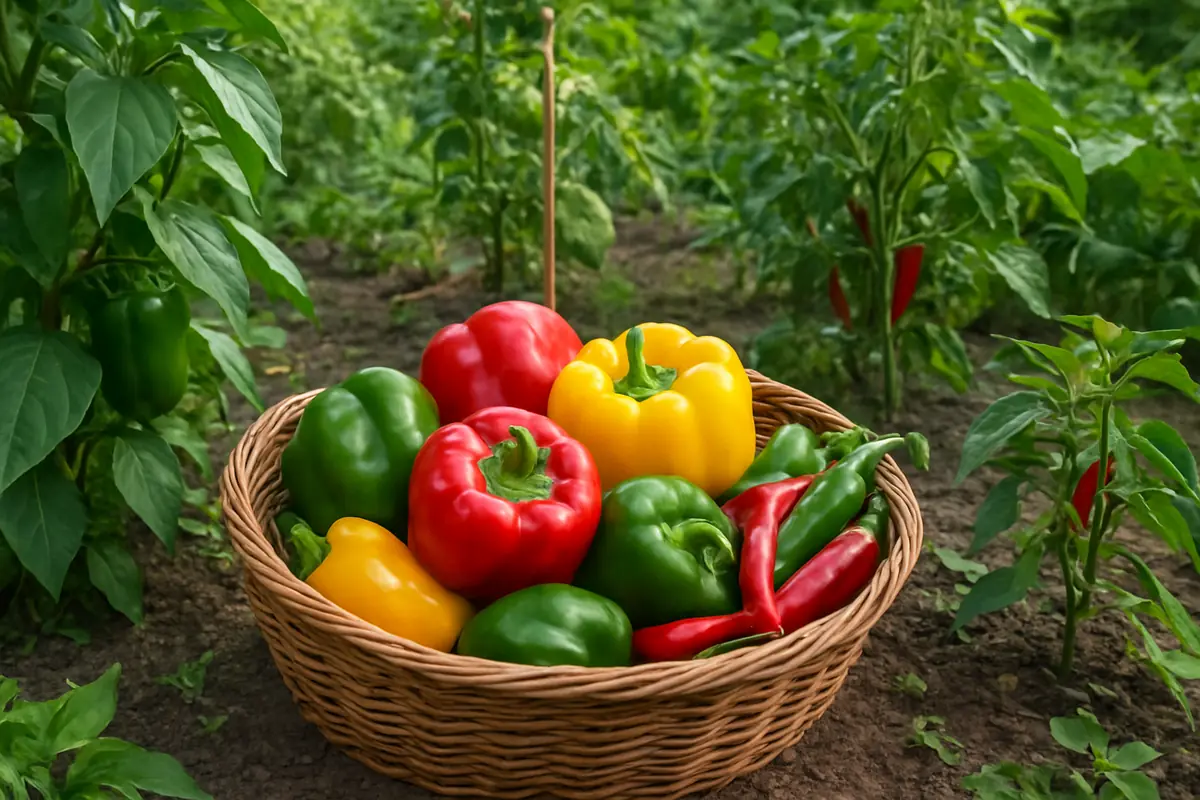
A basket of just-picked bell peppers and chile peppers
A pepper harvest. AI-generated image.

The common assumption is "give pepper plants maximum room for airflow." UC Cooperative Extension's guidance for large-podded peppers in hot climates is the opposite: deliberately double up seedlings in one planting hole to increase leaf cover and cut down on sunscald, since sunburned fruit is caused by too little shade on the pods, not too little space around the plant.

Ready to plan an actual bed? The Plant Spacing Calculator works out exact plant counts for your own bed dimensions : open it pre-set to Pepper.

Pepper Spacing FAQ

How far apart to plant pepper plants?

University of Minnesota Extension recommends 18 inches in-row with 24-36 inches between rows. Some sub-types (pimento, certain hot chile varieties) need different spacing -- see the table above.

Can you plant peppers close together for more shade on the fruit?

Yes -- UC Cooperative Extension Master Gardeners specifically recommend planting two pepper seedlings per hole for large-podded types, to increase leaf cover and reduce sunscald on the pods.

Do bell peppers and hot peppers need different spacing?

Sometimes. Clemson and New Mexico State University both give tighter or wider spacing to specific sub-types (pimento, New Mexican-type chile, paprika), but University of Minnesota Extension uses one figure for all types -- so it isn't a universal rule.

Why are my peppers getting sunscald -- is spacing the cause?

Usually not spacing alone. Cornell's research points to sparse canopy from disease-driven leaf loss, and a University of Delaware trial found staked, upright plants had far less sunscald (2%) than unstaked, leaning plants (17%) of the same variety.

How close can you plant peppers in a raised bed?

As tight as 12 inches (1 plant per sq ft), per NC State Extension's Square Foot Gardening chart.

Cover of The Companion Planting Chart

Free book · 23 pages, PDF

The Companion Planting Chart

What grows well together, what to keep apart, and why.

Sources & further reading

Spacing figures and facts on this page are sourced directly from university cooperative extension services, cited below, not estimated or invented.

For more on how we source and validate the figures used across this site, see our methodology page.

Related Spacing Guides

Real relationships, not a random pick: companion pairings, shared botanical family, or a similar spacing regime.

See every crop in this set on the Plant Spacing hub.

Free book · 23 pages, PDF

The Companion Planting Chart

What grows well together, what to keep apart, and why.

We email the book right away, then a few short emails over the next week or two: a tip from it and how our garden apps can help. After that, about one email a month. Unsubscribe anytime. Privacy policy