How long does butternut squash last? It depends on the form. A whole, cured squash kept in a cool, dry place lasts about 2 to 3 months, according to Iowa State, South Dakota State and Purdue Extension. Cut pieces keep about 5 days in the refrigerator per UMass Amherst, and cooked leftovers keep 3 to 4 days per USDA. Our spaghetti squash storage guide covers its cousin, and this one covers ripeness, curing and spoilage for butternut. If you grow your own, our spacing and planting guides help you plan the patch.
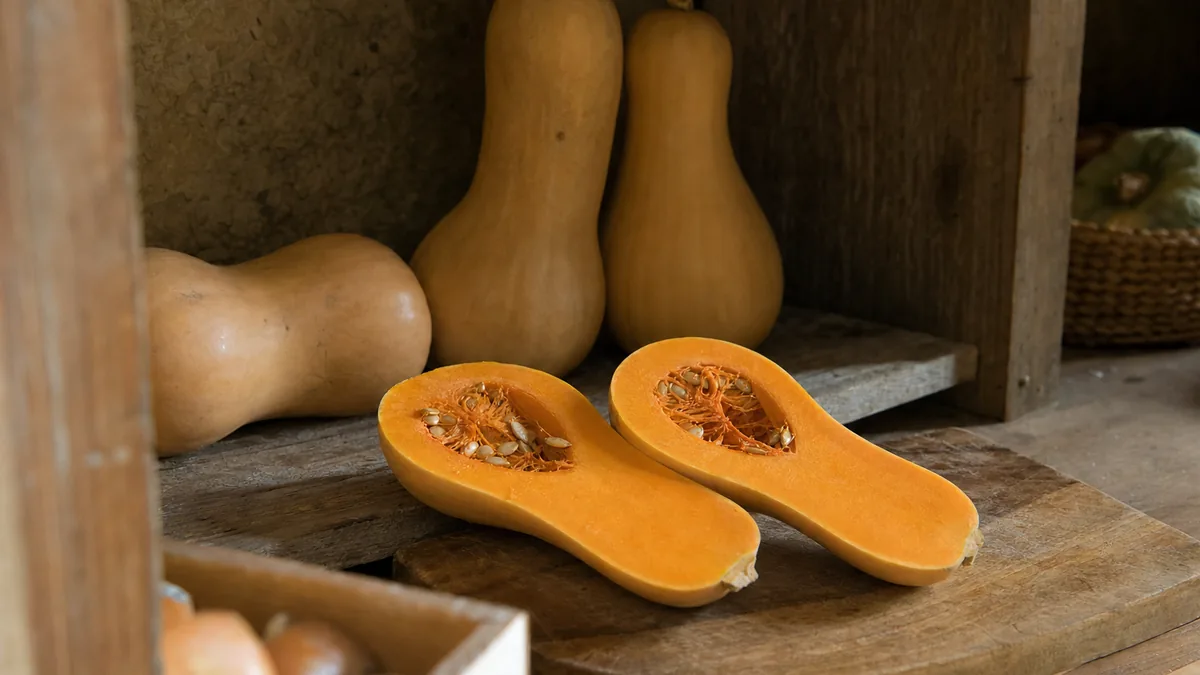
Butternut Squash Shelf Life at a Glance
| Form | How long it keeps | Source |
|---|---|---|
| Whole, cured, cool and dry | About 2 to 3 months in most sources, 7 to 11 weeks in one table, up to 4 to 6 months in the best case | Iowa State, SDSU, Purdue, Penn State, UMass Amherst |
| Cut or peeled, wrapped, refrigerated | 5 to 7 days | UMass Amherst, NC State, Washington State, Clemson |
| Cooked leftovers, refrigerated | 3 to 4 days | USDA Food Safety and Inspection Service |
| Cooked leftovers, frozen | 3 to 4 months (USDA) up to 8 to 12 months (Utah State) | USDA FSIS, Utah State University Extension |
| Best temperature for whole squash | 50 to 60°F, dry and ventilated | Purdue, SDSU, UMass Amherst, Washington State |
How Long Does a Whole Butternut Squash Last?
Extension sources give a range, not one number. Iowa State University Extension says properly cured and stored butternut keeps approximately 2 to 3 months. South Dakota State University Extension gives 2 to 3 months for butternut and adds that optimal eating quality is generally reached after about two months in storage. Purdue Extension lists butternut among the squash that can be stored for 2 to 3 months, and UMass Amherst’s Harvest of the Month page says a whole squash can be stored for up to three months in cool, dry conditions.
Other sources land on either side of that. A Penn State Extension table lists butternut at 7 weeks when held at 50 to 60°F and 8 to 11 weeks when held at 50°F, and says storage of four months or more is possible only if every production, curing and storage recommendation is followed. At the generous end, the University of Tennessee Extension in Rutherford County says whole butternut keeps about four months, and UMass Amherst’s vegetable program says non-pepo winter squash, after a 1 to 2 month wait before eating, will store for 4 to 6 months. At the short end, NC State Extension in Lenoir County says to keep it in a cool, dark place for up to 1 month. That page does not mention curing, which may explain the gap.
Put those together and a sensible plan is to expect 2 to 3 months from a squash that was fully mature, cured and kept cool, and to treat anything beyond that as a bonus.
Butternut also changes in storage in a good way. UMass Amherst says most winter squash should be stored 1 to 2 months before eating so that starches convert to sugars, and that the carotenoid pigments behind the yellow-orange color increase in storage. It adds that mini-butternut can be eaten at harvest and stores for about 3 months.
How to Tell if Butternut Squash Is Ripe
Ripeness sets the shelf life, so check it before you cut a squash from the vine or carry one home from a market. The cues below come from several universities.
- Color: Iowa State Extension says the skin should be uniformly tan. Purdue Extension says deep tan without green streaks. Cornell Cooperative Extension says a butternut turns a slightly darker, duller tan, and that the green stripes seen on younger fruit should have faded or nearly disappeared. University of Illinois Extension describes a pale peach color.
- Hard rind: Iowa State says the skin is hard and cannot be punctured with a thumbnail. Cornell says that if a thumbnail still pushes in easily, the squash is not mature.
- Matte finish: UMass Amherst’s Harvest of the Month page says to pick squash with a matte finish, because a shiny skin suggests it was picked too early. South Dakota State says the rind becomes less glossy as it matures.
- Stem: South Dakota State calls the best indicator the stem corking, when the green stem turns brown and woody where it joins the fruit. The Tennessee Extension page also describes a brownish, woody stem.
- Timing: UMass Amherst’s vegetable program says most squash varieties are ready 50 to 55 days after pollination, and that butternut turns tan at about 45 days but should not be harvested for another 2 weeks. The University of Maryland Extension gives 60 to 100 days to maturity for winter squash generally, so rely on the number on your seed packet.
Color alone can mislead. South Dakota State says that tan color appears two to three weeks before the best harvest time and that picking too early reduces eating quality. It also warns that dead vines alone do not confirm maturity, especially after disease or drought.
How to Pick and Harvest Butternut Squash
The same cues help at the store. Purdue Extension advises choosing winter squash that is heavy for its size, and Utah State University Extension says to choose squash with hard, tough skin and to avoid soft spots, moldy patches and cut or punctured skin. Utah State adds that soft, thin skin suggests an immature fruit. The Tennessee Extension page says whole butternut typically weigh 1½ to 5 pounds and that the longest, fattest necks are the meatiest. For squash in your own garden, follow this order.
- Check the rind first. Press a thumbnail into the skin. If it dents, wait.
- Look at the weather. South Dakota State says the fruit is sensitive to temperatures below 45°F, and the University of Maryland says winter squash is typically harvested in September or October before heavy frosts.
- Cut, do not pull. Use pruning shears or a sharp knife, as South Dakota State and the University of Maryland advise.
- Leave a short stem. Iowa State says to leave a 1-inch stem. Washington State University Extension says to leave at least 1 to 2 inches for long-term storage, and the University of Maryland says about 2 inches. The range is 1 to 2 inches.
- Handle gently. Penn State says any wound lets a fungal or bacterial pathogen enter the rind, so avoid bruises and cuts.
- Sort the harvest. Penn State says second-quality fruit should be used quickly and not stored long-term. Eat the nicked ones first.
A frost check is worth doing early in the season. Look up your average first fall freeze on our frost dates pages, and see what temperature frost forms to understand why a clear, calm night can be colder than the forecast.
How to Cure Butternut Squash
Curing hardens the skin and heals small scratches. Sources agree it is useful for butternut, though the exact numbers differ. Iowa State University Extension says to cure for 10 to 14 days at 80 to 85°F and 80 to 85 percent relative humidity. University of Illinois Extension also says 10 to 14 days, in a spot with good airflow, and says curing is how to achieve the longest shelf life. The Tennessee Extension page says about 10 days at 80 to 85°F. Penn State Extension gives 7 to 10 days on dry, warm days at 70 to 80°F in the field, or in a warm building such as a barn or greenhouse if the weather is poor. It also says to space fruit out and not pile it.
The shortest numbers come from UMass Amherst, whose general winter squash guidance is 5 to 10 days at 80 to 85°F and 80 to 85 percent humidity, and it says Cucurbita moschata types such as butternut can be cured to hasten market readiness. South Dakota State says up to one or two weeks above 80°F right after harvest can raise sugar content and flavor without reducing storage life. Taken together, the range is 5 to 14 days, with 10 days at 80 to 85°F as the common middle.
One caution applies to other squash. UMass Amherst says Cucurbita pepo types, such as acorn and delicata, are ready to eat at harvest and that curing can reduce their storage lifespan. Butternut is a moschata, so that warning is not aimed at it.
Storage Conditions That Extend Shelf Life
A separate guide on how to store butternut squash will go into detail. For the lifespan question, these basics matter most.
- Temperature: Purdue Extension says the ideal is 50 to 60°F, and UMass Amherst agrees. Iowa State says 50 to 55°F, and Illinois says about 50°F. Penn State warns that below 50°F squash can develop skin pitting and more decay, and South Dakota State says sustained temperatures above 80°F reduce storage life.
- Humidity: UMass Amherst and South Dakota State both give 50 to 70 percent relative humidity. UMass says above 70 percent favors decay and below 50 percent causes dehydration.
- Air and neighbors: Iowa State and Penn State both say to keep squash away from apples, pears and other ripening fruit, because ethylene gas shortens storage life.
- Spacing: Washington State says to lay squash in a single layer with space between them for air circulation and to check regularly for soft or discolored spots.
- Dry and unwashed: Clemson says not to wash squash before storing. Penn State says to brush off soil with a dry cloth.
Most homes can meet these ranges in a cool pantry, a closet on an interior wall or a basement. South Dakota State says a cool basement can work well. If you are closing the garden for the season, our winterizing checklist covers what else to finish before the freeze.
Cut and Cooked Butternut Squash in the Refrigerator
Once a squash is cut, the clock speeds up. UMass Amherst’s Harvest of the Month page says peeled or cut butternut keeps up to five days in a covered container in the refrigerator. NC State Extension in Lenoir County agrees, saying to wrap cut squash in plastic and use it within 5 days. Washington State University Extension and Clemson Extension are a little more generous and say cut winter squash wrapped in plastic wrap or a vapor-proof container or bag keeps up to a week. The range is 5 to 7 days, and the shorter end is the safer bet.
Cooked squash follows food-safety rules for leftovers. The USDA Food Safety and Inspection Service says leftovers can be kept in the refrigerator for 3 to 4 days. It also says to refrigerate leftovers within 2 hours of cooking, to throw away perishable food left out for more than 2 hours (1 hour if the temperature is over 90°F), and to keep cold food at 40°F or below. When you reheat, USDA says leftovers should reach 165°F as measured with a food thermometer. So the two clocks are:
- Raw, cut and wrapped: 5 to 7 days (UMass Amherst, NC State, Washington State, Clemson).
- Cooked and cooled: 3 to 4 days (USDA FSIS).
If you are unsure how long a container has been in the refrigerator, throw it out rather than guess.
Freezing Butternut Squash
Freezing is the best way to stretch a big harvest. Utah State University Extension says to cut the squash, remove the seeds, cook it by boiling, steaming or baking until soft, then remove the flesh from the rind and mash it. Cool it quickly, pack it into freezer containers with 1/2 inch of headspace, then seal, label, date and freeze. Washington State University Extension gives the same steps but recommends at least 1 inch of headspace for expansion, so sources differ a little there. Clemson Extension says to bake halves at 325°F for an hour or more until tender and to cool the pan in cold water, stirring occasionally.
The Tennessee Extension page offers a cube method instead: blanch peeled raw cubes for 3 minutes, drain and chill in cold water, then drain well, spread them in a single layer on a cookie sheet and freeze at least 4 hours before moving them to an airtight freezer bag.
For time in the freezer, sources disagree. USDA FSIS says frozen leftovers keep for 3 to 4 months, while Utah State says frozen squash is best used within 8 to 12 months. A cautious approach is to treat the USDA figure as the quality window for cooked leftovers and label every bag with the date. On canning, Clemson Extension says cubed winter squash can be pressure canned, but mashed or pureed pulp cannot be safely canned, and Washington State says pressure canning is necessary because squash is a low-acid food.
How to Tell if Butternut Squash Is Bad
Check stored squash regularly, as Washington State Extension suggests, looking for soft or discolored spots. These are the warning signs the university sources describe.
- Soft spots and punctured skin: Utah State says to avoid squash with soft spots, moldy patches or cut or punctured skin. NC State Extension lists wrinkled skin and soft spots among the flaws to avoid.
- Black, moist or shriveled stem: Purdue Extension says to avoid winter squash with moist, black or shriveled stems.
- Visible rot: Penn State names bacterial soft rot, anthracnose, Alternaria and Phytophthora as storage-rot causes, and says any wound lets a pathogen enter the rind.
- Shriveling: South Dakota State and UMass Amherst say storage humidity below 50 percent causes dehydration and that low humidity may cause the fruit to shrink.
A small surface blemish is a reason to use that squash first. A squash that is soft, wet or moldy should go. The sources we read do not give a rule for cutting away a bad area, so when in doubt, discard it. A rotten garden squash can go in the compost, and our guide to what you can compost explains the details. For cooked squash, the 3 to 4 day USDA limit matters more than appearance, since USDA FSIS says bacteria grow rapidly between 40°F and 140°F.
Growing Butternut Squash for a Storage Harvest
If you grow your own, planning pays off at the end of the season. Butternut is a warm-season vine, so it goes in after frost danger has passed, and our guide to soil temperature for planting explains how to check. The University of Maryland Extension says winter squash takes 60 to 100 days to maturity, so work back from your first fall frost. Our guides to growing squash and pumpkins cover the plants in more depth.
Spacing affects airflow and how much fruit each plant can ripen. The University of Maryland Extension says to plant winter squash seeds 3 to 4 feet apart in rows 6 to 8 feet apart, depending on the type. Browse our plant spacing pages for more crop figures.
A final planning point is volume. A few plants can produce more squash than a household eats in the 2 to 3 months they keep, so match your plant count to what you can use, freeze or share. If you want to stagger crops so the harvest is spread out, see our succession planting guide.
Free book · 23 pages, PDF
How Long Does Butternut Squash Last FAQ
How long does a whole butternut squash last?
About 2 to 3 months in a cool, dry place. Iowa State and South Dakota State Extension both say 2 to 3 months, while a Penn State Extension table lists 7 to 11 weeks and the University of Tennessee Extension says about four months.
How long does cut butternut squash last in the fridge?
UMass Amherst says peeled or cut butternut keeps up to five days in a covered container, while Washington State University Extension says up to one week when wrapped in plastic or kept in a vapor-proof container.
How long does cooked butternut squash last?
The USDA Food Safety and Inspection Service says leftovers can be kept in the refrigerator for 3 to 4 days or frozen for 3 to 4 months. Reheat them to 165°F as measured with a food thermometer.
How do you know when butternut squash is ripe?
Look for uniformly tan skin with a hard rind. Iowa State Extension says the skin cannot be punctured with a thumbnail, Purdue says deep tan without green streaks, and UMass Amherst says a matte finish, since a shiny skin suggests it was picked too early.
How do you cure butternut squash, and for how long?
Iowa State and Illinois Extension say 10 to 14 days, with Iowa State giving 80 to 85°F and 80 to 85 percent humidity. Penn State says 7 to 10 days at 70 to 80°F, and UMass Amherst gives 5 to 10 days for winter squash in general.
How do you tell if a butternut squash is bad?
Utah State University Extension says to avoid squash with soft spots, moldy patches or cut or punctured skin. Purdue Extension adds that moist, black or shriveled stems are a warning sign.
What is the best temperature to store butternut squash?
Between 50 and 60°F. Purdue and UMass Amherst give 50 to 60°F, Iowa State gives 50 to 55°F, and Penn State warns that squash held below 50°F can develop skin pitting and more decay.
Sources & further reading
Whole-squash shelf life, curing and storage figures come from Iowa State University Extension on harvesting butternut squash, Penn State Extension’s Prevent Rot of Winter Squash in Storage, South Dakota State University Extension’s Harvesting and Storing Pumpkins and Winter Squash, Purdue Extension’s Winter Squash FoodLink page, UMass Amherst’s Pumpkin and Winter Squash Harvest, Curing, and Storage, University of Illinois Extension’s Beloved Butternut and University of Tennessee Extension’s Butternut Squash fact sheet. Ripeness and harvest details come from Cornell Cooperative Extension’s guide to winter squash maturity, University of Maryland Extension’s Growing Winter Squash in a Home Garden and UMass Amherst’s Harvest of the Month page on butternut squash. Cut, cooked and frozen squash come from NC State Extension’s All Things Butternut Squash, Washington State University Extension’s Skagit Food Preservation: Winter Squash, Utah State University Extension’s Winter Squash guide, Clemson HGIC’s Using & Storing Winter Squash, Clemson HGIC’s Preserving Pumpkin and Winter Squash and USDA Food Safety and Inspection Service’s Leftovers and Food Safety. For how we source the facts on this site, see our methodology page.
Free book · 23 pages, PDF
The Spacing & Planting Cheat Sheet
Sent