New HarvestMath Garden plans your whole garden in five minutes.

Try it free

When to Plant Vegetables in Montana

Last updated

Last spring frost (median)

May 20

First fall frost (median)

Sep 21

Growing season

~124 days

Across Montana, the median last frost falls around May 20 and the median first fall frost around Sep 21, from NOAA's 1991-2020 climate normals for the weather station nearest each of the state's ZIP codes. Half of years have a later last frost; 1 year in 10 is later than about Jun 4. Every date in the table below is calculated directly from those two dates using standard, extension-verified planting-offset rules, and the ZIP box recalculates it for your own station.

Below: the median across Montana’s 369 ZIP codes, each from its nearest NOAA weather station (1991-2020 records). Enter yours to recalculate the table for your own station.

Montana Planting Calendar

Crop Method Spring window Fall window
Tomatoes (Frost-sensitive) Start Indoors
Start indoors: Mar 25 - Apr 8
Transplant outdoors: May 27 - Jun 3
Transplant once nighttime lows are reliably above 50°F, not just after the calendar frost date.
None
Peppers (Frost-sensitive) Start Indoors
Start indoors: Mar 11 - Mar 25
Transplant outdoors: Jun 3 and later
Peppers want warmer soil than tomatoes -- when in doubt, wait the extra week.
None
Cucumbers (Frost-sensitive) Direct SowTransplant
May 27 - Jun 3
The real trigger is soil temperature (70°F+ at 1 inch deep), not the calendar -- this window is a practical estimate of when that soil temperature typically arrives after the last frost.
None
Beans (Frost-sensitive) Direct Sow
May 20 - May 27
Bean seed rots in cold, wet soil -- wait until the soil has warmed to at least 60°F.
None
Lettuce (Frost-tolerant) Direct Sow
Apr 22 - May 6
Cold-tolerant -- a good candidate for succession sowing every 2-3 weeks through spring.
Sow by Jul 19 - Jul 29
Carrots (Frost-tolerant) Direct Sow
Apr 15 - May 6
None
Squash / zucchini (Frost-sensitive) Direct SowTransplant
May 20 - May 27
Squash doesn’t tolerate cold -- wait for soil to reach about 70°F.
None
Broccoli (Frost-tolerant) Start Indoors
Mar 25 - Apr 8
Sow by Jun 19 - Jun 29
Spinach (Frost-tolerant) Direct Sow
Apr 8 - Apr 22
Sow as soon as the soil can be worked -- extension sources cite anywhere from 2-8 weeks before last frost depending on region; this is a middle estimate.
Sow by Jul 9 - Jul 19
Peas (Frost-tolerant) Direct Sow
Apr 8 - Apr 22
Cold-tolerant -- sow as soon as the soil can be worked.
None
Onions (sets or transplants) (Frost-tolerant) Transplant
Apr 22 - May 6
This window is for long-day onion varieties, the standard choice across most of the US. Gardeners in the Deep South growing short-day varieties follow a different fall/winter planting schedule.
None
Radishes (Frost-tolerant) Direct Sow
Apr 8 - Apr 22
Fast-maturing -- a reliable succession crop every 1-2 weeks through spring.
None
Corn (Frost-sensitive) Direct Sow
May 20 - May 27
Needs soil temperature of at least 50°F to germinate, with 65-75°F optimal for even germination.
None
Pumpkins (Frost-sensitive) Direct Sow
May 20 - May 27
Soil should reach about 65-70°F. If timing for a fall harvest target, count backward from your target date using the variety’s days-to-maturity instead of using this spring window.
None
Beets (Frost-tolerant) Direct Sow
Apr 22 - May 6
None
Cabbage (Frost-tolerant) Start Indoors
Mar 25 - Apr 8
None
Cauliflower (Frost-tolerant) Start Indoors
Mar 25 - Apr 8
Extension sources vary more on this crop than most (some cite as few as 4 weeks, others up to 10) -- this range is a defensible middle estimate, usually grown on the same schedule as cabbage.
None
Kale (Frost-tolerant) Direct Sow
Apr 8 - Apr 22
Sow by Jul 19 - Jul 29
Basil (Frost-sensitive) Start Indoors
Start indoors: Mar 25 - Apr 8
Transplant outdoors: Jun 3 and later
Frost-sensitive, unlike the cold-tolerant crops above -- transplant only after ALL frost risk has passed and soil has warmed to 60°F or more.
None
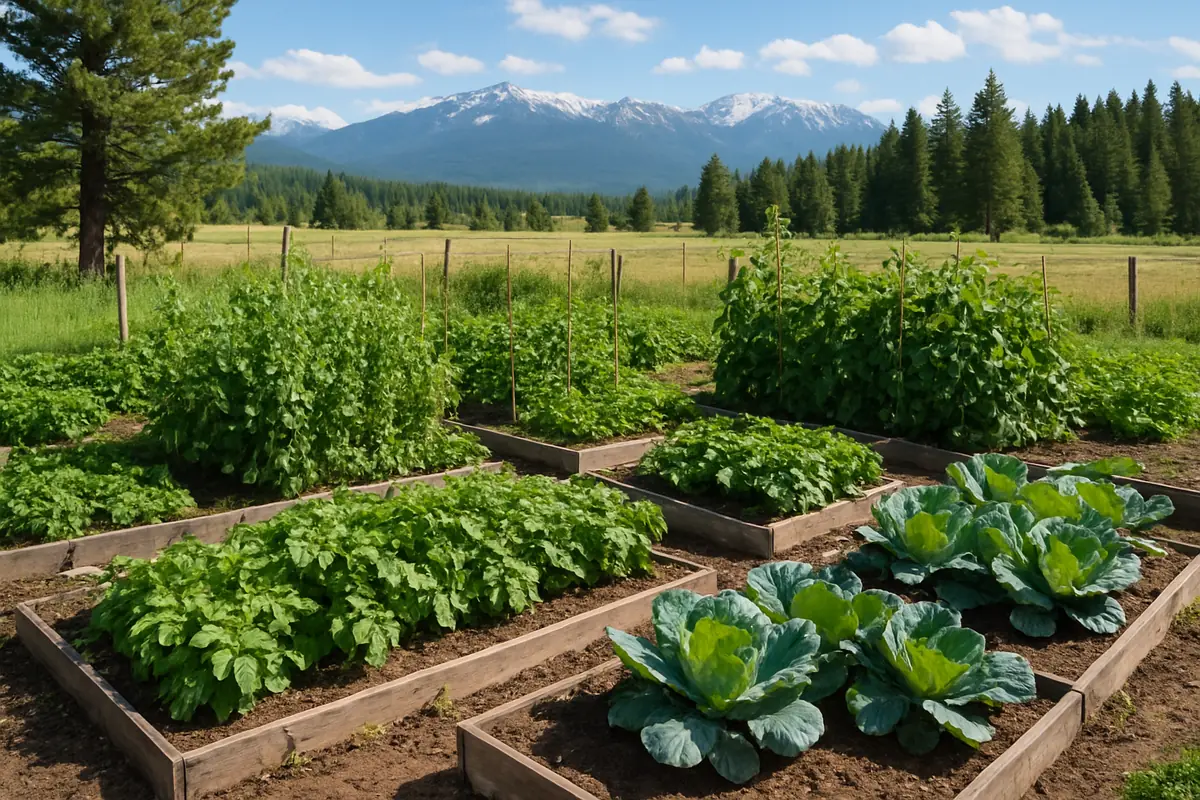
Summer vegetable beds full of potatoes, peas, beans and cabbage in a backyard garden in western Montana, with wide valleys, pines and snow-dusted mountains
The same kind of garden in summer: potatoes, peas, beans and cabbage. AI-generated image.
Cover of The Spacing & Planting Cheat Sheet

Free book · 23 pages, PDF

The Spacing & Planting Cheat Sheet

When to start, when to plant, how far apart.

Understanding Your Planting Windows

These windows come from a simple, real calculation: take Montana's median last-frost and first-frost dates, then apply fixed, extension-verified offset rules for each crop (for example, "start tomato seeds indoors 6-8 weeks before your last frost"). Because the offset rules are the same nationwide but Montana's actual frost dates are specific to Montana, the resulting dates are genuinely Montana's own, not a generic template.

These are statewide medians, though, and your own yard may run warmer or colder depending on elevation, urban heat, or microclimate. Enter your ZIP code in the box at the top of the page for your nearest station's dates. For Montana's full zone range from coldest to warmest areas, see the Montana Growing Zone page.

Want exact seed-starting dates for your specific ZIP code, not just the state average? Use the Seed Starting Calculator.

Sources & further reading

Frost dates come from NOAA NCEI's U.S. Climate Normals, 1991-2020: for each of Montana's ZIP codes, the median last and first 32°F dates at the nearest weather station (an airport station within 15 miles where there is one), with ZIP code points from the U.S. Census Bureau's 2023 ZCTA Gazetteer. The same station data drives our Frost Date Calculator. Planting-offset rules are drawn from US Cooperative Extension sources including UGA, UMN, NC State, Utah State, Iowa State, Penn State, and UConn Extension, cited crop-by-crop in the table above. For more on how we build and verify reference data across this site, see our methodology page.

Planting calendars for nearby states

Frost dates shift gradually across state lines, not sharply:

Or browse all 51 state planting calendars.

Free book · 23 pages, PDF

The Spacing & Planting Cheat Sheet

When to start, when to plant, how far apart.

We email the book right away, then a few short emails over the next week or two: a tip from it and how our garden apps can help. After that, about one email a month. Unsubscribe anytime. Privacy policy