New HarvestMath Garden plans your whole garden in five minutes.

Try it free

Kale Plant Spacing: How Far Apart to Plant Kale

By HarvestMath Editors 5 min read Share:

Space kale 12 inches apart in the row after thinning -- NC State Extension, Utah State University Extension, and this site's own Plant Spacing Calculator all agree closely on that figure. Row spacing is where sources diverge more: this site's calculator uses 18 inches, reflecting tighter raised-bed spacing, while extension guides for a traditional open row garden run wider, at 24 to 36 inches, to accommodate kale's bushy mature spread.

Spacing at a Glance

Kale spacing reference
Type In-row spacing Between-row spacing SFG (per sq ft)
Kale (raised bed) 12 in 18 in 1
Kale (traditional row garden) 12-18 in 24-36 in n/a

In-row spacing matches this site's Plant Spacing Calculator closely. Between-row spacing in a traditional garden runs wider (NC State Extension: 2-3 ft; Utah State University Extension: 24-30 in.) than the calculator's 18 in. default -- the tighter figure reflects raised-bed spacing, where the lack of foot-traffic compaction (see the note on raised beds elsewhere on this site) supports closer rows than an open garden does.

In a 4×8 ft raised bed at 12 in./18 in., kale works out to 8 plants per row and 2 rows -- 16 plants total.

Open the calculator for kale

Thinning You Can Actually Use, and a Harvest-Timing Trick

NC State Extension makes a genuinely kale-specific point most spacing content skips: seedlings pulled at thinning time don't have to be thrown out -- "plants removed at thinning can be transplanted to adjacent areas." That's a real option for kale precisely because, unlike carrots, it doesn't rely on an undisturbed taproot to develop properly.

Utah State University Extension gives a concrete, checkable thinning trigger -- once seedlings reach 3 to 4 true leaves -- rather than a vague "when crowded" rule of thumb.

Why Spacing Matters for Kale

Kale gets noticeably bushy at maturity, which is exactly why between-row spacing needs more room than the in-row figure suggests -- crowd the rows and you'll be fighting your way in to harvest by midseason.

One piece of kale-specific timing advice worth knowing even though it isn't a spacing rule: NC State Extension states plainly that "for sweeter-tasting leaves, wait to harvest until frost or cold weather arrives" -- a light frost is recommended, not just tolerated.
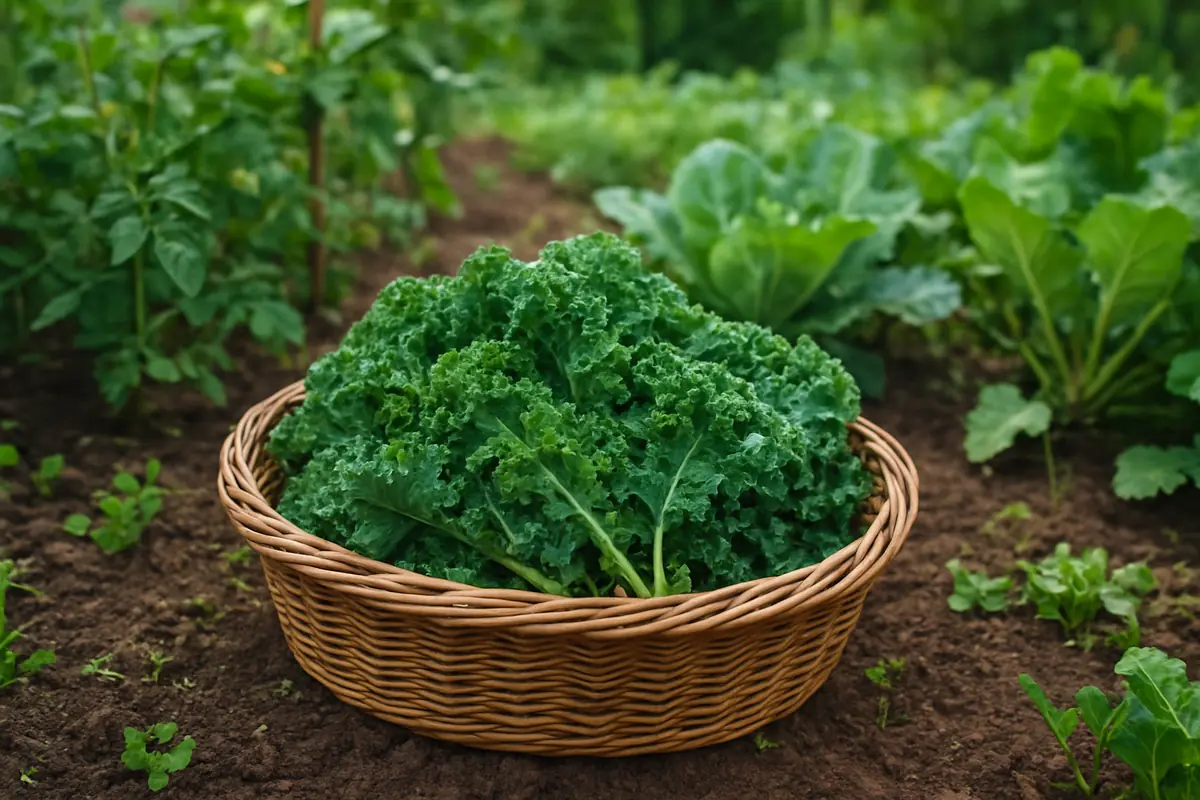
A bundle of freshly cut kale leaves in a basket
A kale harvest. AI-generated image.

Kale actually gets sweeter after a light frost, and NC State Extension recommends deliberately waiting for cold weather before harvesting rather than treating frost as something to race against.

Ready to plan an actual bed? The Plant Spacing Calculator works out exact plant counts for your own bed dimensions : open it pre-set to Kale.

Kale Spacing FAQ

How far apart should kale be spaced?

12 inches between plants in the row after thinning; rows 18-36 inches apart depending on whether you're working a raised bed (tighter) or a traditional open row garden (wider).

Does kale actually taste better after a frost?

Yes -- NC State Extension explicitly recommends delaying harvest until after frost or cold weather for sweeter leaves.

When do you thin kale seedlings?

Once plants reach 3-4 true leaves, per Utah State University Extension; NC State Extension sows at 1 in. spacing and thins progressively to 12 in.

Can you use the kale seedlings you thin out?

Yes -- NC State Extension notes thinned plants can be transplanted elsewhere rather than discarded, unlike taproot crops such as carrots.

How much space does kale need between rows?

18-36 inches depending on garden type -- noticeably more than the in-row spacing, since kale plants get quite bushy at maturity.

Cover of The Companion Planting Chart

Free book · 23 pages, PDF

The Companion Planting Chart

What grows well together, what to keep apart, and why.

Sources & further reading

Spacing figures and facts on this page are sourced directly from university cooperative extension services, cited below, not estimated or invented.

For more on how we source and validate the figures used across this site, see our methodology page.

Related Spacing Guides

Real relationships, not a random pick: companion pairings, shared botanical family, or a similar spacing regime.

See every crop in this set on the Plant Spacing hub.

Free book · 23 pages, PDF

The Companion Planting Chart

What grows well together, what to keep apart, and why.

We email the book right away, then a few short emails over the next week or two: a tip from it and how our garden apps can help. After that, about one email a month. Unsubscribe anytime. Privacy policy