New HarvestMath Garden plans your whole garden in five minutes.

Try it free

Cauliflower Plant Spacing: How Far Apart to Plant Cauliflower

By HarvestMath Editors 5 min read Share:

Space cauliflower 18 to 24 inches apart in the row, with 24 to 36 inches between rows -- figures that, per Oklahoma State University Extension, are essentially identical to broccoli and cabbage spacing. The real difference with cauliflower isn't how far apart you plant it; it's blanching, the practice of tying outer leaves over the developing head to keep it white.

Spacing at a Glance

Cauliflower spacing reference
Type In-row spacing Between-row spacing SFG (per sq ft)
Cauliflower 18-24 in 24-36 in 1 (per Square Foot Gardening convention)

No calculator figure exists for cauliflower yet on this site. The square-foot-gardening figure here reflects the Square Foot Gardening method's own "extra-large plant" category rather than a university extension source -- noted honestly rather than presented as extension-backed.

In a 4×8 ft raised bed at 24 in./30 in., cauliflower works out to about 4 plants per row and 1 row -- 4 plants total, the same footprint as broccoli or cabbage in the same bed.

Open the Plant Spacing Calculator

Blanching and Heat Sensitivity, Not Spacing, Set Cauliflower Apart

Oklahoma State University Extension gives one unified spacing table for broccoli, cauliflower, and cabbage -- "18 inches apart in the row with rows two to four feet apart" -- so the numbers genuinely don't distinguish cauliflower from its brassica relatives.

What does distinguish it: blanching. Ohioline (Ohio State University Extension), University of Maryland Extension, University of Illinois Extension, and Oklahoma State University Extension all describe gathering and tying a cauliflower plant's outer leaves over the developing curd once it reaches roughly 1.5 to 3 inches across, to block sunlight and keep the head from discoloring. Self-blanching varieties exist too -- cultivars bred so their leaves naturally curl inward over the curd, reducing or eliminating the need to tie them by hand.

Cauliflower is also more heat- and temperature-sensitive than its relatives. Oklahoma State University Extension calls it "more sensitive to a dry soil and to fluctuating temperatures" than broccoli or cabbage and names it "the more difficult to grow" of the three; Ohioline gives an optimal range of 60-65°F, with temperatures above 75°F risking "buttoning" -- a stunted, undersized head.

Why Spacing Matters for Cauliflower

Because cauliflower's spacing needs mirror broccoli and cabbage almost exactly, spacing itself isn't the lever that determines success with this crop -- temperature timing and blanching technique are. Plant it at the same spacing as broccoli and you'll be fine on that front; the plant is far more likely to fail from heat stress at head-formation time than from crowding.

Adequate spacing still matters for the blanching step itself, though -- leaves need room to be gathered and tied up over the curd without tangling into a neighboring plant's head.
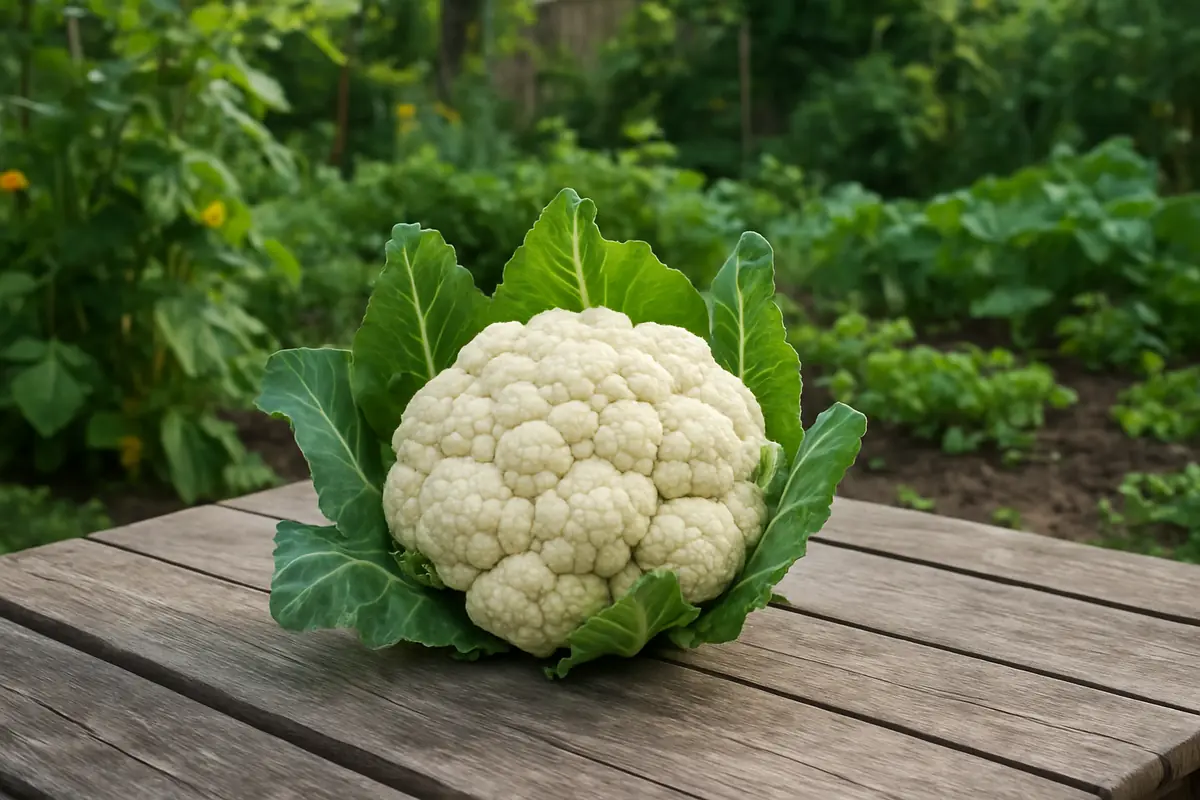
A freshly cut white cauliflower head with its leaves on a garden table
A cauliflower harvest. AI-generated image.

Cauliflower can fail to form a proper head at all -- a condition called "buttoning" -- from heat or cold stress or from planting oversized transplants, a documented failure mode fairly specific to cauliflower's head-formation physiology that broccoli generally doesn't share to the same degree, per Ohioline and Oklahoma State University Extension.

Ready to plan an actual bed? The Plant Spacing Calculator works out exact plant counts for your own bed dimensions . It doesn't have a dedicated Cauliflower preset yet, so enter the figures from the chart above under “Custom.”

Cauliflower Spacing FAQ

Does cauliflower need more space than broccoli?

No -- Oklahoma State University Extension gives broccoli, cauliflower, and cabbage the same spacing range. The real difference is in blanching technique and heat sensitivity, not spacing.

What is blanching, and does it change how far apart I should plant cauliflower?

Blanching is tying a cauliflower plant's outer leaves over the developing head to keep it from discoloring in sunlight. It doesn't change spacing, but leaves need room to be gathered and tied without tangling into a neighboring plant.

Are self-blanching cauliflower varieties worth growing?

They can save the manual tying step, since their leaves naturally curl over the curd -- a real cultivar trait, not a marketing term.

Why does cauliflower fail to form a head ("buttoning")?

Usually heat or cold stress, or transplants that were too large at planting -- a documented failure mode specific to cauliflower's head-formation physiology, per Ohioline and Oklahoma State University Extension.

Is cauliflower harder to grow than broccoli or cabbage?

Oklahoma State University Extension calls it "the more difficult to grow" of the three, mainly due to its sensitivity to dry soil and fluctuating temperatures.

Cover of The Companion Planting Chart

Free book · 23 pages, PDF

The Companion Planting Chart

What grows well together, what to keep apart, and why.

Sources & further reading

Spacing figures and facts on this page are sourced directly from university cooperative extension services, cited below, not estimated or invented.

For more on how we source and validate the figures used across this site, see our methodology page.

Related Spacing Guides

Real relationships, not a random pick: companion pairings, shared botanical family, or a similar spacing regime.

See every crop in this set on the Plant Spacing hub.

Free book · 23 pages, PDF

The Companion Planting Chart

What grows well together, what to keep apart, and why.

We email the book right away, then a few short emails over the next week or two: a tip from it and how our garden apps can help. After that, about one email a month. Unsubscribe anytime. Privacy policy