New HarvestMath Garden plans your whole garden in five minutes.

Try it free

Watermelon Plant Spacing: How Far Apart to Plant Watermelons

By HarvestMath Editors 5 min read Share:

Standard vining watermelon needs a lot of room: extension sources put hill spacing at 5 to 8 feet apart, with 6 to 10 feet between rows. That's because standard watermelon vines run anywhere from 6 to 20 feet long, per University of Maryland Extension. If that sounds too big for your space, genuine bush or "short internode" watermelon varieties exist that produce the same size fruit on a dramatically smaller plant -- worth knowing before you assume watermelon simply doesn't fit a small garden.

Spacing at a Glance

Watermelon spacing reference
Type In-row spacing Between-row spacing SFG (per sq ft)
Standard vining (per hill) 5-8 ft between hills 6-10 ft between rows not established
Bush / dwarf varieties no specific extension figure found n/a n/a

No university extension source gives a specific inch-figure for bush watermelon spacing, and none publishes a square-foot-gardening number for watermelon at all -- both gaps are stated here rather than filled with an invented number.

A standard 4×8 ft raised bed realistically fits only one hill of standard vining watermelon, and even then the vines will run well beyond the bed's edges -- this crop is the clearest case on this site where a small raised bed genuinely isn't the right fit for the full-size version of the plant. A named dwarf cultivar like ‘Bush Sugar Baby’ (University of Georgia Cooperative Extension) is the realistic option for growing real watermelon in a bed this size.

Open the Plant Spacing Calculator

Vining vs. Bush Watermelon: Same Fruit, Very Different Footprint

This is a genuine plant-architecture difference, not a marketing distinction. University of Maryland Extension gives standard watermelon vine length as 6 feet (for shorter vining types) up to 20 feet for standard long-vine types -- over a threefold range within "standard" watermelon.

University of Georgia Cooperative Extension confirms real bush or "short internode" watermelon varieties exist, and is specific that they "produce fruit the same size as standard or long internode types in a smaller amount of space" -- not smaller fruit on a smaller plant, the same fruit on a compressed one. UGA's C1035 publication names ‘Bush Sugar Baby’ as a real commercial cultivar bred for exactly this.

One extension source that isn't about spacing at all but is genuinely watermelon-specific: seedless watermelon is triploid and self-infertile. Per University of Nebraska-Lincoln Extension, a seedless planting needs a regular seeded "pollenizer" variety planted nearby -- roughly one row of pollenizer for every two to three rows of seedless -- or it won't set fruit at all.

Why Spacing Matters for Watermelon

University of Arkansas Cooperative Extension notes watermelon has one of the deepest root systems of any garden vegetable, and warns that "planting too close results in excessive vegetative growth" -- crowded watermelon puts energy into vines and leaves rather than fruit.

For anyone gardening in a raised bed or small plot, the real decision isn't how to squeeze standard watermelon into less space -- it's whether to grow a genuine dwarf cultivar instead, since the plant's actual vine length is what's driving the spacing requirement, not an arbitrary rule.
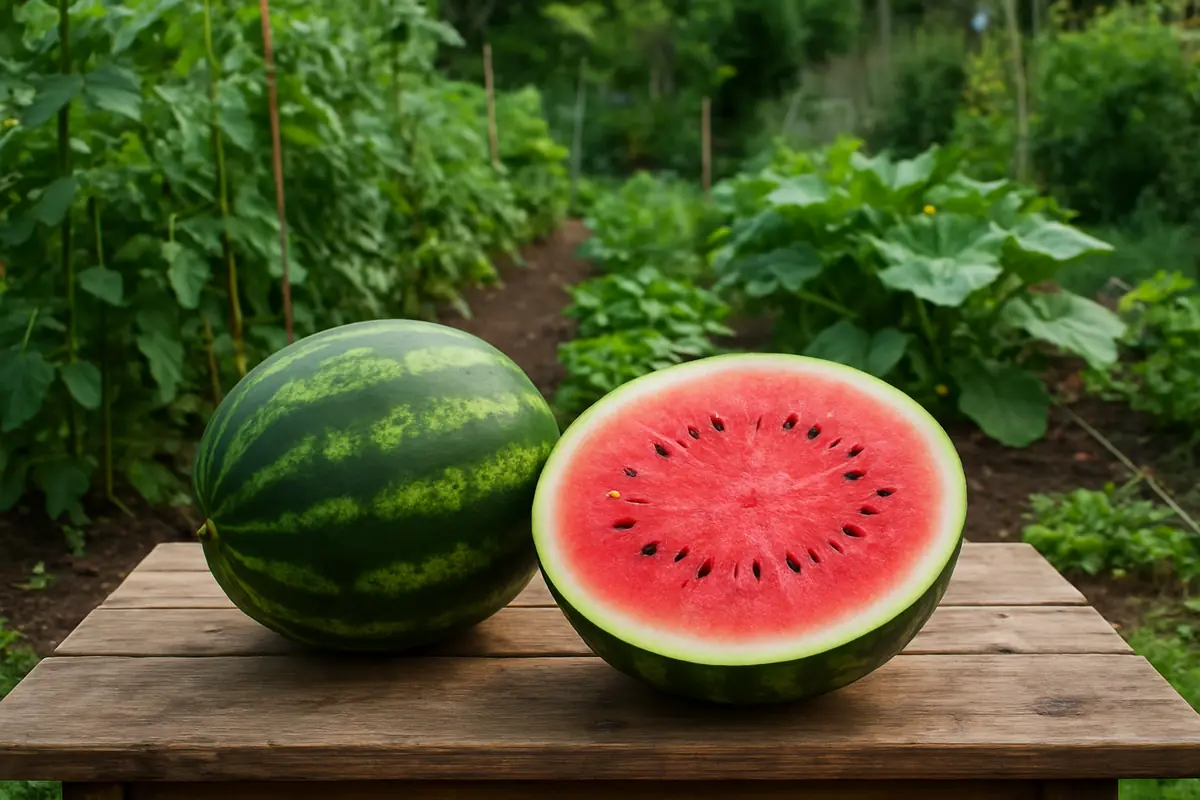

A ripe watermelon cut open on a wooden table in the garden
A watermelon harvest. AI-generated image.

Seedless watermelon can't pollinate itself. It's triploid and genuinely self-infertile, so a planting needs a regular seeded ("diploid") watermelon variety nearby as a pollen source -- University of Nebraska-Lincoln Extension recommends roughly one row of seeded pollenizer for every two to three rows of seedless. Even planted correctly, "seedless" watermelon can still occasionally develop a few small seed coats, which is why growers market it as "virtually seedless" rather than guaranteed seed-free.

Ready to plan an actual bed? The Plant Spacing Calculator works out exact plant counts for your own bed dimensions . It doesn't have a dedicated Watermelon preset yet, so enter the figures from the chart above under “Custom.”

Watermelon Spacing FAQ

How far apart do you plant watermelon?

In hills, roughly 5-8 feet apart depending on the extension source, with 6-10 feet between rows.

How much space does one watermelon plant need?

Standard vining types send out vines 6-20 feet long, which is why hill spacing is so wide. Genuine bush or dwarf cultivars need substantially less room for the same size fruit.

Can you grow watermelon in a small garden or raised bed?

A standard 4×8 ft bed realistically fits only one hill of standard vining watermelon. A named dwarf cultivar like ‘Bush Sugar Baby’ is the practical option for a bed that size.

Do seedless watermelons need a regular watermelon nearby to pollinate them?

Yes -- triploid seedless watermelon is self-infertile and needs a diploid "pollenizer" variety planted nearby, roughly one pollenizer row per two to three seedless rows.

How many watermelon plants per hill?

Extension sources vary: thin to 1 plant per hill (University of Illinois), 1-2 (Alabama), or up to 2-3 (University of Maryland, Arkansas) -- worth treating as a range rather than one fixed number.

Cover of The Companion Planting Chart

Free book · 23 pages, PDF

The Companion Planting Chart

What grows well together, what to keep apart, and why.

Sources & further reading

Spacing figures and facts on this page are sourced directly from university cooperative extension services, cited below, not estimated or invented.

For more on how we source and validate the figures used across this site, see our methodology page.

Related Spacing Guides

Real relationships, not a random pick: companion pairings, shared botanical family, or a similar spacing regime.

See every crop in this set on the Plant Spacing hub.

Free book · 23 pages, PDF

The Companion Planting Chart

What grows well together, what to keep apart, and why.

We email the book right away, then a few short emails over the next week or two: a tip from it and how our garden apps can help. After that, about one email a month. Unsubscribe anytime. Privacy policy