New HarvestMath Garden plans your whole garden in five minutes.

Try it free

Squash Plant Spacing: How Far Apart to Plant Squash

By HarvestMath Editors 5 min read Share:

This page covers winter squash -- butternut, acorn, spaghetti, Hubbard, and similar long-storage types -- as distinct from zucchini and other summer squash, which have their own spacing page. Space winter squash 36 inches apart in the row. Between rows, this site's Plant Spacing Calculator uses 48 inches, but University of Maryland Extension and University of Minnesota Extension both recommend meaningfully more room in an open garden -- 60 to 96 inches -- since winter squash vines sprawl further than summer types.

Spacing at a Glance

Squash spacing reference
Type In-row spacing Between-row spacing SFG (per sq ft)
Winter squash (raised bed) 36 in 48 in 9
Winter squash (traditional row garden) 36-48 in 60-96 in n/a

In-row spacing and the square-foot-gardening figure (9 sq ft/plant, the Square Foot Gardening method's own bush-squash convention) match this site's Plant Spacing Calculator. Between-row spacing is where extension guidance runs notably wider than the calculator's 48 in. default -- if you're growing in an open row garden rather than a raised bed, budget the extra room.

In a 4×8 ft raised bed at 36 in./48 in., winter squash works out to about 2 plants per row and 1 row -- 2 plants total, reflecting how much room this crop genuinely needs even at the tighter raised-bed end of its range.

Open the calculator for squash

Three Species, and Why Only Some Winter Squash Can Go Vertical

Winter squash isn't one plant -- per University of Minnesota Extension, it spans three distinct species: Cucurbita pepo (acorn, delicata, spaghetti squash), C. moschata (butternut), and C. maxima (Hubbard, kabocha, buttercup), with mature fruit size ranging from single-serving to 15-plus pounds.

Trellising is genuinely fruit-weight-limited, not just space-limited. UMN Extension notes small-fruited types like delicata and acorn can be trained vertically on a trellis, but large-fruited varieties -- a big Hubbard or maxima-type squash -- have to stay on the ground, since the fruit is simply too heavy to support on a trellis. University of Maryland Extension adds a related, specific care note: trellised winter squash needs watering more often than ground-grown plants, because vertical growth changes how the root zone retains soil moisture.

Why Spacing Matters for Winter Squash

Winter squash vines are simply longer and heavier than summer squash vines, which is the direct reason extension row-spacing figures run so much wider than for zucchini. Underspace it in an open garden and vines from adjacent rows will tangle together well before harvest, making it hard to tell whose fruit is whose and complicating disease management.

For a small raised bed, the practical decision is less about squeezing in extra plants and more about choosing small-fruited, trellis-friendly cultivars (acorn, delicata) over large-fruited ground types (big Hubbard, large kabocha) if vertical growing is the plan.
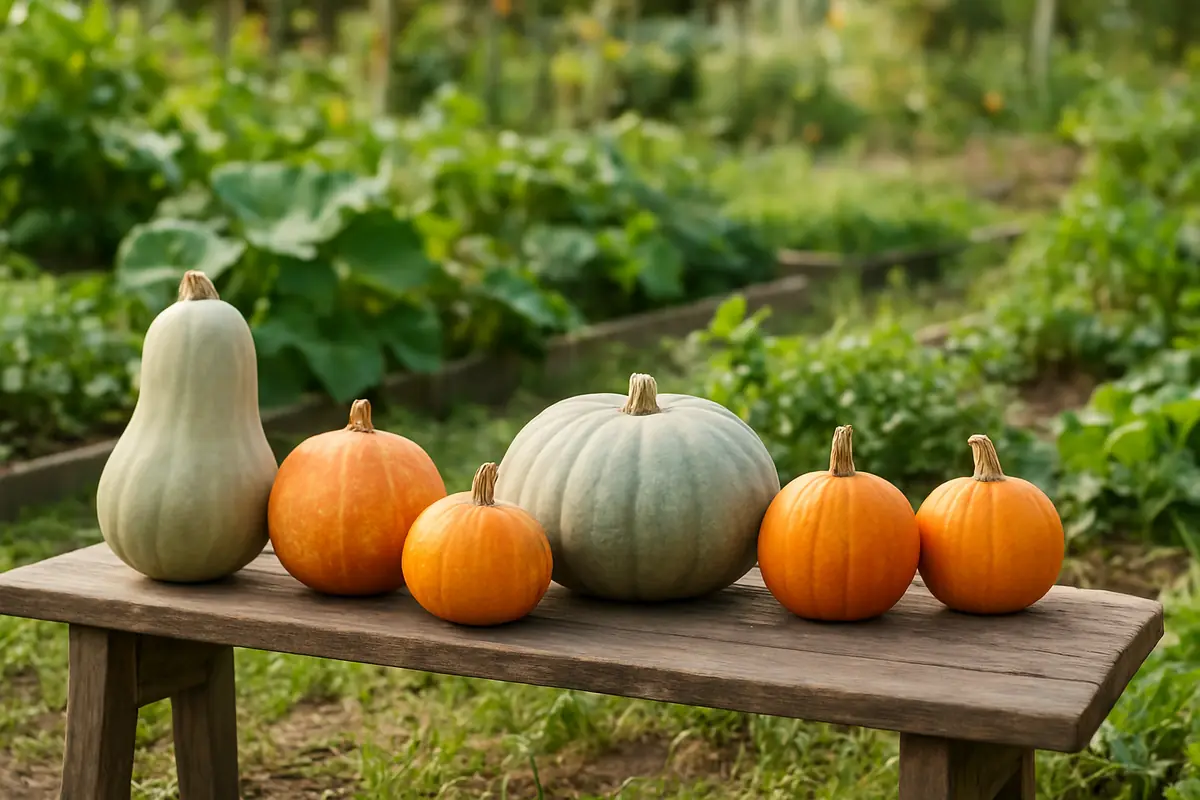
Harvested winter squash and pumpkins lined up on a wooden bench
A squash harvest. AI-generated image.

Ready to plan an actual bed? The Plant Spacing Calculator works out exact plant counts for your own bed dimensions : open it pre-set to Squash (winter).

Squash Spacing FAQ

How far apart to plant winter squash?

Roughly 36 inches in-row, but between-row spacing needs meaningfully more room than summer squash -- 60-96 inches in an open garden per University of Maryland and University of Minnesota Extension.

Can I grow winter squash on a trellis to save space?

Yes, but only for small-fruited types like acorn or delicata -- large-fruited varieties (Hubbard, big kabocha or buttercup types) have to stay on the ground because of fruit weight, per University of Minnesota Extension.

What's the difference between bush and vining winter squash spacing?

University of Minnesota Extension attributes its in-row range directly to habit: the tighter end is for bush varieties, the wider end for vining types.

Is butternut squash the same species as acorn squash?

No -- butternut is Cucurbita moschata, acorn and delicata are Cucurbita pepo, and Hubbard/kabocha/buttercup are Cucurbita maxima, per University of Minnesota Extension.

Does a trellised winter squash need more water?

Yes -- University of Maryland Extension notes trellised winter squash needs watering more often than ground-grown plants because of how vertical growth affects root-zone soil moisture.

Cover of The Companion Planting Chart

Free book · 23 pages, PDF

The Companion Planting Chart

What grows well together, what to keep apart, and why.

Sources & further reading

Spacing figures and facts on this page are sourced directly from university cooperative extension services, cited below, not estimated or invented.

For more on how we source and validate the figures used across this site, see our methodology page.

Related Spacing Guides

Real relationships, not a random pick: companion pairings, shared botanical family, or a similar spacing regime.

See every crop in this set on the Plant Spacing hub.

Free book · 23 pages, PDF

The Companion Planting Chart

What grows well together, what to keep apart, and why.

We email the book right away, then a few short emails over the next week or two: a tip from it and how our garden apps can help. After that, about one email a month. Unsubscribe anytime. Privacy policy